

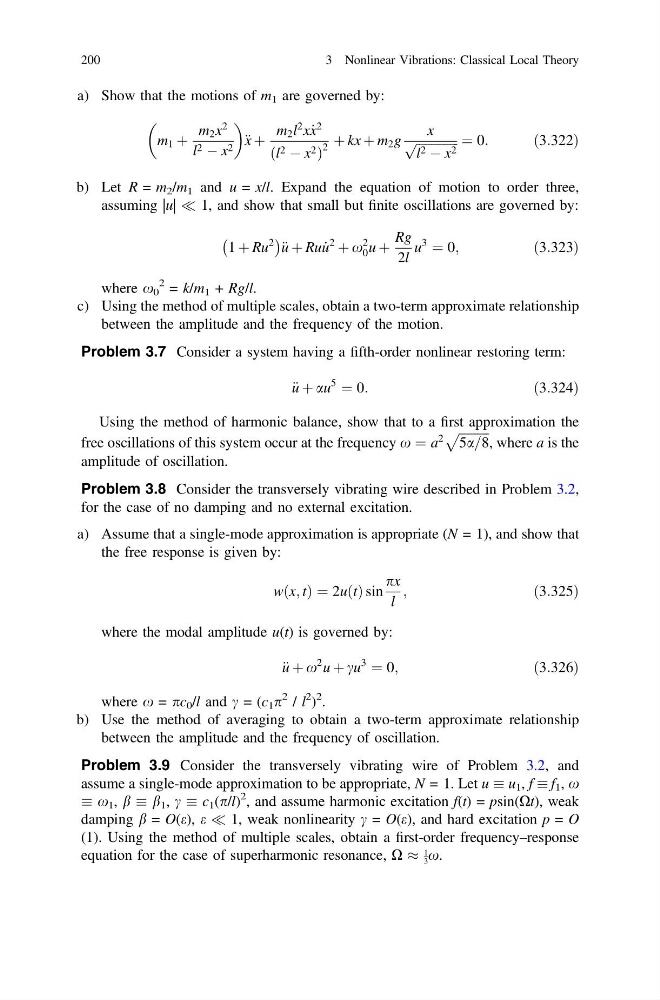
a) Show that the motions of m 1 are governed by:
m 1 þ
m 2 x
2
l 2 À x 2
€ x þ
m 2 l
2 x_ x
2
l 2 À x 2
ð
Þ
2
þ kx þ m 2 g
x
ffiffiffiffiffiffiffiffiffiffiffiffiffi ffi
l 2 À x 2
p
¼ 0:
ð3:322Þ
b) Let R = m 2 /m 1 and u = x/l. Expand the equation of motion to order three,
assuming |u| ( 1, and show that small but finite oscillations are governed by:
1 þ Ru
2
À
Á € u þ Ru _
u
2
þ x
2
0 u þ
Rg
2l
u
3
¼ 0;
ð3:323Þ
where x 0
2 = k/m 1 + Rg/l.
c) Using the method of multiple scales, obtain a two-term approximate relationship
between the amplitude and the frequency of the motion.
Problem 3.7 Consider a system having a fifth-order nonlinear restoring term:
€ u þ au
5
¼ 0:
ð3:324Þ
Using the method of harmonic balance, show that to a first approximation the
free oscillations of this system occur at the frequency x ¼ a
2
ffiffiffiffiffiffiffiffiffiffi
5a=8
p
, where a is the
amplitude of oscillation.
Problem 3.8 Consider the transversely vibrating wire described in Problem 3.2,
for the case of no damping and no external excitation.
a) Assume that a single-mode approximation is appropriate (N = 1), and show that
the free response is given by:
wðx; tÞ ¼ 2uðtÞ sin
px
l
;
ð3:325Þ
where the modal amplitude u(t) is governed by:
€ u þ x
2 u þ cu
3
¼ 0;
ð3:326Þ
where x = pc 0 /l and c = (c 1 p
2 / l
2 )
2 .
b) Use the method of averaging to obtain a two-term approximate relationship
between the amplitude and the frequency of oscillation.
Problem 3.9 Consider the transversely vibrating wire of Problem 3.2, and
assume a single-mode approximation to be appropriate, N = 1. Let u u 1 , f f 1 , x
x 1 , b b 1 , c c 1 (p/l)
2 , and assume harmonic excitation f(t) = psin(Xt), weak
damping b = O(e), e ( 1, weak nonlinearity c = O(e), and hard excitation p = O
(1). Using the method of multiple scales, obtain a first-order frequency–response
equation for the case of superharmonic resonance, X %
1
3 x.
200
3 Nonlinear Vibrations: Classical Local Theory
m 1 þ
m 2 x
2
l 2 À x 2
€ x þ
m 2 l
2 x_ x
2
l 2 À x 2
ð
Þ
2
þ kx þ m 2 g
x
ffiffiffiffiffiffiffiffiffiffiffiffiffi ffi
l 2 À x 2
p
¼ 0:
ð3:322Þ
b) Let R = m 2 /m 1 and u = x/l. Expand the equation of motion to order three,
assuming |u| ( 1, and show that small but finite oscillations are governed by:
1 þ Ru
2
À
Á € u þ Ru _
u
2
þ x
2
0 u þ
Rg
2l
u
3
¼ 0;
ð3:323Þ
where x 0
2 = k/m 1 + Rg/l.
c) Using the method of multiple scales, obtain a two-term approximate relationship
between the amplitude and the frequency of the motion.
Problem 3.7 Consider a system having a fifth-order nonlinear restoring term:
€ u þ au
5
¼ 0:
ð3:324Þ
Using the method of harmonic balance, show that to a first approximation the
free oscillations of this system occur at the frequency x ¼ a
2
ffiffiffiffiffiffiffiffiffiffi
5a=8
p
, where a is the
amplitude of oscillation.
Problem 3.8 Consider the transversely vibrating wire described in Problem 3.2,
for the case of no damping and no external excitation.
a) Assume that a single-mode approximation is appropriate (N = 1), and show that
the free response is given by:
wðx; tÞ ¼ 2uðtÞ sin
px
l
;
ð3:325Þ
where the modal amplitude u(t) is governed by:
€ u þ x
2 u þ cu
3
¼ 0;
ð3:326Þ
where x = pc 0 /l and c = (c 1 p
2 / l
2 )
2 .
b) Use the method of averaging to obtain a two-term approximate relationship
between the amplitude and the frequency of oscillation.
Problem 3.9 Consider the transversely vibrating wire of Problem 3.2, and
assume a single-mode approximation to be appropriate, N = 1. Let u u 1 , f f 1 , x
x 1 , b b 1 , c c 1 (p/l)
2 , and assume harmonic excitation f(t) = psin(Xt), weak
damping b = O(e), e ( 1, weak nonlinearity c = O(e), and hard excitation p = O
(1). Using the method of multiple scales, obtain a first-order frequency–response
equation for the case of superharmonic resonance, X %
1
3 x.
200
3 Nonlinear Vibrations: Classical Local Theory