

1.2.2 Damped Free Vibrations
With F(t) = 0 and 0 < c < 2
ffiffiffiffiffiffi
km
p
the solution to (1.1)/(1.2) becomes:
xðtÞ ¼ Ae
Àfxt sinð ~
xt þ wÞ;
ð1:5Þ
where f is the damping ratio (actual to critical damping):
f ¼
c
c cr
¼
c
2
ffiffiffiffiffiffi
km
p ;
ð1:6Þ
and ~
x is the damped natural frequency:
~
x ¼ x
ffiffiffiffiffiffiffiffiffiffiffiffi ffi
1 À f
2
q
:
ð1:7Þ
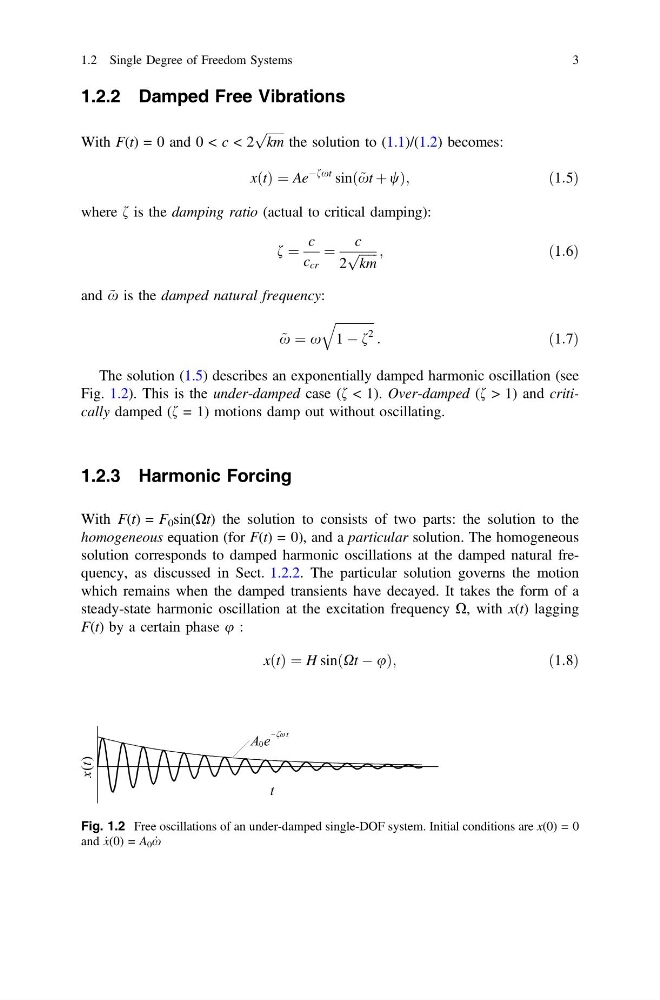
The solution (1.5) describes an exponentially damped harmonic oscillation (see
Fig. 1.2). This is the under-damped case (f < 1). Over-damped (f > 1) and critically damped (f = 1) motions damp out without oscillating.
1.2.3 Harmonic Forcing
With F(t) = F 0 sin(Xt) the solution to consists of two parts: the solution to the
homogeneous equation (for F(t) = 0), and a particular solution. The homogeneous
solution corresponds to damped harmonic oscillations at the damped natural frequency, as discussed in Sect. 1.2.2. The particular solution governs the motion
which remains when the damped transients have decayed. It takes the form of a
steady-state harmonic oscillation at the excitation frequency X, with x(t) lagging
F(t) by a certain phase u :
xðtÞ ¼ H sinðXt À uÞ;
ð1:8Þ
Fig. 1.2 Free oscillations of an under-damped single-DOF system. Initial conditions are x(0) = 0
and _
x(0) = A 0 _
x
1.2 Single Degree of Freedom Systems
3
With F(t) = 0 and 0 < c < 2
ffiffiffiffiffiffi
km
p
the solution to (1.1)/(1.2) becomes:
xðtÞ ¼ Ae
Àfxt sinð ~
xt þ wÞ;
ð1:5Þ
where f is the damping ratio (actual to critical damping):
f ¼
c
c cr
¼
c
2
ffiffiffiffiffiffi
km
p ;
ð1:6Þ
and ~
x is the damped natural frequency:
~
x ¼ x
ffiffiffiffiffiffiffiffiffiffiffiffi ffi
1 À f
2
q
:
ð1:7Þ
The solution (1.5) describes an exponentially damped harmonic oscillation (see
Fig. 1.2). This is the under-damped case (f < 1). Over-damped (f > 1) and critically damped (f = 1) motions damp out without oscillating.
1.2.3 Harmonic Forcing
With F(t) = F 0 sin(Xt) the solution to consists of two parts: the solution to the
homogeneous equation (for F(t) = 0), and a particular solution. The homogeneous
solution corresponds to damped harmonic oscillations at the damped natural frequency, as discussed in Sect. 1.2.2. The particular solution governs the motion
which remains when the damped transients have decayed. It takes the form of a
steady-state harmonic oscillation at the excitation frequency X, with x(t) lagging
F(t) by a certain phase u :
xðtÞ ¼ H sinðXt À uÞ;
ð1:8Þ
Fig. 1.2 Free oscillations of an under-damped single-DOF system. Initial conditions are x(0) = 0
and _
x(0) = A 0 _
x
1.2 Single Degree of Freedom Systems
3