

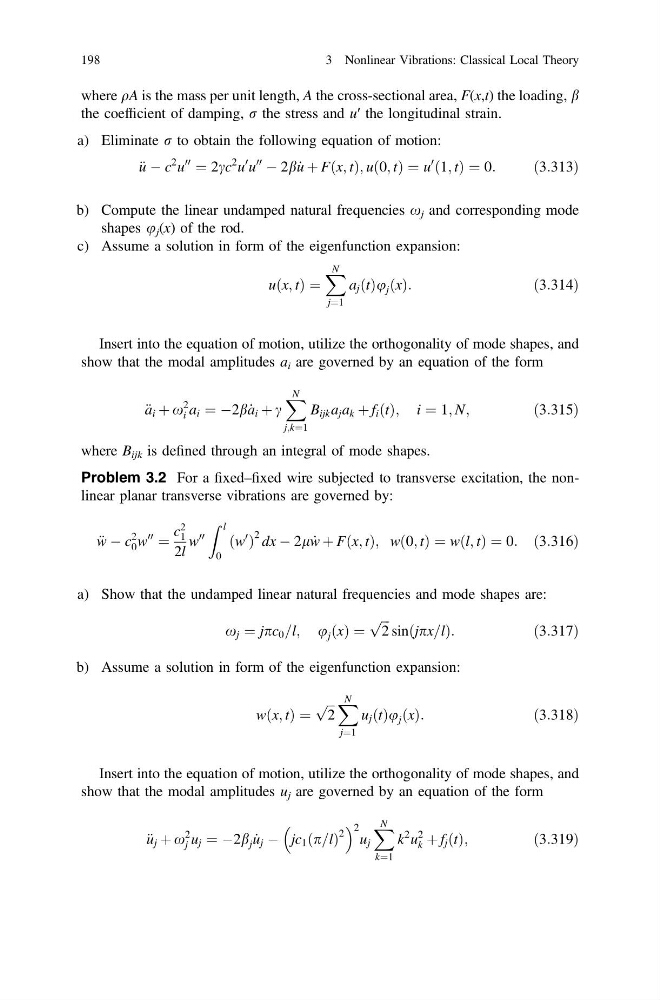
where qA is the mass per unit length, A the cross-sectional area, F(x,t) the loading, b
the coefficient of damping, r the stress and u′ the longitudinal strain.
a) Eliminate r to obtain the following equation of motion:
€ u À c
2 u
00
¼ 2cc
2 u
0 u
00
À 2b _
u þ Fðx; tÞ; uð0; tÞ ¼ u
0
ð1; tÞ ¼ 0:
ð3:313Þ
b) Compute the linear undamped natural frequencies x j and corresponding mode
shapes u j (x) of the rod.
c) Assume a solution in form of the eigenfunction expansion:
uðx; tÞ ¼
X N
j¼1
a j ðtÞu j ðxÞ:
ð3:314Þ
Insert into the equation of motion, utilize the orthogonality of mode shapes, and
show that the modal amplitudes a i are governed by an equation of the form
€ a i þ x
2
i a i ¼ À2b _
a i þ c
X N
j;k¼1
B ijk a j a k þ f i ðtÞ; i ¼ 1; N;
ð3:315Þ
where B ijk is defined through an integral of mode shapes.
Problem 3.2 For a fixed–fixed wire subjected to transverse excitation, the nonlinear planar transverse vibrations are governed by:
€
w À c
2
0 w
00
¼
c
2
1
2l
w
00
Z l
0
w
0
ð Þ
2 dx À 2l _
w þ Fðx; tÞ; wð0; tÞ ¼ wðl; tÞ ¼ 0: ð3:316Þ
a) Show that the undamped linear natural frequencies and mode shapes are:
x j ¼ jpc 0 =l; u j ðxÞ ¼
ffiffi ffi
2
p
sinðjpx=lÞ:
ð3:317Þ
b) Assume a solution in form of the eigenfunction expansion:
wðx; tÞ ¼
ffiffi ffi
2
p X N
j¼1
u j ðtÞu j ðxÞ:
ð3:318Þ
Insert into the equation of motion, utilize the orthogonality of mode shapes, and
show that the modal amplitudes u j are governed by an equation of the form
€ u j þ x
2
j u j ¼ À2b j _
u j À jc 1 p=l
ð Þ
2
2
u j
X N
k¼1
k
2 u
2
k þ f j ðtÞ;
ð3:319Þ
198
3 Nonlinear Vibrations: Classical Local Theory
the coefficient of damping, r the stress and u′ the longitudinal strain.
a) Eliminate r to obtain the following equation of motion:
€ u À c
2 u
00
¼ 2cc
2 u
0 u
00
À 2b _
u þ Fðx; tÞ; uð0; tÞ ¼ u
0
ð1; tÞ ¼ 0:
ð3:313Þ
b) Compute the linear undamped natural frequencies x j and corresponding mode
shapes u j (x) of the rod.
c) Assume a solution in form of the eigenfunction expansion:
uðx; tÞ ¼
X N
j¼1
a j ðtÞu j ðxÞ:
ð3:314Þ
Insert into the equation of motion, utilize the orthogonality of mode shapes, and
show that the modal amplitudes a i are governed by an equation of the form
€ a i þ x
2
i a i ¼ À2b _
a i þ c
X N
j;k¼1
B ijk a j a k þ f i ðtÞ; i ¼ 1; N;
ð3:315Þ
where B ijk is defined through an integral of mode shapes.
Problem 3.2 For a fixed–fixed wire subjected to transverse excitation, the nonlinear planar transverse vibrations are governed by:
€
w À c
2
0 w
00
¼
c
2
1
2l
w
00
Z l
0
w
0
ð Þ
2 dx À 2l _
w þ Fðx; tÞ; wð0; tÞ ¼ wðl; tÞ ¼ 0: ð3:316Þ
a) Show that the undamped linear natural frequencies and mode shapes are:
x j ¼ jpc 0 =l; u j ðxÞ ¼
ffiffi ffi
2
p
sinðjpx=lÞ:
ð3:317Þ
b) Assume a solution in form of the eigenfunction expansion:
wðx; tÞ ¼
ffiffi ffi
2
p X N
j¼1
u j ðtÞu j ðxÞ:
ð3:318Þ
Insert into the equation of motion, utilize the orthogonality of mode shapes, and
show that the modal amplitudes u j are governed by an equation of the form
€ u j þ x
2
j u j ¼ À2b j _
u j À jc 1 p=l
ð Þ
2
2
u j
X N
k¼1
k
2 u
2
k þ f j ðtÞ;
ð3:319Þ
198
3 Nonlinear Vibrations: Classical Local Theory