

described in Sect. 3.9.2 can be systematically extended to any order of accuracy
required, i.e. x = x 1 + ex 2 + …, though the computational burden increases rapidly
with accuracy order. Of primary interest is typically to improve the accuracy of the
slowly changing variable x 1 , while increased accuracy in the small and rapidly
oscillating motions ex 2 may be interesting only by its effect on x 1 . A procedure for
extended second-order averaging for discontinuous systems is provided in Fidlin
(2006), and applied in Thomsen and Fidlin (2008) to the friction oscillator with a
one-sided stop of Sect. 3.9.5. As appears from Fig. 3.35 (dotted line) the
second-order analysis increases accuracy. However, it is also considerably more
elaborate.
3.10 Summing Up
Hopefully some basic understanding of nonlinear phenomena and perturbation and
other approximate methods has by now emerged. Only near-equilibrium behavior
of mostly weakly nonlinear one-dimensional systems has been dealt with, and in
most of the elaborated examples the nonlinearity involved took the form of a cubic
restoring term. All of these limitations will be explored in the following chapters.
3.11 Problems
Problem 3.1 Consider a fixed-free elastic rod, subjected to viscous damping,
distributed axial loading and a nonlinear material law. The axial vibrations are
governed by:
qA€ u ¼ r
0 A À 2qAb _
u þ qAFðx; tÞ; r ¼ Eu
0
ð1 þ cu
0
Þ;
x 2 0; 1
½ ; u ¼ uðx; tÞ; uð0; tÞ ¼ rð1; tÞ ¼ 0;
ð3:312Þ
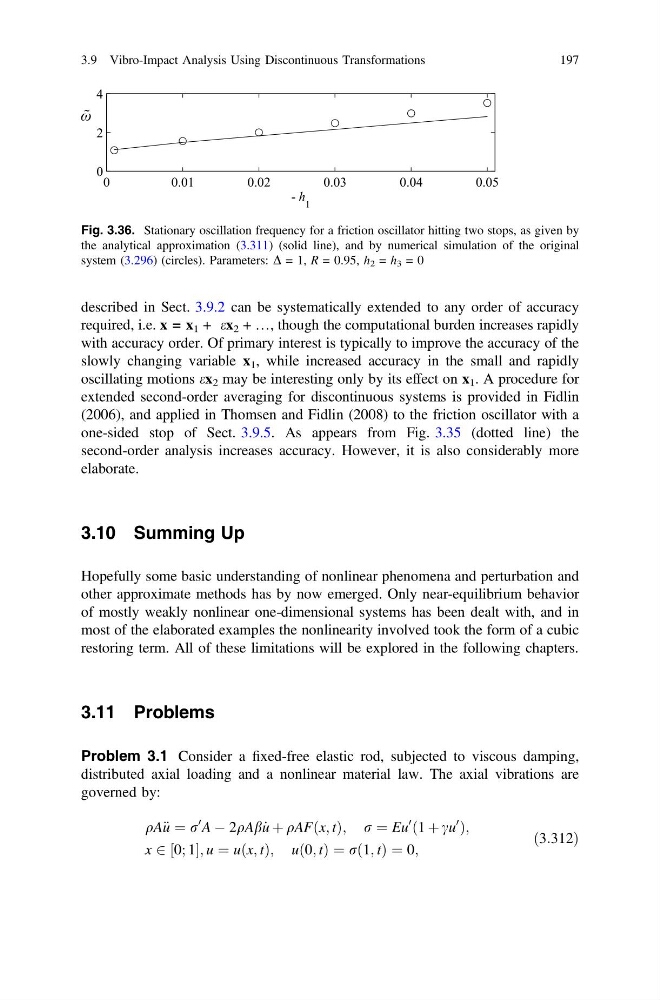
Fig. 3.36. Stationary oscillation frequency for a friction oscillator hitting two stops, as given by
the analytical approximation (3.311) (solid line), and by numerical simulation of the original
system (3.296) (circles). Parameters: D = 1, R = 0.95, h 2 = h 3 = 0
3.9 Vibro-Impact Analysis Using Discontinuous Transformations
197
required, i.e. x = x 1 + ex 2 + …, though the computational burden increases rapidly
with accuracy order. Of primary interest is typically to improve the accuracy of the
slowly changing variable x 1 , while increased accuracy in the small and rapidly
oscillating motions ex 2 may be interesting only by its effect on x 1 . A procedure for
extended second-order averaging for discontinuous systems is provided in Fidlin
(2006), and applied in Thomsen and Fidlin (2008) to the friction oscillator with a
one-sided stop of Sect. 3.9.5. As appears from Fig. 3.35 (dotted line) the
second-order analysis increases accuracy. However, it is also considerably more
elaborate.
3.10 Summing Up
Hopefully some basic understanding of nonlinear phenomena and perturbation and
other approximate methods has by now emerged. Only near-equilibrium behavior
of mostly weakly nonlinear one-dimensional systems has been dealt with, and in
most of the elaborated examples the nonlinearity involved took the form of a cubic
restoring term. All of these limitations will be explored in the following chapters.
3.11 Problems
Problem 3.1 Consider a fixed-free elastic rod, subjected to viscous damping,
distributed axial loading and a nonlinear material law. The axial vibrations are
governed by:
qA€ u ¼ r
0 A À 2qAb _
u þ qAFðx; tÞ; r ¼ Eu
0
ð1 þ cu
0
Þ;
x 2 0; 1
½ ; u ¼ uðx; tÞ; uð0; tÞ ¼ rð1; tÞ ¼ 0;
ð3:312Þ
Fig. 3.36. Stationary oscillation frequency for a friction oscillator hitting two stops, as given by
the analytical approximation (3.311) (solid line), and by numerical simulation of the original
system (3.296) (circles). Parameters: D = 1, R = 0.95, h 2 = h 3 = 0
3.9 Vibro-Impact Analysis Using Discontinuous Transformations
197