

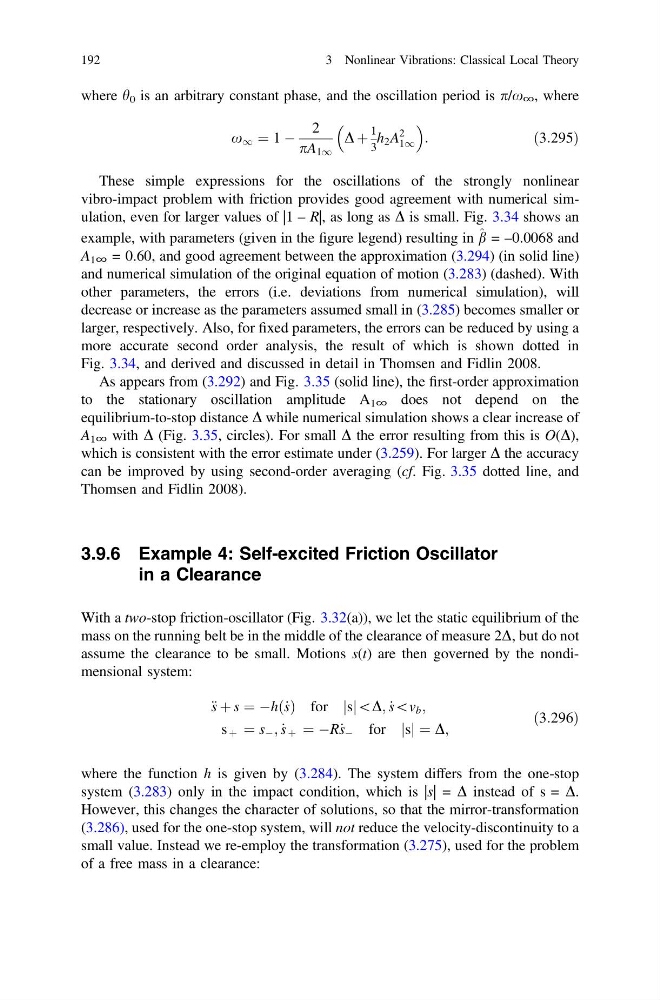
where h 0 is an arbitrary constant phase, and the oscillation period is p/x ∞ , where
x 1 ¼ 1 À
2
pA 11
D þ
1
3
h 2 A
2
11
:
ð3:295Þ
These simple expressions for the oscillations of the strongly nonlinear
vibro-impact problem with friction provides good agreement with numerical simulation, even for larger values of |1 – R|, as long as D is small. Fig. 3.34 shows an
example, with parameters (given in the figure legend) resulting in ^
b = –0.0068 and
A 1∞ = 0.60, and good agreement between the approximation (3.294) (in solid line)
and numerical simulation of the original equation of motion (3.283) (dashed). With
other parameters, the errors (i.e. deviations from numerical simulation), will
decrease or increase as the parameters assumed small in (3.285) becomes smaller or
larger, respectively. Also, for fixed parameters, the errors can be reduced by using a
more accurate second order analysis, the result of which is shown dotted in
Fig. 3.34, and derived and discussed in detail in Thomsen and Fidlin 2008.
As appears from (3.292) and Fig. 3.35 (solid line), the first-order approximation
to the stationary oscillation amplitude A 1∞ does not depend on the
equilibrium-to-stop distance D while numerical simulation shows a clear increase of
A 1∞ with D (Fig. 3.35, circles). For small D the error resulting from this is O(D),
which is consistent with the error estimate under (3.259). For larger D the accuracy
can be improved by using second-order averaging (cf. Fig. 3.35 dotted line, and
Thomsen and Fidlin 2008).
3.9.6 Example 4: Self-excited Friction Oscillator
in a Clearance
With a two-stop friction-oscillator (Fig. 3.32(a)), we let the static equilibrium of the
mass on the running belt be in the middle of the clearance of measure 2D, but do not
assume the clearance to be small. Motions s(t) are then governed by the nondimensional system:
€ s þ s ¼ Àh _
s
ð Þ for s
j j\D; _
s\v b ;
s þ ¼ s À ; _
s þ ¼ ÀR_ s À for s
j j ¼ D;
ð3:296Þ
where the function h is given by (3.284). The system differs from the one-stop
system (3.283) only in the impact condition, which is |s| = D instead of s = D.
However, this changes the character of solutions, so that the mirror-transformation
(3.286), used for the one-stop system, will not reduce the velocity-discontinuity to a
small value. Instead we re-employ the transformation (3.275), used for the problem
of a free mass in a clearance:
192
3 Nonlinear Vibrations: Classical Local Theory
x 1 ¼ 1 À
2
pA 11
D þ
1
3
h 2 A
2
11
:
ð3:295Þ
These simple expressions for the oscillations of the strongly nonlinear
vibro-impact problem with friction provides good agreement with numerical simulation, even for larger values of |1 – R|, as long as D is small. Fig. 3.34 shows an
example, with parameters (given in the figure legend) resulting in ^
b = –0.0068 and
A 1∞ = 0.60, and good agreement between the approximation (3.294) (in solid line)
and numerical simulation of the original equation of motion (3.283) (dashed). With
other parameters, the errors (i.e. deviations from numerical simulation), will
decrease or increase as the parameters assumed small in (3.285) becomes smaller or
larger, respectively. Also, for fixed parameters, the errors can be reduced by using a
more accurate second order analysis, the result of which is shown dotted in
Fig. 3.34, and derived and discussed in detail in Thomsen and Fidlin 2008.
As appears from (3.292) and Fig. 3.35 (solid line), the first-order approximation
to the stationary oscillation amplitude A 1∞ does not depend on the
equilibrium-to-stop distance D while numerical simulation shows a clear increase of
A 1∞ with D (Fig. 3.35, circles). For small D the error resulting from this is O(D),
which is consistent with the error estimate under (3.259). For larger D the accuracy
can be improved by using second-order averaging (cf. Fig. 3.35 dotted line, and
Thomsen and Fidlin 2008).
3.9.6 Example 4: Self-excited Friction Oscillator
in a Clearance
With a two-stop friction-oscillator (Fig. 3.32(a)), we let the static equilibrium of the
mass on the running belt be in the middle of the clearance of measure 2D, but do not
assume the clearance to be small. Motions s(t) are then governed by the nondimensional system:
€ s þ s ¼ Àh _
s
ð Þ for s
j j\D; _
s\v b ;
s þ ¼ s À ; _
s þ ¼ ÀR_ s À for s
j j ¼ D;
ð3:296Þ
where the function h is given by (3.284). The system differs from the one-stop
system (3.283) only in the impact condition, which is |s| = D instead of s = D.
However, this changes the character of solutions, so that the mirror-transformation
(3.286), used for the one-stop system, will not reduce the velocity-discontinuity to a
small value. Instead we re-employ the transformation (3.275), used for the problem
of a free mass in a clearance:
192
3 Nonlinear Vibrations: Classical Local Theory