

_
A ¼ D þ h 2 A
2 cos
2 w
À
Á
cos wsgn sin w
ð
Þ
À h 1 þ h 3 A
2 cos
2 w
À
Á
A cos
2 w
_
h ¼ À
D
A
þ h 2 A cos
2 w
sin w
j
j
þ h 1 þ h 3 A
2 cos
2 w
À
Á
cos w sin w
9
> > > > > > > > =
> > > > > > > > ;
for w 6 ¼ jp; j ¼ 0; 1; . . .;
A þ À A À ¼ Àð1 À RÞA À
h þ À h À ¼ 0; w ¼ jp
)
for w ¼ jp:
ð3:288Þ
Under assumptions (3.285) and A ) |D| we find, using order analysis as in
(3.267), that dA=dw ¼ _
A þ O ðD; h 1;2;3 Þ
2
and dh=dw ¼ _
h þ O ðD; h 1;2;3 Þ
2
; so
that to first order of accuracy of the small parameters, we can replace _
A and _
h with
dA/dw and dh/dw, respectively. Then (3.288) has the general form (3.258), and
(3.259) can be used to calculate the averaged system:
_
A 1 ¼ À ^
bA 1 À
3h 3 A
3
1
8
;
_
h 1 ¼ À
2
p
D
A 1
þ
h 2 A 1
3
;
ð3:289Þ
where
^
b ¼
h 1
2
þ
1 À R
p
:
ð3:290Þ
This system is rather similar to (3.269)–(3.270) for the viscously damped simple
impact oscillator, though with the important difference that in (3.289) – (3.290) the
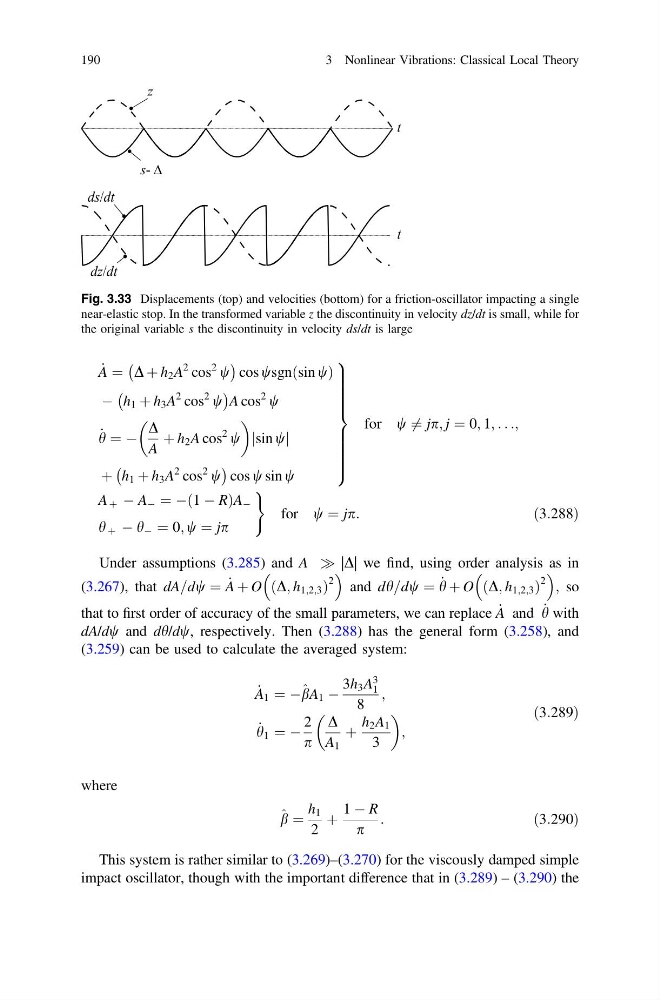
Fig. 3.33 Displacements (top) and velocities (bottom) for a friction-oscillator impacting a single
near-elastic stop. In the transformed variable z the discontinuity in velocity dz/dt is small, while for
the original variable s the discontinuity in velocity ds/dt is large
190
3 Nonlinear Vibrations: Classical Local Theory
A ¼ D þ h 2 A
2 cos
2 w
À
Á
cos wsgn sin w
ð
Þ
À h 1 þ h 3 A
2 cos
2 w
À
Á
A cos
2 w
_
h ¼ À
D
A
þ h 2 A cos
2 w
sin w
j
j
þ h 1 þ h 3 A
2 cos
2 w
À
Á
cos w sin w
9
> > > > > > > > =
> > > > > > > > ;
for w 6 ¼ jp; j ¼ 0; 1; . . .;
A þ À A À ¼ Àð1 À RÞA À
h þ À h À ¼ 0; w ¼ jp
)
for w ¼ jp:
ð3:288Þ
Under assumptions (3.285) and A ) |D| we find, using order analysis as in
(3.267), that dA=dw ¼ _
A þ O ðD; h 1;2;3 Þ
2
and dh=dw ¼ _
h þ O ðD; h 1;2;3 Þ
2
; so
that to first order of accuracy of the small parameters, we can replace _
A and _
h with
dA/dw and dh/dw, respectively. Then (3.288) has the general form (3.258), and
(3.259) can be used to calculate the averaged system:
_
A 1 ¼ À ^
bA 1 À
3h 3 A
3
1
8
;
_
h 1 ¼ À
2
p
D
A 1
þ
h 2 A 1
3
;
ð3:289Þ
where
^
b ¼
h 1
2
þ
1 À R
p
:
ð3:290Þ
This system is rather similar to (3.269)–(3.270) for the viscously damped simple
impact oscillator, though with the important difference that in (3.289) – (3.290) the
Fig. 3.33 Displacements (top) and velocities (bottom) for a friction-oscillator impacting a single
near-elastic stop. In the transformed variable z the discontinuity in velocity dz/dt is small, while for
the original variable s the discontinuity in velocity ds/dt is large
190
3 Nonlinear Vibrations: Classical Local Theory