

Assuming weak dissipation the parameters h 1 , h 2 , and h 3 are small. In addition
we assume near-elastic impacts, and a small distance from the equilibrium of the
unstrained spring, i.e.:
0\ ð1 À RÞ ( 1; h 1;2;3
( 1; D
j j ( 1:
ð3:285Þ
To turn (3.283)–(3.284) into the form (3.258), we repeat the procedure from
Sect. 3.9.3, and even start with the same discontinuous transformation (3.262),
though with a shift in sign (since the stop is now situated s = +D):
s ¼ D À z
j j; z þ z À \0:
ð3:286Þ
In the z-variable, then, every other oscillation of s and _
s will be mirrored, so that
if R = 1 the velocity-discontinuity at impact is eliminated, while for near-elastic
impacts 0 < (1 – R) 1 the discontinuity will be small, as illustrated in Fig. 3.33.
Inserting (3.286) into (3.283), the transformed system becomes:
€ z þ z ¼ Dsgnz À h 1 _
z þ h 2 _
z
2 sgnz À h 3 _
z
3 for z 6 ¼ 0; _
z
j j\v b ;
_
z þ À _
z À ¼ Àð1 À RÞ_ z À for z ¼ 0:
ð3:287Þ
Next, to turn (3.287) further into the general form (3.258), we note that the first
equation in (3.287) is quasi-linear, so that the standard van der Pol transformation
(3.264)–(3.265) can be used, giving:
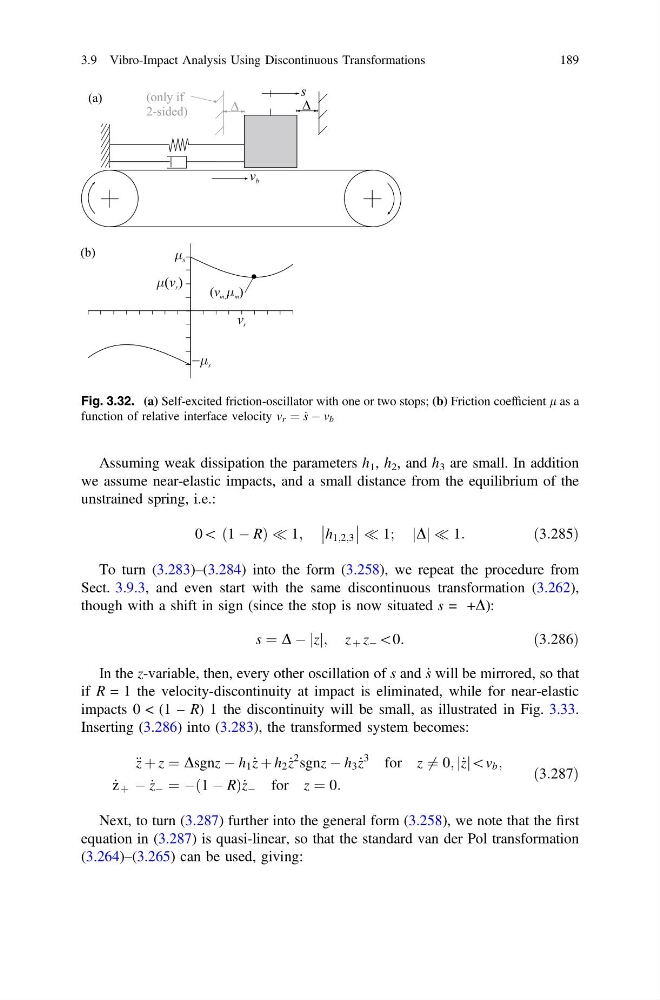
Fig. 3.32. (a) Self-excited friction-oscillator with one or two stops; (b) Friction coefficient l as a
function of relative interface velocity v r ¼ _
s À v b
3.9 Vibro-Impact Analysis Using Discontinuous Transformations
189
we assume near-elastic impacts, and a small distance from the equilibrium of the
unstrained spring, i.e.:
0\ ð1 À RÞ ( 1; h 1;2;3
( 1; D
j j ( 1:
ð3:285Þ
To turn (3.283)–(3.284) into the form (3.258), we repeat the procedure from
Sect. 3.9.3, and even start with the same discontinuous transformation (3.262),
though with a shift in sign (since the stop is now situated s = +D):
s ¼ D À z
j j; z þ z À \0:
ð3:286Þ
In the z-variable, then, every other oscillation of s and _
s will be mirrored, so that
if R = 1 the velocity-discontinuity at impact is eliminated, while for near-elastic
impacts 0 < (1 – R) 1 the discontinuity will be small, as illustrated in Fig. 3.33.
Inserting (3.286) into (3.283), the transformed system becomes:
€ z þ z ¼ Dsgnz À h 1 _
z þ h 2 _
z
2 sgnz À h 3 _
z
3 for z 6 ¼ 0; _
z
j j\v b ;
_
z þ À _
z À ¼ Àð1 À RÞ_ z À for z ¼ 0:
ð3:287Þ
Next, to turn (3.287) further into the general form (3.258), we note that the first
equation in (3.287) is quasi-linear, so that the standard van der Pol transformation
(3.264)–(3.265) can be used, giving:
Fig. 3.32. (a) Self-excited friction-oscillator with one or two stops; (b) Friction coefficient l as a
function of relative interface velocity v r ¼ _
s À v b
3.9 Vibro-Impact Analysis Using Discontinuous Transformations
189