

which was suggested by Zhuravlev and Klimov (1988) for R = 1, but here we use it
even for R % 1. From (3.274) and (3.275) it follows that:
_
s ¼
2D
p
MðzÞ_ z; € s ¼
2D
p
M
0
ðzÞ_ z þ MðzÞ€ z
ð
Þ for z 6 ¼
p
2
þ jp; j ¼ 0; 1; . . .; ð3:276Þ
where MðzÞ ¼ dP=dz ¼ sgnðcos zÞ. With (3.274)–(3.276), the system (3.273) then
transforms into:
€ z ¼ 0; z 6 ¼
p
2
þ jp for j ¼ 0; 1; Á Á Á ;
z þ ¼ z À ; _
z þ À _
z À ¼ Àð1 À RÞ_ z À for z ¼
p
2
þ jp:
ð3:277Þ
where it appears that the discontinuity in the velocity _
z of the new dependent
variable z has been reduced to a small value proportional to (1 – R). This also
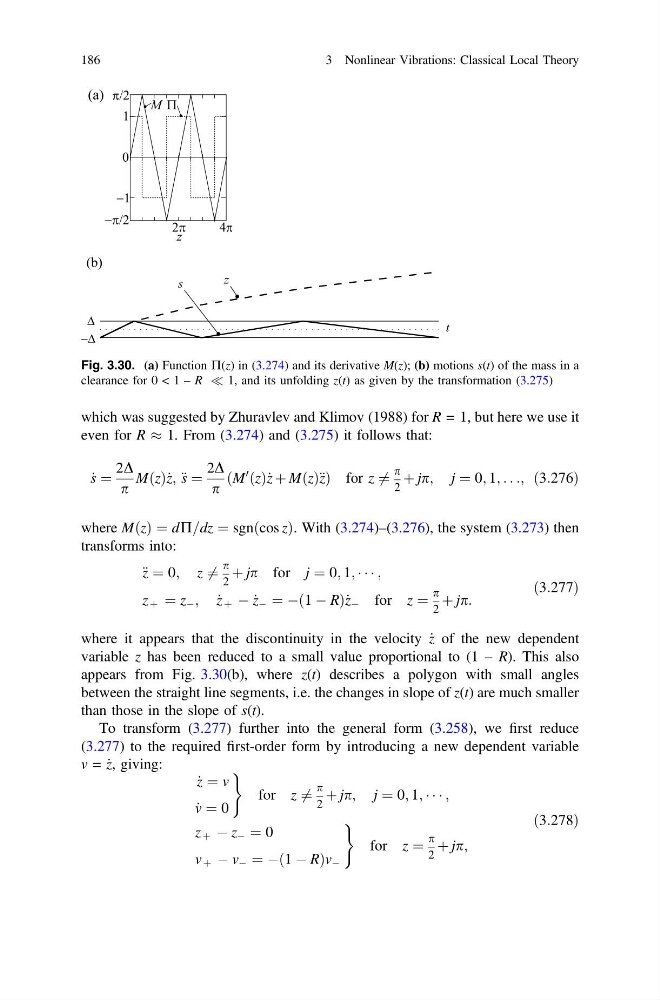
appears from Fig. 3.30(b), where z(t) describes a polygon with small angles
between the straight line segments, i.e. the changes in slope of z(t) are much smaller
than those in the slope of s(t).
To transform (3.277) further into the general form (3.258), we first reduce
(3.277) to the required first-order form by introducing a new dependent variable
v = _
z, giving:
_
z ¼ v
_
v ¼ 0
)
for z 6 ¼
p
2
þ jp; j ¼ 0; 1; Á Á Á ;
z þ À z À ¼ 0
v þ À v À ¼ Àð1 À RÞv À
)
for z ¼
p
2
þ jp;
ð3:278Þ
Fig. 3.30. (a) Function P(z) in (3.274) and its derivative M(z); (b) motions s(t) of the mass in a
clearance for 0 < 1 – R ( 1, and its unfolding z(t) as given by the transformation (3.275)
186
3 Nonlinear Vibrations: Classical Local Theory
even for R % 1. From (3.274) and (3.275) it follows that:
_
s ¼
2D
p
MðzÞ_ z; € s ¼
2D
p
M
0
ðzÞ_ z þ MðzÞ€ z
ð
Þ for z 6 ¼
p
2
þ jp; j ¼ 0; 1; . . .; ð3:276Þ
where MðzÞ ¼ dP=dz ¼ sgnðcos zÞ. With (3.274)–(3.276), the system (3.273) then
transforms into:
€ z ¼ 0; z 6 ¼
p
2
þ jp for j ¼ 0; 1; Á Á Á ;
z þ ¼ z À ; _
z þ À _
z À ¼ Àð1 À RÞ_ z À for z ¼
p
2
þ jp:
ð3:277Þ
where it appears that the discontinuity in the velocity _
z of the new dependent
variable z has been reduced to a small value proportional to (1 – R). This also
appears from Fig. 3.30(b), where z(t) describes a polygon with small angles
between the straight line segments, i.e. the changes in slope of z(t) are much smaller
than those in the slope of s(t).
To transform (3.277) further into the general form (3.258), we first reduce
(3.277) to the required first-order form by introducing a new dependent variable
v = _
z, giving:
_
z ¼ v
_
v ¼ 0
)
for z 6 ¼
p
2
þ jp; j ¼ 0; 1; Á Á Á ;
z þ À z À ¼ 0
v þ À v À ¼ Àð1 À RÞv À
)
for z ¼
p
2
þ jp;
ð3:278Þ
Fig. 3.30. (a) Function P(z) in (3.274) and its derivative M(z); (b) motions s(t) of the mass in a
clearance for 0 < 1 – R ( 1, and its unfolding z(t) as given by the transformation (3.275)
186
3 Nonlinear Vibrations: Classical Local Theory