

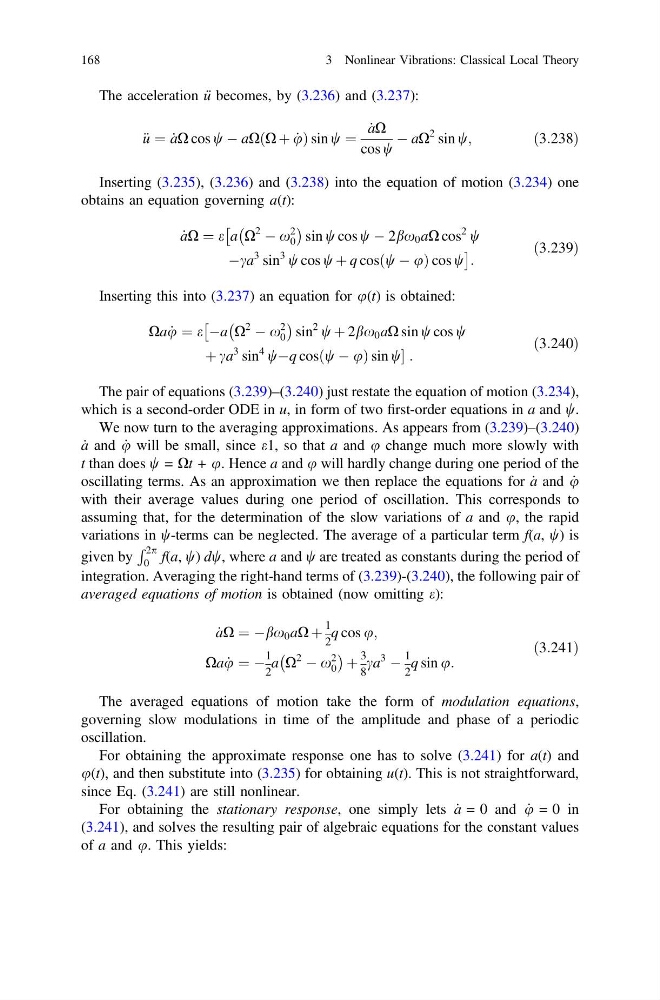
The acceleration ü becomes, by (3.236) and (3.237):
€ u ¼ _
aX cos w À aXðX þ _
uÞ sin w ¼
_
aX
cos w
À aX
2 sin w;
ð3:238Þ
Inserting (3.235), (3.236) and (3.238) into the equation of motion (3.234) one
obtains an equation governing a(t):
_
aX ¼ e a X
2
À x
2
0
À
Á
sin w cos w À 2bx 0 aX cos
2 w
Â
Àca
3 sin
3 w cos w þ q cosðw À uÞ cos w
à :
ð3:239Þ
Inserting this into (3.237) an equation for u(t) is obtained:
Xa _
u ¼ e Àa X
2
À x
2
0
À
Á
sin
2 w þ 2bx 0 aX sin w cos w
Â
þ ca
3 sin
4 wÀq cosðw À uÞ sin w :
ð3:240Þ
The pair of equations (3.239)–(3.240) just restate the equation of motion (3.234),
which is a second-order ODE in u, in form of two first-order equations in a and w.
We now turn to the averaging approximations. As appears from (3.239)–(3.240)
_
a and _
u will be small, since e1, so that a and u change much more slowly with
t than does w = Xt + u. Hence a and u will hardly change during one period of the
oscillating terms. As an approximation we then replace the equations for _
a and _
u
with their average values during one period of oscillation. This corresponds to
assuming that, for the determination of the slow variations of a and u, the rapid
variations in w-terms can be neglected. The average of a particular term f(a, w) is
given by
R 2p
0 f(a, w) dw, where a and w are treated as constants during the period of
integration. Averaging the right-hand terms of (3.239)-(3.240), the following pair of
averaged equations of motion is obtained (now omitting e):
_
aX ¼ Àbx 0 aX þ
1
2
q cos u;
Xa _
u ¼ À
1
2
a X
2
À x
2
0
À
Á þ
3
8
ca
3
À
1
2
q sin u:
ð3:241Þ
The averaged equations of motion take the form of modulation equations,
governing slow modulations in time of the amplitude and phase of a periodic
oscillation.
For obtaining the approximate response one has to solve (3.241) for a(t) and
u(t), and then substitute into (3.235) for obtaining u(t). This is not straightforward,
since Eq. (3.241) are still nonlinear.
For obtaining the stationary response, one simply lets _
a = 0 and _
u = 0 in
(3.241), and solves the resulting pair of algebraic equations for the constant values
of a and u. This yields:
168
3 Nonlinear Vibrations: Classical Local Theory
€ u ¼ _
aX cos w À aXðX þ _
uÞ sin w ¼
_
aX
cos w
À aX
2 sin w;
ð3:238Þ
Inserting (3.235), (3.236) and (3.238) into the equation of motion (3.234) one
obtains an equation governing a(t):
_
aX ¼ e a X
2
À x
2
0
À
Á
sin w cos w À 2bx 0 aX cos
2 w
Â
Àca
3 sin
3 w cos w þ q cosðw À uÞ cos w
à :
ð3:239Þ
Inserting this into (3.237) an equation for u(t) is obtained:
Xa _
u ¼ e Àa X
2
À x
2
0
À
Á
sin
2 w þ 2bx 0 aX sin w cos w
Â
þ ca
3 sin
4 wÀq cosðw À uÞ sin w :
ð3:240Þ
The pair of equations (3.239)–(3.240) just restate the equation of motion (3.234),
which is a second-order ODE in u, in form of two first-order equations in a and w.
We now turn to the averaging approximations. As appears from (3.239)–(3.240)
_
a and _
u will be small, since e1, so that a and u change much more slowly with
t than does w = Xt + u. Hence a and u will hardly change during one period of the
oscillating terms. As an approximation we then replace the equations for _
a and _
u
with their average values during one period of oscillation. This corresponds to
assuming that, for the determination of the slow variations of a and u, the rapid
variations in w-terms can be neglected. The average of a particular term f(a, w) is
given by
R 2p
0 f(a, w) dw, where a and w are treated as constants during the period of
integration. Averaging the right-hand terms of (3.239)-(3.240), the following pair of
averaged equations of motion is obtained (now omitting e):
_
aX ¼ Àbx 0 aX þ
1
2
q cos u;
Xa _
u ¼ À
1
2
a X
2
À x
2
0
À
Á þ
3
8
ca
3
À
1
2
q sin u:
ð3:241Þ
The averaged equations of motion take the form of modulation equations,
governing slow modulations in time of the amplitude and phase of a periodic
oscillation.
For obtaining the approximate response one has to solve (3.241) for a(t) and
u(t), and then substitute into (3.235) for obtaining u(t). This is not straightforward,
since Eq. (3.241) are still nonlinear.
For obtaining the stationary response, one simply lets _
a = 0 and _
u = 0 in
(3.241), and solves the resulting pair of algebraic equations for the constant values
of a and u. This yields:
168
3 Nonlinear Vibrations: Classical Local Theory