

Thus, we reconsider the system (3.152), subjected to near-resonant weak excitation, weak damping, and weak nonlinearity:
€ u þ 2ebx 0 _
u þ x
2
0 u þ ecu
3
¼ eq cosðXtÞ;
X
2
À x
2
0 ¼ OðeÞ; e ( 1:
ð3:234Þ
When c = 0 the problem is linear, and the stationary solution has the form
u = asin(Xt + u), where a and u are constants. With the averaging method one
assumes the solution of the weakly nonlinear problem to be similar in character to
the linear one, though, with the amplitude a and phase u allowed to vary in time.
Thus we let u(t) = a(t)sin(Xt + u(t)), and write this in the form:
u ¼ aðtÞ sin w; wðtÞ Xt þ uðtÞ:
ð3:235Þ
The unknown amplitudes a(t) and u(t) are thereby considered dependent variables of the problem, and a variable shift is performed from the original dependent
variable u(t) to the new variables a and u. In performing this transformation there
are three unknowns (u, a, u), but only two Eqs. ((3.234) and (3.235)). For a third
equation we impose the arbitrary but convenient restriction that the velocity _
u
should take a form similar to that of the linear case, that is:
_
u ¼ aX cos w;
ð3:236Þ
which by (3.235) requires that _
asinw + a _
ucosw = 0, that is:
a _
u ¼ À_ a tan w:
ð3:237Þ
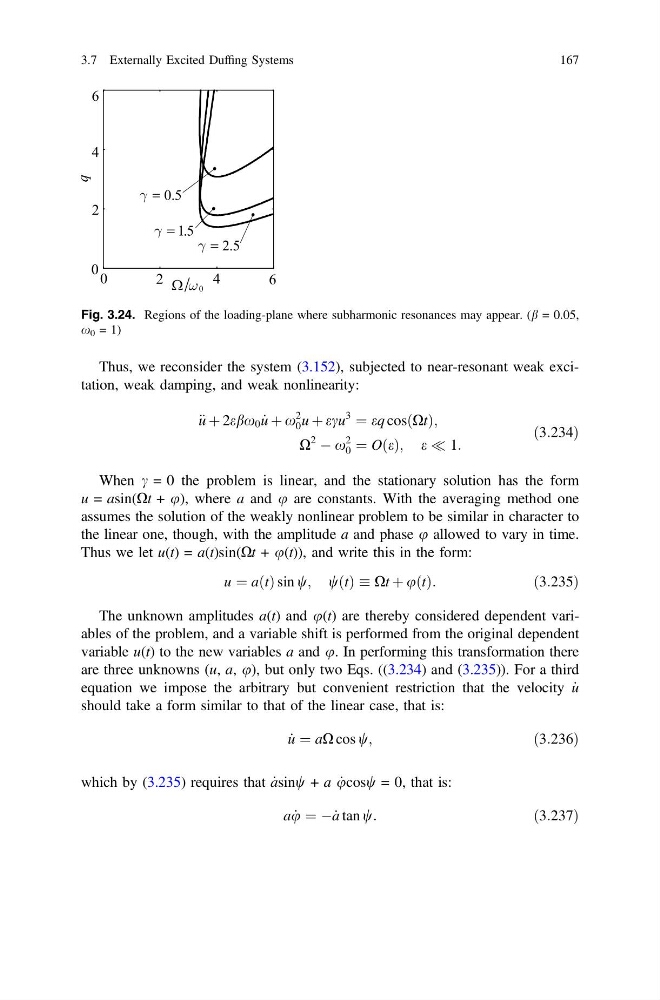
Fig. 3.24. Regions of the loading-plane where subharmonic resonances may appear. (b = 0.05,
x 0 = 1)
3.7 Externally Excited Duffing Systems
167
€ u þ 2ebx 0 _
u þ x
2
0 u þ ecu
3
¼ eq cosðXtÞ;
X
2
À x
2
0 ¼ OðeÞ; e ( 1:
ð3:234Þ
When c = 0 the problem is linear, and the stationary solution has the form
u = asin(Xt + u), where a and u are constants. With the averaging method one
assumes the solution of the weakly nonlinear problem to be similar in character to
the linear one, though, with the amplitude a and phase u allowed to vary in time.
Thus we let u(t) = a(t)sin(Xt + u(t)), and write this in the form:
u ¼ aðtÞ sin w; wðtÞ Xt þ uðtÞ:
ð3:235Þ
The unknown amplitudes a(t) and u(t) are thereby considered dependent variables of the problem, and a variable shift is performed from the original dependent
variable u(t) to the new variables a and u. In performing this transformation there
are three unknowns (u, a, u), but only two Eqs. ((3.234) and (3.235)). For a third
equation we impose the arbitrary but convenient restriction that the velocity _
u
should take a form similar to that of the linear case, that is:
_
u ¼ aX cos w;
ð3:236Þ
which by (3.235) requires that _
asinw + a _
ucosw = 0, that is:
a _
u ¼ À_ a tan w:
ð3:237Þ
Fig. 3.24. Regions of the loading-plane where subharmonic resonances may appear. (b = 0.05,
x 0 = 1)
3.7 Externally Excited Duffing Systems
167