

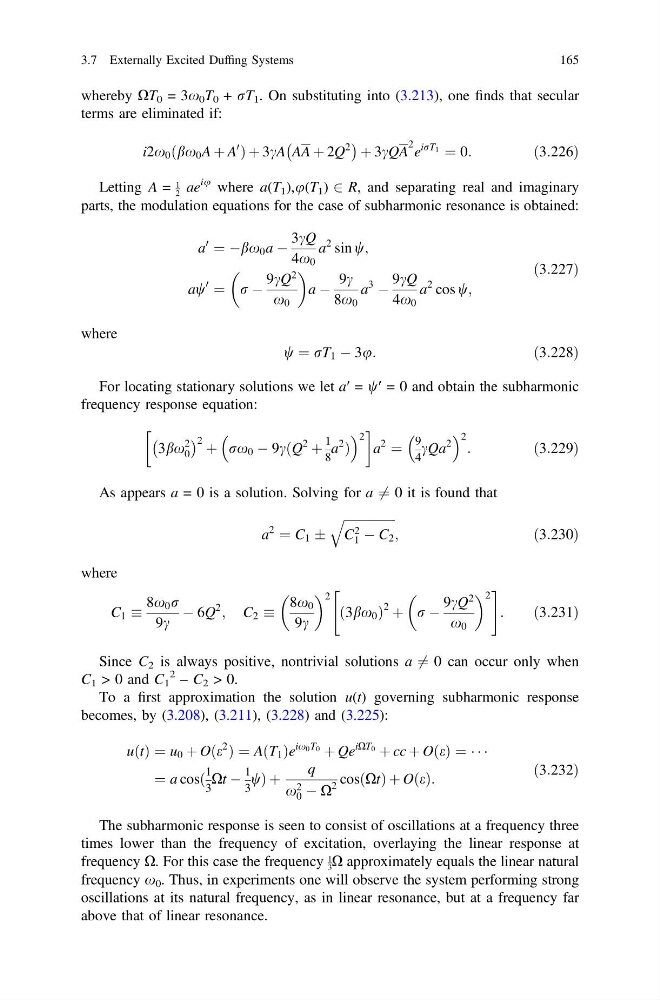
whereby XT 0 = 3x 0 T 0 + rT 1 . On substituting into (3.213), one finds that secular
terms are eliminated if:
i2x 0 bx 0 A þ A
0
ð
Þþ3cA AA þ 2Q
2
À
Á þ 3cQA
2 e
irT 1 ¼ 0:
ð3:226Þ
Letting A =
1
2 ae
iu where a(T 1 ),u(T 1 ) 2 R, and separating real and imaginary
parts, the modulation equations for the case of subharmonic resonance is obtained:
a
0
¼ Àbx 0 a À
3cQ
4x 0
a
2 sin w;
aw
0
¼ r À
9cQ
2
x 0
a À
9c
8x 0
a
3
À
9cQ
4x 0
a
2 cos w;
ð3:227Þ
where
w ¼ rT 1 À 3u:
ð3:228Þ
For locating stationary solutions we let a′ = w′ = 0 and obtain the subharmonic
frequency response equation:
3bx
2
0
À
Á 2 þ rx 0 À 9cðQ
2
þ
1
8
a
2
Þ
2
!
a
2
¼
9
4
cQa
2
2 :
ð3:229Þ
As appears a = 0 is a solution. Solving for a 6 ¼ 0 it is found that
a
2
¼ C 1 Æ
ffiffiffiffiffiffiffiffiffiffiffiffiffiffiffiffi ffi
C 2
1 À C 2
q
;
ð3:230Þ
where
C 1
8x 0 r
9c
À 6Q
2
; C 2
8x 0
9c
2
3bx 0
ð
Þ
2 þ r À
9cQ
2
x 0
2
"
#
:
ð3:231Þ
Since C 2 is always positive, nontrivial solutions a 6 ¼ 0 can occur only when
C 1 > 0 and C 1
2
– C 2 > 0.
To a first approximation the solution u(t) governing subharmonic response
becomes, by (3.208), (3.211), (3.228) and (3.225):
uðtÞ ¼ u 0 þ Oðe
2
Þ ¼ AðT 1 Þe
ix 0 T 0 þ Qe
iXT 0 þ cc þ OðeÞ ¼ Á Á Á
¼ a cosð
1
3
Xt À
1
3
wÞ þ
q
x 2
0 À X
2
cosðXtÞ þ OðeÞ:
ð3:232Þ
The subharmonic response is seen to consist of oscillations at a frequency three
times lower than the frequency of excitation, overlaying the linear response at
frequency X. For this case the frequency
1
3 X approximately equals the linear natural
frequency x 0 . Thus, in experiments one will observe the system performing strong
oscillations at its natural frequency, as in linear resonance, but at a frequency far
above that of linear resonance.
3.7 Externally Excited Duffing Systems
165
terms are eliminated if:
i2x 0 bx 0 A þ A
0
ð
Þþ3cA AA þ 2Q
2
À
Á þ 3cQA
2 e
irT 1 ¼ 0:
ð3:226Þ
Letting A =
1
2 ae
iu where a(T 1 ),u(T 1 ) 2 R, and separating real and imaginary
parts, the modulation equations for the case of subharmonic resonance is obtained:
a
0
¼ Àbx 0 a À
3cQ
4x 0
a
2 sin w;
aw
0
¼ r À
9cQ
2
x 0
a À
9c
8x 0
a
3
À
9cQ
4x 0
a
2 cos w;
ð3:227Þ
where
w ¼ rT 1 À 3u:
ð3:228Þ
For locating stationary solutions we let a′ = w′ = 0 and obtain the subharmonic
frequency response equation:
3bx
2
0
À
Á 2 þ rx 0 À 9cðQ
2
þ
1
8
a
2
Þ
2
!
a
2
¼
9
4
cQa
2
2 :
ð3:229Þ
As appears a = 0 is a solution. Solving for a 6 ¼ 0 it is found that
a
2
¼ C 1 Æ
ffiffiffiffiffiffiffiffiffiffiffiffiffiffiffiffi ffi
C 2
1 À C 2
q
;
ð3:230Þ
where
C 1
8x 0 r
9c
À 6Q
2
; C 2
8x 0
9c
2
3bx 0
ð
Þ
2 þ r À
9cQ
2
x 0
2
"
#
:
ð3:231Þ
Since C 2 is always positive, nontrivial solutions a 6 ¼ 0 can occur only when
C 1 > 0 and C 1
2
– C 2 > 0.
To a first approximation the solution u(t) governing subharmonic response
becomes, by (3.208), (3.211), (3.228) and (3.225):
uðtÞ ¼ u 0 þ Oðe
2
Þ ¼ AðT 1 Þe
ix 0 T 0 þ Qe
iXT 0 þ cc þ OðeÞ ¼ Á Á Á
¼ a cosð
1
3
Xt À
1
3
wÞ þ
q
x 2
0 À X
2
cosðXtÞ þ OðeÞ:
ð3:232Þ
The subharmonic response is seen to consist of oscillations at a frequency three
times lower than the frequency of excitation, overlaying the linear response at
frequency X. For this case the frequency
1
3 X approximately equals the linear natural
frequency x 0 . Thus, in experiments one will observe the system performing strong
oscillations at its natural frequency, as in linear resonance, but at a frequency far
above that of linear resonance.
3.7 Externally Excited Duffing Systems
165