

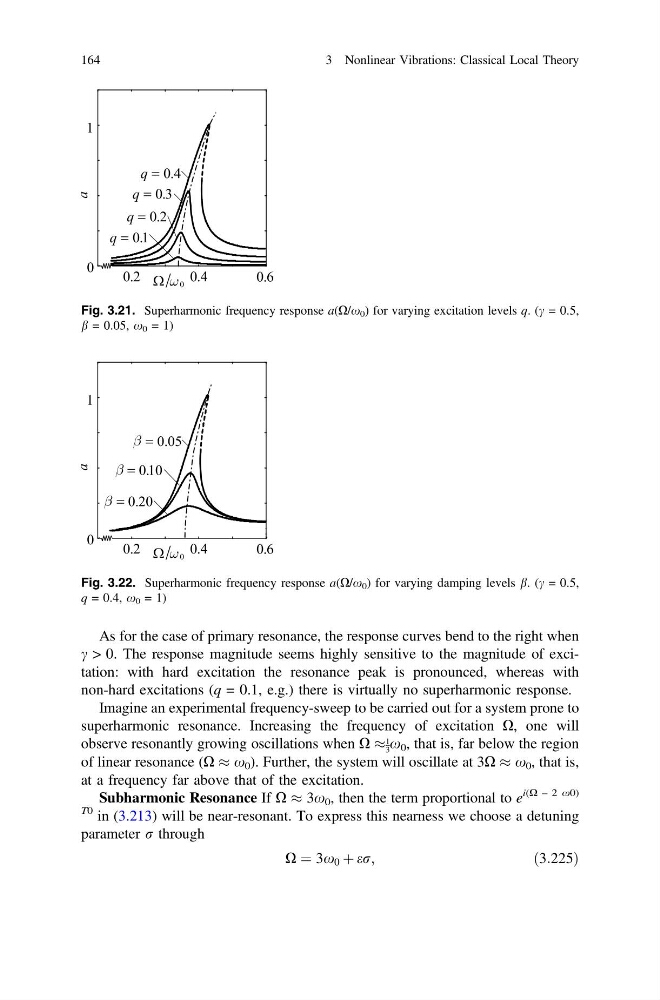
As for the case of primary resonance, the response curves bend to the right when
c > 0. The response magnitude seems highly sensitive to the magnitude of excitation: with hard excitation the resonance peak is pronounced, whereas with
non-hard excitations (q = 0.1, e.g.) there is virtually no superharmonic response.
Imagine an experimental frequency-sweep to be carried out for a system prone to
superharmonic resonance. Increasing the frequency of excitation X, one will
observe resonantly growing oscillations when X %
1
3 x 0 , that is, far below the region
of linear resonance (X % x 0 ). Further, the system will oscillate at 3X % x 0 , that is,
at a frequency far above that of the excitation.
Subharmonic Resonance If X % 3x 0 , then the term proportional to e
i(X – 2 x0)
T0 in (3.213) will be near-resonant. To express this nearness we choose a detuning
parameter r through
X ¼ 3x 0 þ er;
ð3:225Þ
Fig. 3.21. Superharmonic frequency response a(X/x 0 ) for varying excitation levels q. (c = 0.5,
b = 0.05, x 0 = 1)
Fig. 3.22. Superharmonic frequency response a(X/x 0 ) for varying damping levels b. (c = 0.5,
q = 0.4, x 0 = 1)
164
3 Nonlinear Vibrations: Classical Local Theory
c > 0. The response magnitude seems highly sensitive to the magnitude of excitation: with hard excitation the resonance peak is pronounced, whereas with
non-hard excitations (q = 0.1, e.g.) there is virtually no superharmonic response.
Imagine an experimental frequency-sweep to be carried out for a system prone to
superharmonic resonance. Increasing the frequency of excitation X, one will
observe resonantly growing oscillations when X %
1
3 x 0 , that is, far below the region
of linear resonance (X % x 0 ). Further, the system will oscillate at 3X % x 0 , that is,
at a frequency far above that of the excitation.
Subharmonic Resonance If X % 3x 0 , then the term proportional to e
i(X – 2 x0)
T0 in (3.213) will be near-resonant. To express this nearness we choose a detuning
parameter r through
X ¼ 3x 0 þ er;
ð3:225Þ
Fig. 3.21. Superharmonic frequency response a(X/x 0 ) for varying excitation levels q. (c = 0.5,
b = 0.05, x 0 = 1)
Fig. 3.22. Superharmonic frequency response a(X/x 0 ) for varying damping levels b. (c = 0.5,
q = 0.4, x 0 = 1)
164
3 Nonlinear Vibrations: Classical Local Theory