

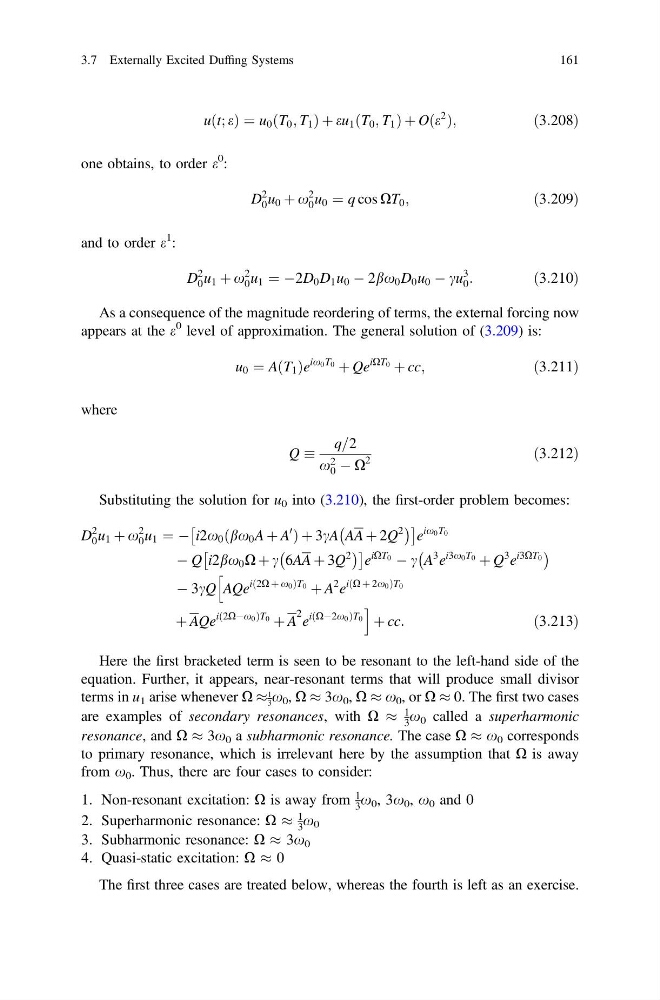
uðt; eÞ ¼ u 0 ðT 0 ; T 1 Þ þ eu 1 ðT 0 ; T 1 Þ þ Oðe
2
Þ;
ð3:208Þ
one obtains, to order e
0 :
D
2
0 u 0 þ x
2
0 u 0 ¼ q cos XT 0 ;
ð3:209Þ
and to order e
1 :
D
2
0 u 1 þ x
2
0 u 1 ¼ À2D 0 D 1 u 0 À 2bx 0 D 0 u 0 À cu
3
0 :
ð3:210Þ
As a consequence of the magnitude reordering of terms, the external forcing now
appears at the e
0 level of approximation. The general solution of (3.209) is:
u 0 ¼ AðT 1 Þe
ix 0 T 0 þ Qe
iXT 0 þ cc;
ð3:211Þ
where
Q
q=2
x 2
0 À X
2
ð3:212Þ
Substituting the solution for u 0 into (3.210), the first-order problem becomes:
D
2
0 u 1 þ x
2
0 u 1 ¼ À i2x 0 bx 0 A þ A
0
ð
Þþ3cA AA þ 2Q
2
À
Á
Â
Ã
e
ix 0 T 0
À Q i2bx 0 X þ c 6AA þ 3Q
2
À
Á
Â
Ã
e
iXT 0 À c A
3 e
i3x 0 T 0 þ Q
3 e
i3XT 0
À
Á
À 3cQ AQe
ið2X þ x 0 ÞT 0 þ A
2 e
iðX þ 2x 0 ÞT 0
h
þ AQe
ið2XÀx 0 ÞT 0 þ A
2 e
iðXÀ2x 0 ÞT 0
i
þ cc:
ð3:213Þ
Here the first bracketed term is seen to be resonant to the left-hand side of the
equation. Further, it appears, near-resonant terms that will produce small divisor
terms in u 1 arise whenever X %
1
3 x 0 , X % 3x 0 , X % x 0 , or X % 0. The first two cases
are examples of secondary resonances, with X %
1
3 x 0 called a superharmonic
resonance, and X % 3x 0 a subharmonic resonance. The case X % x 0 corresponds
to primary resonance, which is irrelevant here by the assumption that X is away
from x 0 . Thus, there are four cases to consider:
1. Non-resonant excitation: X is away from
1
3 x 0 , 3x 0 , x 0 and 0
2. Superharmonic resonance: X %
1
3 x 0
3. Subharmonic resonance: X % 3x 0
4. Quasi-static excitation: X % 0
The first three cases are treated below, whereas the fourth is left as an exercise.
3.7 Externally Excited Duffing Systems
161
2
Þ;
ð3:208Þ
one obtains, to order e
0 :
D
2
0 u 0 þ x
2
0 u 0 ¼ q cos XT 0 ;
ð3:209Þ
and to order e
1 :
D
2
0 u 1 þ x
2
0 u 1 ¼ À2D 0 D 1 u 0 À 2bx 0 D 0 u 0 À cu
3
0 :
ð3:210Þ
As a consequence of the magnitude reordering of terms, the external forcing now
appears at the e
0 level of approximation. The general solution of (3.209) is:
u 0 ¼ AðT 1 Þe
ix 0 T 0 þ Qe
iXT 0 þ cc;
ð3:211Þ
where
Q
q=2
x 2
0 À X
2
ð3:212Þ
Substituting the solution for u 0 into (3.210), the first-order problem becomes:
D
2
0 u 1 þ x
2
0 u 1 ¼ À i2x 0 bx 0 A þ A
0
ð
Þþ3cA AA þ 2Q
2
À
Á
Â
Ã
e
ix 0 T 0
À Q i2bx 0 X þ c 6AA þ 3Q
2
À
Á
Â
Ã
e
iXT 0 À c A
3 e
i3x 0 T 0 þ Q
3 e
i3XT 0
À
Á
À 3cQ AQe
ið2X þ x 0 ÞT 0 þ A
2 e
iðX þ 2x 0 ÞT 0
h
þ AQe
ið2XÀx 0 ÞT 0 þ A
2 e
iðXÀ2x 0 ÞT 0
i
þ cc:
ð3:213Þ
Here the first bracketed term is seen to be resonant to the left-hand side of the
equation. Further, it appears, near-resonant terms that will produce small divisor
terms in u 1 arise whenever X %
1
3 x 0 , X % 3x 0 , X % x 0 , or X % 0. The first two cases
are examples of secondary resonances, with X %
1
3 x 0 called a superharmonic
resonance, and X % 3x 0 a subharmonic resonance. The case X % x 0 corresponds
to primary resonance, which is irrelevant here by the assumption that X is away
from x 0 . Thus, there are four cases to consider:
1. Non-resonant excitation: X is away from
1
3 x 0 , 3x 0 , x 0 and 0
2. Superharmonic resonance: X %
1
3 x 0
3. Subharmonic resonance: X % 3x 0
4. Quasi-static excitation: X % 0
The first three cases are treated below, whereas the fourth is left as an exercise.
3.7 Externally Excited Duffing Systems
161