

a
Ã
¼
q
2bx 2
0
;
ð3:205Þ
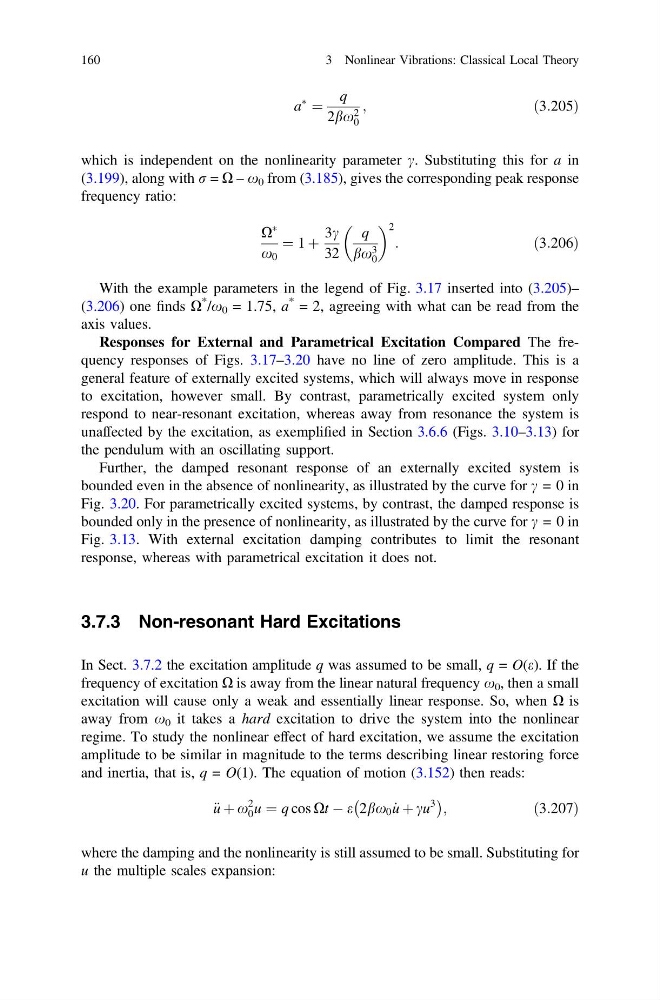
which is independent on the nonlinearity parameter c. Substituting this for a in
(3.199), along with r = X – x 0 from (3.185), gives the corresponding peak response
frequency ratio:
X
Ã
x 0
¼ 1 þ
3c
32
q
bx
3
0
2
:
ð3:206Þ
With the example parameters in the legend of Fig. 3.17 inserted into (3.205)–
(3.206) one finds X
* /x 0 = 1.75, a
* = 2, agreeing with what can be read from the
axis values.
Responses for External and Parametrical Excitation Compared The frequency responses of Figs. 3.17–3.20 have no line of zero amplitude. This is a
general feature of externally excited systems, which will always move in response
to excitation, however small. By contrast, parametrically excited system only
respond to near-resonant excitation, whereas away from resonance the system is
unaffected by the excitation, as exemplified in Section 3.6.6 (Figs. 3.10–3.13) for
the pendulum with an oscillating support.
Further, the damped resonant response of an externally excited system is
bounded even in the absence of nonlinearity, as illustrated by the curve for c = 0 in
Fig. 3.20. For parametrically excited systems, by contrast, the damped response is
bounded only in the presence of nonlinearity, as illustrated by the curve for c = 0 in
Fig. 3.13. With external excitation damping contributes to limit the resonant
response, whereas with parametrical excitation it does not.
3.7.3 Non-resonant Hard Excitations
In Sect. 3.7.2 the excitation amplitude q was assumed to be small, q = O(e). If the
frequency of excitation X is away from the linear natural frequency x 0 , then a small
excitation will cause only a weak and essentially linear response. So, when X is
away from x 0 it takes a hard excitation to drive the system into the nonlinear
regime. To study the nonlinear effect of hard excitation, we assume the excitation
amplitude to be similar in magnitude to the terms describing linear restoring force
and inertia, that is, q = O(1). The equation of motion (3.152) then reads:
€ u þ x
2
0 u ¼ q cos Xt À e 2bx 0 _
u þ cu
3
À
Á ;
ð3:207Þ
where the damping and the nonlinearity is still assumed to be small. Substituting for
u the multiple scales expansion:
160
3 Nonlinear Vibrations: Classical Local Theory
Ã
¼
q
2bx 2
0
;
ð3:205Þ
which is independent on the nonlinearity parameter c. Substituting this for a in
(3.199), along with r = X – x 0 from (3.185), gives the corresponding peak response
frequency ratio:
X
Ã
x 0
¼ 1 þ
3c
32
q
bx
3
0
2
:
ð3:206Þ
With the example parameters in the legend of Fig. 3.17 inserted into (3.205)–
(3.206) one finds X
* /x 0 = 1.75, a
* = 2, agreeing with what can be read from the
axis values.
Responses for External and Parametrical Excitation Compared The frequency responses of Figs. 3.17–3.20 have no line of zero amplitude. This is a
general feature of externally excited systems, which will always move in response
to excitation, however small. By contrast, parametrically excited system only
respond to near-resonant excitation, whereas away from resonance the system is
unaffected by the excitation, as exemplified in Section 3.6.6 (Figs. 3.10–3.13) for
the pendulum with an oscillating support.
Further, the damped resonant response of an externally excited system is
bounded even in the absence of nonlinearity, as illustrated by the curve for c = 0 in
Fig. 3.20. For parametrically excited systems, by contrast, the damped response is
bounded only in the presence of nonlinearity, as illustrated by the curve for c = 0 in
Fig. 3.13. With external excitation damping contributes to limit the resonant
response, whereas with parametrical excitation it does not.
3.7.3 Non-resonant Hard Excitations
In Sect. 3.7.2 the excitation amplitude q was assumed to be small, q = O(e). If the
frequency of excitation X is away from the linear natural frequency x 0 , then a small
excitation will cause only a weak and essentially linear response. So, when X is
away from x 0 it takes a hard excitation to drive the system into the nonlinear
regime. To study the nonlinear effect of hard excitation, we assume the excitation
amplitude to be similar in magnitude to the terms describing linear restoring force
and inertia, that is, q = O(1). The equation of motion (3.152) then reads:
€ u þ x
2
0 u ¼ q cos Xt À e 2bx 0 _
u þ cu
3
À
Á ;
ð3:207Þ
where the damping and the nonlinearity is still assumed to be small. Substituting for
u the multiple scales expansion:
160
3 Nonlinear Vibrations: Classical Local Theory