

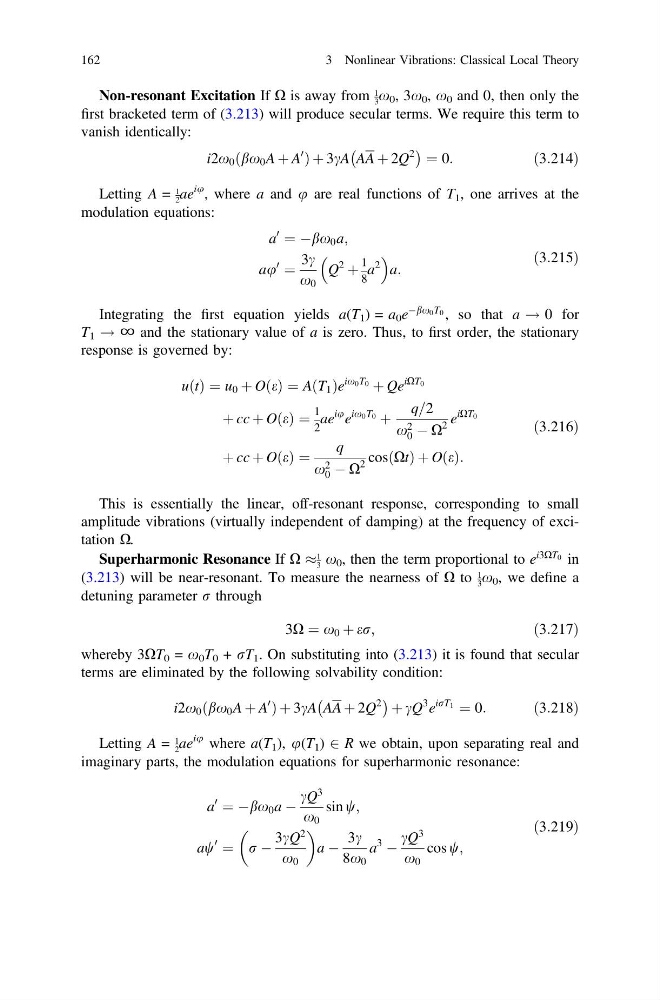
Non-resonant Excitation If X is away from
1
3 x 0 , 3x 0 , x 0 and 0, then only the
first bracketed term of (3.213) will produce secular terms. We require this term to
vanish identically:
i2x 0 bx 0 A þ A
0
ð
Þþ3cA AA þ 2Q
2
À
Á ¼ 0:
ð3:214Þ
Letting A =
1
2 ae
iu , where a and u are real functions of T 1 , one arrives at the
modulation equations:
a
0
¼ Àbx 0 a;
au
0
¼
3c
x 0
Q
2
þ
1
8
a
2
a:
ð3:215Þ
Integrating the first equation yields a(T 1 ) = a 0 e
Àbx 0 T 0 , so that a ! 0 for
T 1 ! ∞ and the stationary value of a is zero. Thus, to first order, the stationary
response is governed by:
uðtÞ ¼ u 0 þ OðeÞ ¼ AðT 1 Þe
ix 0 T 0 þ Qe
iXT 0
þ cc þ OðeÞ ¼
1
2
ae
iu e
ix 0 T 0 þ
q=2
x 2
0 À X
2
e
iXT 0
þ cc þ OðeÞ ¼
q
x 2
0 À X
2
cosðXtÞ þ OðeÞ:
ð3:216Þ
This is essentially the linear, off-resonant response, corresponding to small
amplitude vibrations (virtually independent of damping) at the frequency of excitation X.
Superharmonic Resonance If X %
1
3 x 0 , then the term proportional to e
i3XT 0 in
(3.213) will be near-resonant. To measure the nearness of X to
1
3 x 0 , we define a
detuning parameter r through
3X ¼ x 0 þ er;
ð3:217Þ
whereby 3XT 0 = x 0 T 0 + rT 1 . On substituting into (3.213) it is found that secular
terms are eliminated by the following solvability condition:
i2x 0 bx 0 A þ A
0
ð
Þþ3cA AA þ 2Q
2
À
Á þ cQ
3 e
irT 1 ¼ 0:
ð3:218Þ
Letting A =
1
2 ae
iu where a(T 1 ), u(T 1 ) 2 R we obtain, upon separating real and
imaginary parts, the modulation equations for superharmonic resonance:
a
0
¼ Àbx 0 a À
cQ
3
x 0
sin w;
aw
0
¼ r À
3cQ
2
x 0
a À
3c
8x 0
a
3
À
cQ
3
x 0
cos w;
ð3:219Þ
162
3 Nonlinear Vibrations: Classical Local Theory
1
3 x 0 , 3x 0 , x 0 and 0, then only the
first bracketed term of (3.213) will produce secular terms. We require this term to
vanish identically:
i2x 0 bx 0 A þ A
0
ð
Þþ3cA AA þ 2Q
2
À
Á ¼ 0:
ð3:214Þ
Letting A =
1
2 ae
iu , where a and u are real functions of T 1 , one arrives at the
modulation equations:
a
0
¼ Àbx 0 a;
au
0
¼
3c
x 0
Q
2
þ
1
8
a
2
a:
ð3:215Þ
Integrating the first equation yields a(T 1 ) = a 0 e
Àbx 0 T 0 , so that a ! 0 for
T 1 ! ∞ and the stationary value of a is zero. Thus, to first order, the stationary
response is governed by:
uðtÞ ¼ u 0 þ OðeÞ ¼ AðT 1 Þe
ix 0 T 0 þ Qe
iXT 0
þ cc þ OðeÞ ¼
1
2
ae
iu e
ix 0 T 0 þ
q=2
x 2
0 À X
2
e
iXT 0
þ cc þ OðeÞ ¼
q
x 2
0 À X
2
cosðXtÞ þ OðeÞ:
ð3:216Þ
This is essentially the linear, off-resonant response, corresponding to small
amplitude vibrations (virtually independent of damping) at the frequency of excitation X.
Superharmonic Resonance If X %
1
3 x 0 , then the term proportional to e
i3XT 0 in
(3.213) will be near-resonant. To measure the nearness of X to
1
3 x 0 , we define a
detuning parameter r through
3X ¼ x 0 þ er;
ð3:217Þ
whereby 3XT 0 = x 0 T 0 + rT 1 . On substituting into (3.213) it is found that secular
terms are eliminated by the following solvability condition:
i2x 0 bx 0 A þ A
0
ð
Þþ3cA AA þ 2Q
2
À
Á þ cQ
3 e
irT 1 ¼ 0:
ð3:218Þ
Letting A =
1
2 ae
iu where a(T 1 ), u(T 1 ) 2 R we obtain, upon separating real and
imaginary parts, the modulation equations for superharmonic resonance:
a
0
¼ Àbx 0 a À
cQ
3
x 0
sin w;
aw
0
¼ r À
3cQ
2
x 0
a À
3c
8x 0
a
3
À
cQ
3
x 0
cos w;
ð3:219Þ
162
3 Nonlinear Vibrations: Classical Local Theory