

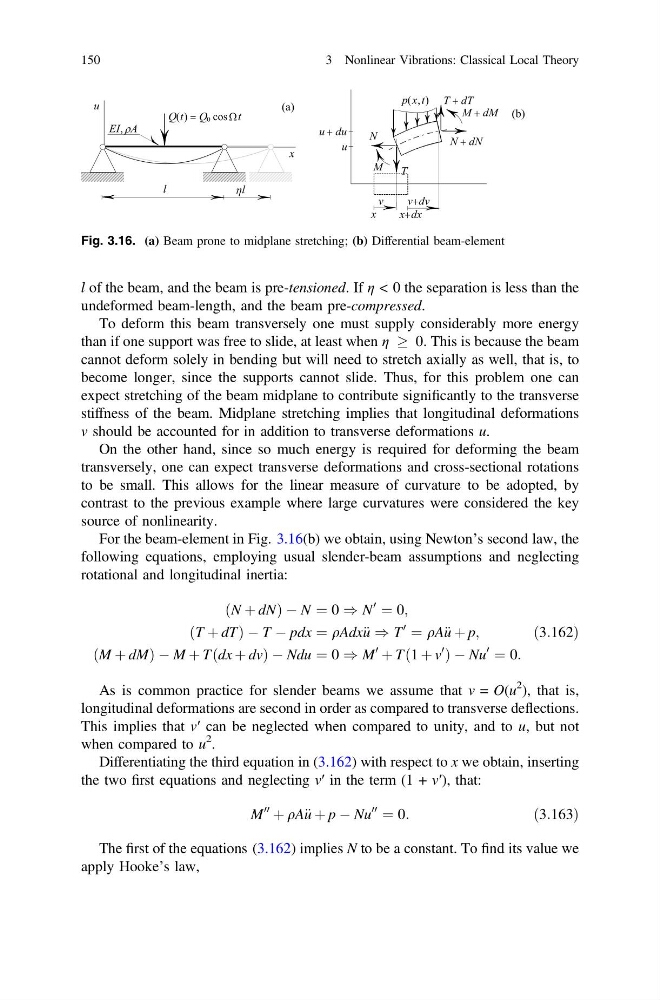
l of the beam, and the beam is pre-tensioned. If η < 0 the separation is less than the
undeformed beam-length, and the beam pre-compressed.
To deform this beam transversely one must supply considerably more energy
than if one support was free to slide, at least when η ! 0. This is because the beam
cannot deform solely in bending but will need to stretch axially as well, that is, to
become longer, since the supports cannot slide. Thus, for this problem one can
expect stretching of the beam midplane to contribute significantly to the transverse
stiffness of the beam. Midplane stretching implies that longitudinal deformations
v should be accounted for in addition to transverse deformations u.
On the other hand, since so much energy is required for deforming the beam
transversely, one can expect transverse deformations and cross-sectional rotations
to be small. This allows for the linear measure of curvature to be adopted, by
contrast to the previous example where large curvatures were considered the key
source of nonlinearity.
For the beam-element in Fig. 3.16(b) we obtain, using Newton’s second law, the
following equations, employing usual slender-beam assumptions and neglecting
rotational and longitudinal inertia:
ðN þ dNÞ À N ¼ 0 ) N
0
¼ 0;
ðT þ dTÞ À T À pdx ¼ qAdx€ u ) T
0
¼ qA€ u þ p;
ðM þ dMÞ À M þ Tðdx þ dvÞ À Ndu ¼ 0 ) M
0
þ Tð1 þ v
0
Þ À Nu
0
¼ 0:
ð3:162Þ
As is common practice for slender beams we assume that v = O(u
2 ), that is,
longitudinal deformations are second in order as compared to transverse deflections.
This implies that v′ can be neglected when compared to unity, and to u, but not
when compared to u
2 .
Differentiating the third equation in (3.162) with respect to x we obtain, inserting
the two first equations and neglecting v′ in the term (1 + v′), that:
M
00
þ qA€ u þ p À Nu
00
¼ 0:
ð3:163Þ
The first of the equations (3.162) implies N to be a constant. To find its value we
apply Hooke’s law,
Fig. 3.16. (a) Beam prone to midplane stretching; (b) Differential beam-element
150
3 Nonlinear Vibrations: Classical Local Theory
undeformed beam-length, and the beam pre-compressed.
To deform this beam transversely one must supply considerably more energy
than if one support was free to slide, at least when η ! 0. This is because the beam
cannot deform solely in bending but will need to stretch axially as well, that is, to
become longer, since the supports cannot slide. Thus, for this problem one can
expect stretching of the beam midplane to contribute significantly to the transverse
stiffness of the beam. Midplane stretching implies that longitudinal deformations
v should be accounted for in addition to transverse deformations u.
On the other hand, since so much energy is required for deforming the beam
transversely, one can expect transverse deformations and cross-sectional rotations
to be small. This allows for the linear measure of curvature to be adopted, by
contrast to the previous example where large curvatures were considered the key
source of nonlinearity.
For the beam-element in Fig. 3.16(b) we obtain, using Newton’s second law, the
following equations, employing usual slender-beam assumptions and neglecting
rotational and longitudinal inertia:
ðN þ dNÞ À N ¼ 0 ) N
0
¼ 0;
ðT þ dTÞ À T À pdx ¼ qAdx€ u ) T
0
¼ qA€ u þ p;
ðM þ dMÞ À M þ Tðdx þ dvÞ À Ndu ¼ 0 ) M
0
þ Tð1 þ v
0
Þ À Nu
0
¼ 0:
ð3:162Þ
As is common practice for slender beams we assume that v = O(u
2 ), that is,
longitudinal deformations are second in order as compared to transverse deflections.
This implies that v′ can be neglected when compared to unity, and to u, but not
when compared to u
2 .
Differentiating the third equation in (3.162) with respect to x we obtain, inserting
the two first equations and neglecting v′ in the term (1 + v′), that:
M
00
þ qA€ u þ p À Nu
00
¼ 0:
ð3:163Þ
The first of the equations (3.162) implies N to be a constant. To find its value we
apply Hooke’s law,
Fig. 3.16. (a) Beam prone to midplane stretching; (b) Differential beam-element
150
3 Nonlinear Vibrations: Classical Local Theory