

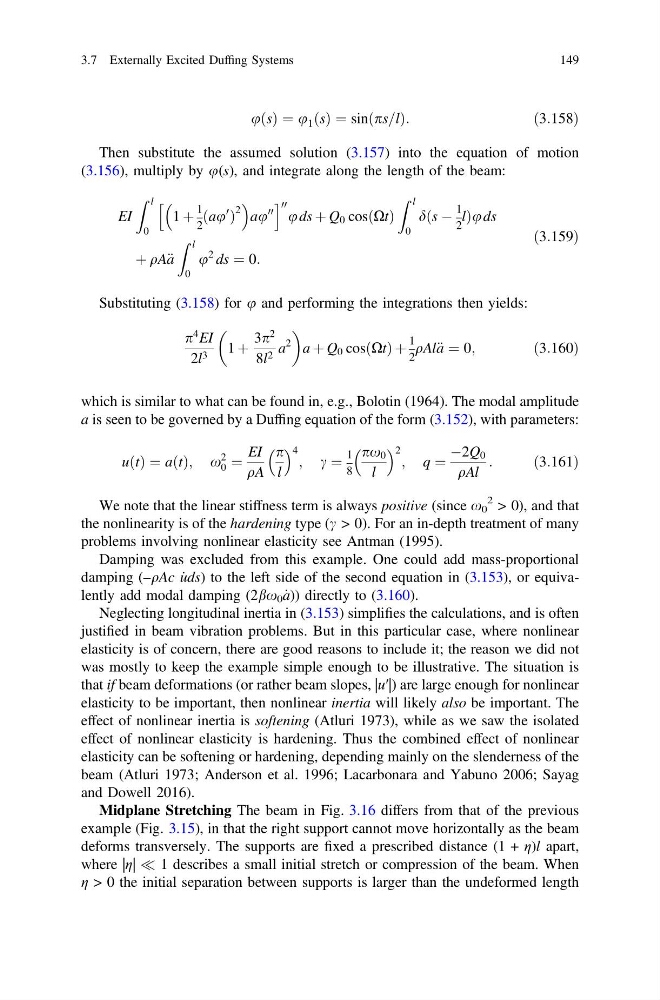
uðsÞ ¼ u 1 ðsÞ ¼ sinðps=lÞ:
ð3:158Þ
Then substitute the assumed solution (3.157) into the equation of motion
(3.156), multiply by u(s), and integrate along the length of the beam:
EI
Z l
0
1 þ
1
2
au
0
ð Þ
2
au
00
h
i 00
u ds þ Q 0 cosðXtÞ
Z l
0
dðs À
1
2
lÞu ds
þ qA€ a
Z l
0
u
2 ds ¼ 0:
ð3:159Þ
Substituting (3.158) for u and performing the integrations then yields:
p
4 EI
2l 3 1 þ
3p
2
8l 2 a
2
a þ Q 0 cosðXtÞ þ
1
2
qAl€ a ¼ 0;
ð3:160Þ
which is similar to what can be found in, e.g., Bolotin (1964). The modal amplitude
a is seen to be governed by a Duffing equation of the form (3.152), with parameters:
uðtÞ ¼ aðtÞ; x
2
0 ¼
EI
qA
p
l
4 ; c ¼
1
8
px 0
l
2 ; q ¼
À2Q 0
qAl
:
ð3:161Þ
We note that the linear stiffness term is always positive (since x 0
2 > 0), and that
the nonlinearity is of the hardening type (c > 0). For an in-depth treatment of many
problems involving nonlinear elasticity see Antman (1995).
Damping was excluded from this example. One could add mass-proportional
damping (–qAc _
uds) to the left side of the second equation in (3.153), or equivalently add modal damping (2bx 0 _
a)) directly to (3.160).
Neglecting longitudinal inertia in (3.153) simplifies the calculations, and is often
justified in beam vibration problems. But in this particular case, where nonlinear
elasticity is of concern, there are good reasons to include it; the reason we did not
was mostly to keep the example simple enough to be illustrative. The situation is
that if beam deformations (or rather beam slopes, |u′|) are large enough for nonlinear
elasticity to be important, then nonlinear inertia will likely also be important. The
effect of nonlinear inertia is softening (Atluri 1973), while as we saw the isolated
effect of nonlinear elasticity is hardening. Thus the combined effect of nonlinear
elasticity can be softening or hardening, depending mainly on the slenderness of the
beam (Atluri 1973; Anderson et al. 1996; Lacarbonara and Yabuno 2006; Sayag
and Dowell 2016).
Midplane Stretching The beam in Fig. 3.16 differs from that of the previous
example (Fig. 3.15), in that the right support cannot move horizontally as the beam
deforms transversely. The supports are fixed a prescribed distance (1 + η)l apart,
where |η| ( 1 describes a small initial stretch or compression of the beam. When
η > 0 the initial separation between supports is larger than the undeformed length
3.7 Externally Excited Duffing Systems
149
ð3:158Þ
Then substitute the assumed solution (3.157) into the equation of motion
(3.156), multiply by u(s), and integrate along the length of the beam:
EI
Z l
0
1 þ
1
2
au
0
ð Þ
2
au
00
h
i 00
u ds þ Q 0 cosðXtÞ
Z l
0
dðs À
1
2
lÞu ds
þ qA€ a
Z l
0
u
2 ds ¼ 0:
ð3:159Þ
Substituting (3.158) for u and performing the integrations then yields:
p
4 EI
2l 3 1 þ
3p
2
8l 2 a
2
a þ Q 0 cosðXtÞ þ
1
2
qAl€ a ¼ 0;
ð3:160Þ
which is similar to what can be found in, e.g., Bolotin (1964). The modal amplitude
a is seen to be governed by a Duffing equation of the form (3.152), with parameters:
uðtÞ ¼ aðtÞ; x
2
0 ¼
EI
qA
p
l
4 ; c ¼
1
8
px 0
l
2 ; q ¼
À2Q 0
qAl
:
ð3:161Þ
We note that the linear stiffness term is always positive (since x 0
2 > 0), and that
the nonlinearity is of the hardening type (c > 0). For an in-depth treatment of many
problems involving nonlinear elasticity see Antman (1995).
Damping was excluded from this example. One could add mass-proportional
damping (–qAc _
uds) to the left side of the second equation in (3.153), or equivalently add modal damping (2bx 0 _
a)) directly to (3.160).
Neglecting longitudinal inertia in (3.153) simplifies the calculations, and is often
justified in beam vibration problems. But in this particular case, where nonlinear
elasticity is of concern, there are good reasons to include it; the reason we did not
was mostly to keep the example simple enough to be illustrative. The situation is
that if beam deformations (or rather beam slopes, |u′|) are large enough for nonlinear
elasticity to be important, then nonlinear inertia will likely also be important. The
effect of nonlinear inertia is softening (Atluri 1973), while as we saw the isolated
effect of nonlinear elasticity is hardening. Thus the combined effect of nonlinear
elasticity can be softening or hardening, depending mainly on the slenderness of the
beam (Atluri 1973; Anderson et al. 1996; Lacarbonara and Yabuno 2006; Sayag
and Dowell 2016).
Midplane Stretching The beam in Fig. 3.16 differs from that of the previous
example (Fig. 3.15), in that the right support cannot move horizontally as the beam
deforms transversely. The supports are fixed a prescribed distance (1 + η)l apart,
where |η| ( 1 describes a small initial stretch or compression of the beam. When
η > 0 the initial separation between supports is larger than the undeformed length
3.7 Externally Excited Duffing Systems
149