

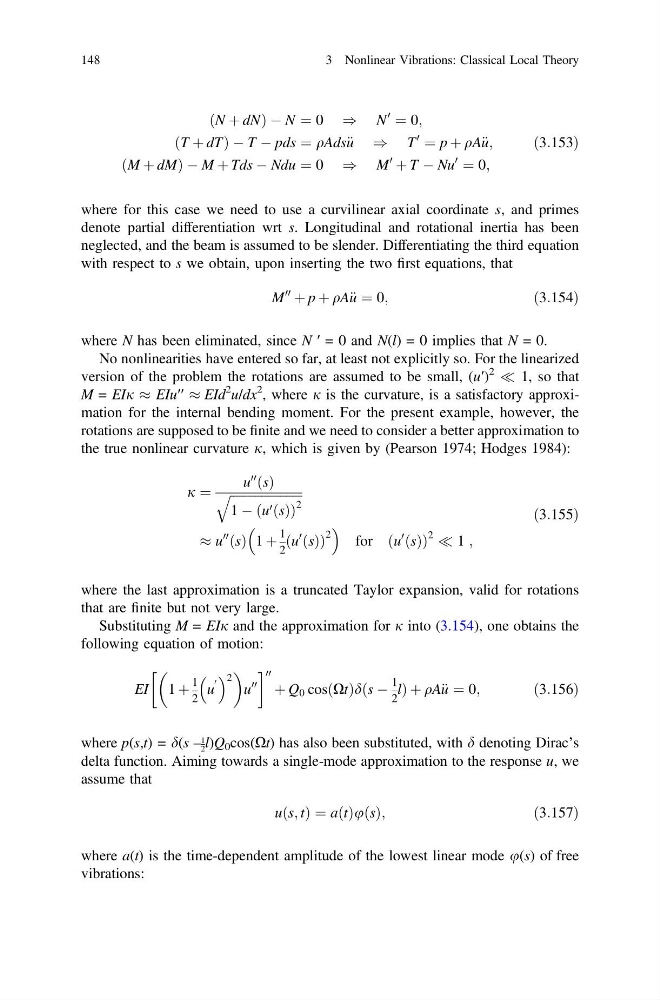
ðN þ dNÞ À N ¼ 0 ) N
0
¼ 0;
ðT þ dTÞ À T À pds ¼ qAds€ u ) T
0
¼ p þ qA€ u;
ðM þ dMÞ À M þ Tds À Ndu ¼ 0 ) M
0
þ T À Nu
0
¼ 0;
ð3:153Þ
where for this case we need to use a curvilinear axial coordinate s, and primes
denote partial differentiation wrt s. Longitudinal and rotational inertia has been
neglected, and the beam is assumed to be slender. Differentiating the third equation
with respect to s we obtain, upon inserting the two first equations, that
M
00
þ p þ qA€ u ¼ 0;
ð3:154Þ
where N has been eliminated, since N ′ = 0 and N(l) = 0 implies that N = 0.
No nonlinearities have entered so far, at least not explicitly so. For the linearized
version of the problem the rotations are assumed to be small, (u′)
2
( 1, so that
M = EIj % EIu′′ % EId
2 u/dx
2 , where j is the curvature, is a satisfactory approximation for the internal bending moment. For the present example, however, the
rotations are supposed to be finite and we need to consider a better approximation to
the true nonlinear curvature j, which is given by (Pearson 1974; Hodges 1984):
j ¼
u
00
ðsÞ
ffiffiffiffiffiffiffiffiffiffiffiffiffiffiffiffiffiffiffiffiffiffiffi
1 À u 0 ðsÞ
ð
Þ
2
q
% u
00
ðsÞ 1 þ
1
2
u
0
ðsÞ
ð
Þ
2
for ðu
0
ðsÞÞ
2 ( 1 ;
ð3:155Þ
where the last approximation is a truncated Taylor expansion, valid for rotations
that are finite but not very large.
Substituting M = EIj and the approximation for j into (3.154), one obtains the
following equation of motion:
EI 1 þ
1
2
u
0
2
u
00
! 00
þ Q 0 cosðXtÞdðs À
1
2
lÞ þ qA€ u ¼ 0;
ð3:156Þ
where p(s,t) = d(s –
1
2 l)Q 0 cos(Xt) has also been substituted, with d denoting Dirac’s
delta function. Aiming towards a single-mode approximation to the response u, we
assume that
uðs; tÞ ¼ aðtÞuðsÞ;
ð3:157Þ
where a(t) is the time-dependent amplitude of the lowest linear mode u(s) of free
vibrations:
148
3 Nonlinear Vibrations: Classical Local Theory
0
¼ 0;
ðT þ dTÞ À T À pds ¼ qAds€ u ) T
0
¼ p þ qA€ u;
ðM þ dMÞ À M þ Tds À Ndu ¼ 0 ) M
0
þ T À Nu
0
¼ 0;
ð3:153Þ
where for this case we need to use a curvilinear axial coordinate s, and primes
denote partial differentiation wrt s. Longitudinal and rotational inertia has been
neglected, and the beam is assumed to be slender. Differentiating the third equation
with respect to s we obtain, upon inserting the two first equations, that
M
00
þ p þ qA€ u ¼ 0;
ð3:154Þ
where N has been eliminated, since N ′ = 0 and N(l) = 0 implies that N = 0.
No nonlinearities have entered so far, at least not explicitly so. For the linearized
version of the problem the rotations are assumed to be small, (u′)
2
( 1, so that
M = EIj % EIu′′ % EId
2 u/dx
2 , where j is the curvature, is a satisfactory approximation for the internal bending moment. For the present example, however, the
rotations are supposed to be finite and we need to consider a better approximation to
the true nonlinear curvature j, which is given by (Pearson 1974; Hodges 1984):
j ¼
u
00
ðsÞ
ffiffiffiffiffiffiffiffiffiffiffiffiffiffiffiffiffiffiffiffiffiffiffi
1 À u 0 ðsÞ
ð
Þ
2
q
% u
00
ðsÞ 1 þ
1
2
u
0
ðsÞ
ð
Þ
2
for ðu
0
ðsÞÞ
2 ( 1 ;
ð3:155Þ
where the last approximation is a truncated Taylor expansion, valid for rotations
that are finite but not very large.
Substituting M = EIj and the approximation for j into (3.154), one obtains the
following equation of motion:
EI 1 þ
1
2
u
0
2
u
00
! 00
þ Q 0 cosðXtÞdðs À
1
2
lÞ þ qA€ u ¼ 0;
ð3:156Þ
where p(s,t) = d(s –
1
2 l)Q 0 cos(Xt) has also been substituted, with d denoting Dirac’s
delta function. Aiming towards a single-mode approximation to the response u, we
assume that
uðs; tÞ ¼ aðtÞuðsÞ;
ð3:157Þ
where a(t) is the time-dependent amplitude of the lowest linear mode u(s) of free
vibrations:
148
3 Nonlinear Vibrations: Classical Local Theory