

Brennan 2011). Dependent on the signs of x 0
2 and c there can be one or three static
equilibria, each of which can be stable or unstable. And dependent on the balance
between input forcing amplitude q, dissipation coefficient b, and the frequency ratio
X/x 0 , the response can be anything from simple mono-frequency harmonic oscillations, over nonlinearly distorted oscillations with multiple amplitudes possible, to
chaotic/random-like oscillations (see Chap. 6), and bursting oscillations (Rakaric
and Kovacic 2016). In this section we focus on oscillations that occur near the static
equilibria of (3.152), while chaotic solutions are considered in Chap. 6.
Comparing (3.152) to the equation of motion (3.107) for the pendulum, one sees
that they are similar except for the excitation term. For the pendulum the excitation
is parametric (multiplying a dependent variable), whereas for the Duffing system
the excitation is external (to the free system).
The analysis to follow will provide us with the opportunity to further exercise
the method of multiple scales, to enlighten the significance of ordering terms, and to
introduce the phenomena of superharmonic and subharmonic resonance. Nayfeh
and Mook (1979) and Kovacic and Brennan (2011) may be consulted for further
reference on Duffing systems.
To provide an opportunity for viewing results in the light of real systems, we
first present two physical models for which the Duffing system (3.152) apply.
3.7.1 Two Physical Examples
Both examples involve a hinged-hinged, transversely loaded beam.
In the first example, one support is allowed to move freely in the horizontal
direction. Considering large rotations, a problem of nonlinear elasticity arises, with
a nonlinear restoring force of the hardening type.
In the second example, the supports of the beam are separated a fixed horizontal
distance apart. Rotations are assumed to be small and the nonlinearity involved is
due to midplane stretching, causing a nonlinear restoring force of the hardening
type. In this example the linear stiffness parameter can be positive, negative or zero,
depending on whether the support-separation is larger than, less than, or equal to the
undeformed length of the beam.
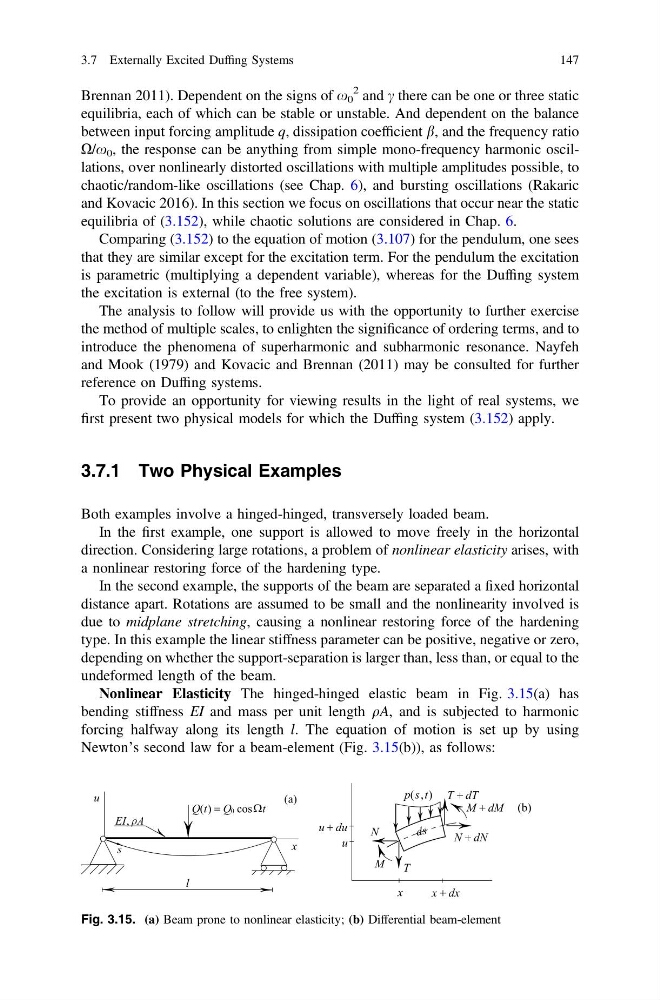
Nonlinear Elasticity The hinged-hinged elastic beam in Fig. 3.15(a) has
bending stiffness EI and mass per unit length qA, and is subjected to harmonic
forcing halfway along its length l. The equation of motion is set up by using
Newton’s second law for a beam-element (Fig. 3.15(b)), as follows:
Fig. 3.15. (a) Beam prone to nonlinear elasticity; (b) Differential beam-element
3.7 Externally Excited Duffing Systems
147
2 and c there can be one or three static
equilibria, each of which can be stable or unstable. And dependent on the balance
between input forcing amplitude q, dissipation coefficient b, and the frequency ratio
X/x 0 , the response can be anything from simple mono-frequency harmonic oscillations, over nonlinearly distorted oscillations with multiple amplitudes possible, to
chaotic/random-like oscillations (see Chap. 6), and bursting oscillations (Rakaric
and Kovacic 2016). In this section we focus on oscillations that occur near the static
equilibria of (3.152), while chaotic solutions are considered in Chap. 6.
Comparing (3.152) to the equation of motion (3.107) for the pendulum, one sees
that they are similar except for the excitation term. For the pendulum the excitation
is parametric (multiplying a dependent variable), whereas for the Duffing system
the excitation is external (to the free system).
The analysis to follow will provide us with the opportunity to further exercise
the method of multiple scales, to enlighten the significance of ordering terms, and to
introduce the phenomena of superharmonic and subharmonic resonance. Nayfeh
and Mook (1979) and Kovacic and Brennan (2011) may be consulted for further
reference on Duffing systems.
To provide an opportunity for viewing results in the light of real systems, we
first present two physical models for which the Duffing system (3.152) apply.
3.7.1 Two Physical Examples
Both examples involve a hinged-hinged, transversely loaded beam.
In the first example, one support is allowed to move freely in the horizontal
direction. Considering large rotations, a problem of nonlinear elasticity arises, with
a nonlinear restoring force of the hardening type.
In the second example, the supports of the beam are separated a fixed horizontal
distance apart. Rotations are assumed to be small and the nonlinearity involved is
due to midplane stretching, causing a nonlinear restoring force of the hardening
type. In this example the linear stiffness parameter can be positive, negative or zero,
depending on whether the support-separation is larger than, less than, or equal to the
undeformed length of the beam.
Nonlinear Elasticity The hinged-hinged elastic beam in Fig. 3.15(a) has
bending stiffness EI and mass per unit length qA, and is subjected to harmonic
forcing halfway along its length l. The equation of motion is set up by using
Newton’s second law for a beam-element (Fig. 3.15(b)), as follows:
Fig. 3.15. (a) Beam prone to nonlinear elasticity; (b) Differential beam-element
3.7 Externally Excited Duffing Systems
147