

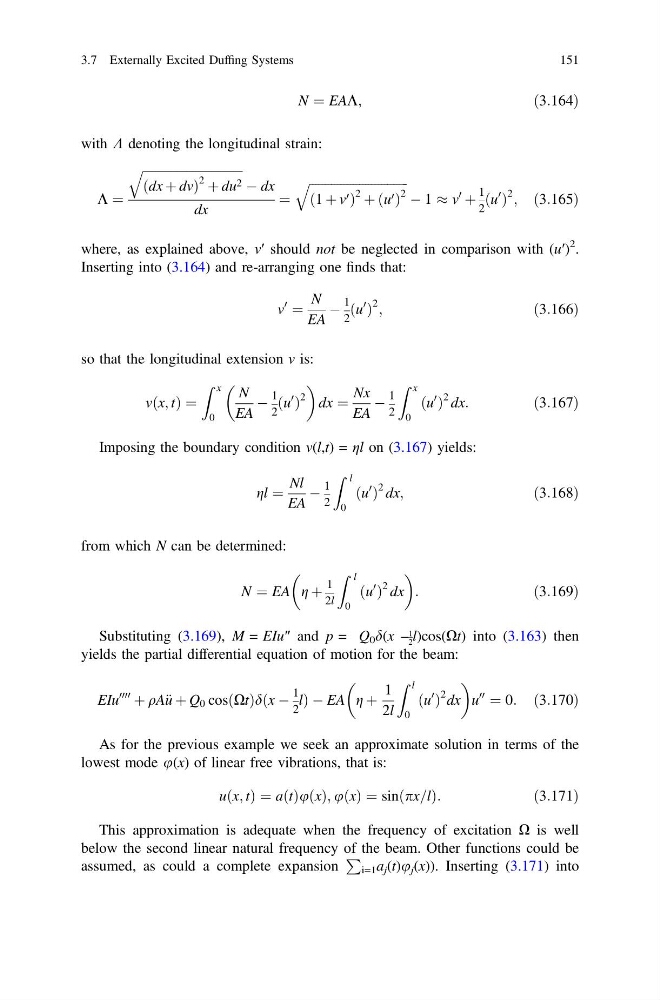
N ¼ EAK;
ð3:164Þ
with K denoting the longitudinal strain:
K ¼
ffiffiffiffiffiffiffiffiffiffiffiffiffiffiffiffiffiffiffiffiffiffiffiffiffiffiffiffiffiffiffiffi
ðdx þ dvÞ
2 þ du 2
q
À dx
dx
¼
ffiffiffiffiffiffiffiffiffiffiffiffiffiffiffiffiffiffiffiffiffiffiffiffiffiffiffiffiffiffiffi ffi
ð1 þ v 0 Þ
2 þ ðu 0 Þ
2
q
À 1 % v
0
þ
1
2
ðu
0
Þ
2 ; ð3:165Þ
where, as explained above, v′ should not be neglected in comparison with (u′)
2 .
Inserting into (3.164) and re-arranging one finds that:
v
0
¼
N
EA
À
1
2
ðu
0
Þ
2 ;
ð3:166Þ
so that the longitudinal extension v is:
vðx; tÞ ¼
Z x
0
N
EA
À
1
2
ðu
0
Þ
2
dx ¼
Nx
EA
À
1
2
Z x
0
ðu
0
Þ
2 dx:
ð3:167Þ
Imposing the boundary condition v(l,t) = ηl on (3.167) yields:
gl ¼
Nl
EA
À
1
2
Z l
0
ðu
0
Þ
2 dx;
ð3:168Þ
from which N can be determined:
N ¼ EA g þ
1
2l
Z l
0
ðu
0
Þ
2 dx
:
ð3:169Þ
Substituting (3.169), M = EIu″ and p = Q 0 d(x –
1
2 l)cos(Xt) into (3.163) then
yields the partial differential equation of motion for the beam:
EIu
0000
þ qA€ u þ Q 0 cosðXtÞdðx À
1
2
lÞ À EA g þ
1
2l
Z l
0
ðu
0
Þ
2 dx
u
00
¼ 0: ð3:170Þ
As for the previous example we seek an approximate solution in terms of the
lowest mode u(x) of linear free vibrations, that is:
uðx; tÞ ¼ aðtÞuðxÞ; uðxÞ ¼ sinðpx=lÞ:
ð3:171Þ
This approximation is adequate when the frequency of excitation X is well
below the second linear natural frequency of the beam. Other functions could be
assumed, as could a complete expansion
P
i=1 a j (t)u j (x)). Inserting (3.171) into
3.7 Externally Excited Duffing Systems
151
ð3:164Þ
with K denoting the longitudinal strain:
K ¼
ffiffiffiffiffiffiffiffiffiffiffiffiffiffiffiffiffiffiffiffiffiffiffiffiffiffiffiffiffiffiffiffi
ðdx þ dvÞ
2 þ du 2
q
À dx
dx
¼
ffiffiffiffiffiffiffiffiffiffiffiffiffiffiffiffiffiffiffiffiffiffiffiffiffiffiffiffiffiffiffi ffi
ð1 þ v 0 Þ
2 þ ðu 0 Þ
2
q
À 1 % v
0
þ
1
2
ðu
0
Þ
2 ; ð3:165Þ
where, as explained above, v′ should not be neglected in comparison with (u′)
2 .
Inserting into (3.164) and re-arranging one finds that:
v
0
¼
N
EA
À
1
2
ðu
0
Þ
2 ;
ð3:166Þ
so that the longitudinal extension v is:
vðx; tÞ ¼
Z x
0
N
EA
À
1
2
ðu
0
Þ
2
dx ¼
Nx
EA
À
1
2
Z x
0
ðu
0
Þ
2 dx:
ð3:167Þ
Imposing the boundary condition v(l,t) = ηl on (3.167) yields:
gl ¼
Nl
EA
À
1
2
Z l
0
ðu
0
Þ
2 dx;
ð3:168Þ
from which N can be determined:
N ¼ EA g þ
1
2l
Z l
0
ðu
0
Þ
2 dx
:
ð3:169Þ
Substituting (3.169), M = EIu″ and p = Q 0 d(x –
1
2 l)cos(Xt) into (3.163) then
yields the partial differential equation of motion for the beam:
EIu
0000
þ qA€ u þ Q 0 cosðXtÞdðx À
1
2
lÞ À EA g þ
1
2l
Z l
0
ðu
0
Þ
2 dx
u
00
¼ 0: ð3:170Þ
As for the previous example we seek an approximate solution in terms of the
lowest mode u(x) of linear free vibrations, that is:
uðx; tÞ ¼ aðtÞuðxÞ; uðxÞ ¼ sinðpx=lÞ:
ð3:171Þ
This approximation is adequate when the frequency of excitation X is well
below the second linear natural frequency of the beam. Other functions could be
assumed, as could a complete expansion
P
i=1 a j (t)u j (x)). Inserting (3.171) into
3.7 Externally Excited Duffing Systems
151