

hðsÞ ¼ h 0 ðT 0 ; T 1 Þ þ eh 1 ðT 0 ; T 1 Þ þ Oðe
2
Þ;
ð3:131Þ
where:
h 0 ¼ AðT 1 Þe
iT 0 þ
AðT 1 Þe
ÀiT 0
ðby ð3:113ÞÞ
¼
1
2
a e
iðT 0 þ uÞ
þ e
ÀiðT 0 þ uÞ
ðby ð3:117ÞÞ
¼ a cosðT 0 þ uÞ
¼ a cos T 0 þ
1
2
ðrT 1 À wÞ
ðby ð3:126ÞÞ
¼ a cos s þ
1
2
x À 2
e
es À w
ðby ð3:109; 3:120ÞÞ
¼ a cos
1
2
ðxs À wÞ
;
ð3:132Þ
and, by (3.124) and the same substitutions as above:
h 1 ¼
1
8
c A
3 e
i3T 0 þ
A
3 e
Ài3T 0
À
Á
À
1
16
qx
2 Ae
ið3T 0 þ rT 1 Þ
þ
Ae
Àið3T 0 þ rT 1 Þ
¼
1
32
ca
3 cos
3
2
ðxs À wÞ
À
1
16
qx
2 a cos
3
2
ðxs À
1
3
wÞ
:
ð3:133Þ
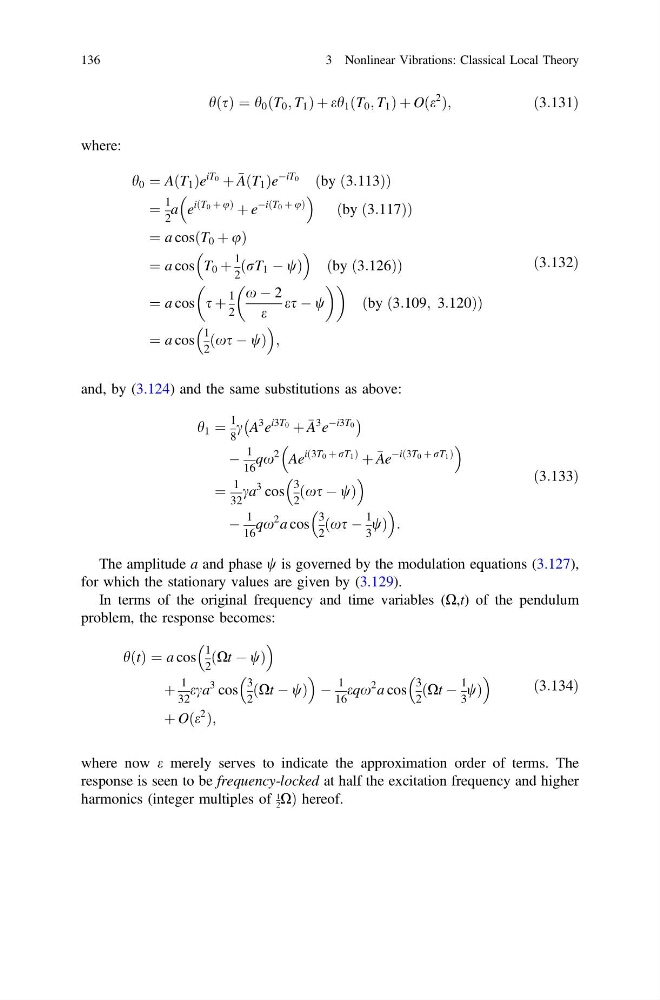
The amplitude a and phase w is governed by the modulation equations (3.127),
for which the stationary values are given by (3.129).
In terms of the original frequency and time variables (X,t) of the pendulum
problem, the response becomes:
hðtÞ ¼ a cos
1
2
ðXt À wÞ
þ
1
32
eca
3 cos
3
2
ðXt À wÞ
À
1
16
eqx
2 a cos
3
2
ðXt À
1
3
wÞ
þ Oðe
2
Þ;
ð3:134Þ
where now e merely serves to indicate the approximation order of terms. The
response is seen to be frequency-locked at half the excitation frequency and higher
harmonics (integer multiples of
1
2 XÞ hereof.
136
3 Nonlinear Vibrations: Classical Local Theory
2
Þ;
ð3:131Þ
where:
h 0 ¼ AðT 1 Þe
iT 0 þ
AðT 1 Þe
ÀiT 0
ðby ð3:113ÞÞ
¼
1
2
a e
iðT 0 þ uÞ
þ e
ÀiðT 0 þ uÞ
ðby ð3:117ÞÞ
¼ a cosðT 0 þ uÞ
¼ a cos T 0 þ
1
2
ðrT 1 À wÞ
ðby ð3:126ÞÞ
¼ a cos s þ
1
2
x À 2
e
es À w
ðby ð3:109; 3:120ÞÞ
¼ a cos
1
2
ðxs À wÞ
;
ð3:132Þ
and, by (3.124) and the same substitutions as above:
h 1 ¼
1
8
c A
3 e
i3T 0 þ
A
3 e
Ài3T 0
À
Á
À
1
16
qx
2 Ae
ið3T 0 þ rT 1 Þ
þ
Ae
Àið3T 0 þ rT 1 Þ
¼
1
32
ca
3 cos
3
2
ðxs À wÞ
À
1
16
qx
2 a cos
3
2
ðxs À
1
3
wÞ
:
ð3:133Þ
The amplitude a and phase w is governed by the modulation equations (3.127),
for which the stationary values are given by (3.129).
In terms of the original frequency and time variables (X,t) of the pendulum
problem, the response becomes:
hðtÞ ¼ a cos
1
2
ðXt À wÞ
þ
1
32
eca
3 cos
3
2
ðXt À wÞ
À
1
16
eqx
2 a cos
3
2
ðXt À
1
3
wÞ
þ Oðe
2
Þ;
ð3:134Þ
where now e merely serves to indicate the approximation order of terms. The
response is seen to be frequency-locked at half the excitation frequency and higher
harmonics (integer multiples of
1
2 XÞ hereof.
136
3 Nonlinear Vibrations: Classical Local Theory