

Comparing this harmonic balance result to the multiple scales solution (3.80)
and to the method of averaging solution (3.94) (where a 0 plays the role of A 1 ), we
note that the three methods agree to the lowest order of approximation.
From the above example it may seem that the method of harmonic balance
involves considerably less algebra than the methods of multiple scales and averaging. However, this is the case only because the assumed harmonic series captures
the essential features of the true solution. If nothing was known about the true
solution, then a large number of terms had to be included and the resulting number
of algebraic manipulations would quickly outperform those required for the multiple scales method.
The method of harmonic balance, by contrast to perturbation methods, does not
assume weak nonlinearity, and may thus work even with strongly nonlinear terms.
Mickens (1984) discussed the conditions under which harmonic balance could be
used with good results, and recommended it mainly for strongly nonlinear problems; for weakly nonlinear problems perturbation methods (like the method of
multiple scales and the method of averaging) should be preferred. More recently
variants of the method of harmonic balance have been suggested for improving its
efficiency and accuracy (Wu et al. 2018; Zhou et al. 2020; Sorokin et al. 2015b).
3.6 The Forced Response – Multiple Scales Analysis
3.6.1 Posing the Problem
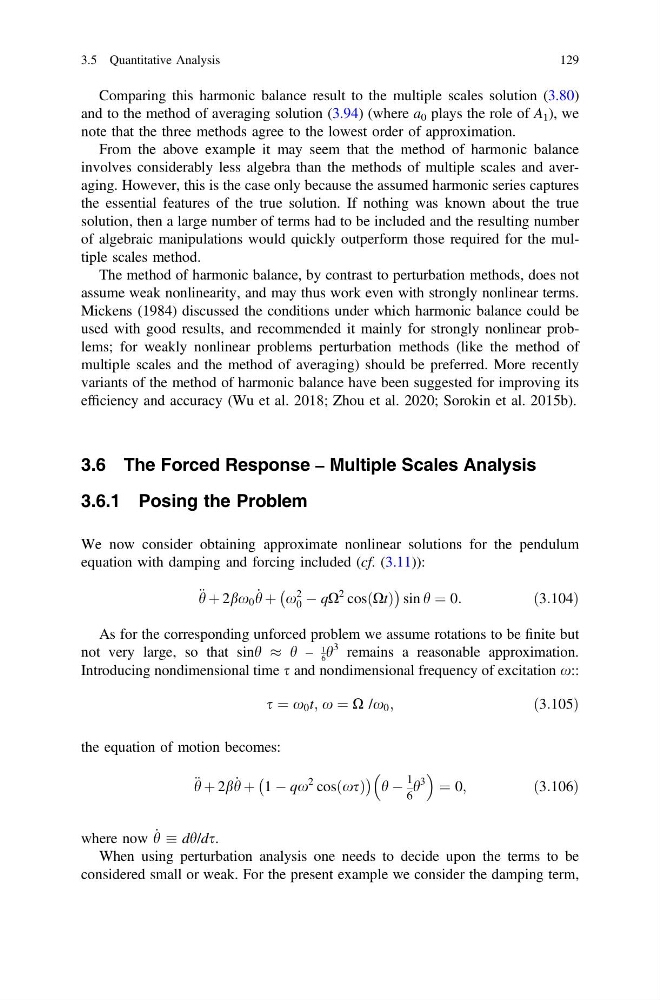
We now consider obtaining approximate nonlinear solutions for the pendulum
equation with damping and forcing included (cf. (3.11)):
€ h þ 2bx 0 _
h þ x
2
0 À qX
2 cosðXtÞ
À
Á
sin h ¼ 0:
ð3:104Þ
As for the corresponding unforced problem we assume rotations to be finite but
not very large, so that sinh % h –
1
6 h
3 remains a reasonable approximation.
Introducing nondimensional time s and nondimensional frequency of excitation x::
s ¼ x 0 t; x ¼ X /x 0 ;
ð3:105Þ
the equation of motion becomes:
€ h þ 2b _
h þ 1 À qx
2 cosðxsÞ
À
Á
h À
1
6
h
3
¼ 0;
ð3:106Þ
where now _
h dh/ds.
When using perturbation analysis one needs to decide upon the terms to be
considered small or weak. For the present example we consider the damping term,
3.5 Quantitative Analysis
129
and to the method of averaging solution (3.94) (where a 0 plays the role of A 1 ), we
note that the three methods agree to the lowest order of approximation.
From the above example it may seem that the method of harmonic balance
involves considerably less algebra than the methods of multiple scales and averaging. However, this is the case only because the assumed harmonic series captures
the essential features of the true solution. If nothing was known about the true
solution, then a large number of terms had to be included and the resulting number
of algebraic manipulations would quickly outperform those required for the multiple scales method.
The method of harmonic balance, by contrast to perturbation methods, does not
assume weak nonlinearity, and may thus work even with strongly nonlinear terms.
Mickens (1984) discussed the conditions under which harmonic balance could be
used with good results, and recommended it mainly for strongly nonlinear problems; for weakly nonlinear problems perturbation methods (like the method of
multiple scales and the method of averaging) should be preferred. More recently
variants of the method of harmonic balance have been suggested for improving its
efficiency and accuracy (Wu et al. 2018; Zhou et al. 2020; Sorokin et al. 2015b).
3.6 The Forced Response – Multiple Scales Analysis
3.6.1 Posing the Problem
We now consider obtaining approximate nonlinear solutions for the pendulum
equation with damping and forcing included (cf. (3.11)):
€ h þ 2bx 0 _
h þ x
2
0 À qX
2 cosðXtÞ
À
Á
sin h ¼ 0:
ð3:104Þ
As for the corresponding unforced problem we assume rotations to be finite but
not very large, so that sinh % h –
1
6 h
3 remains a reasonable approximation.
Introducing nondimensional time s and nondimensional frequency of excitation x::
s ¼ x 0 t; x ¼ X /x 0 ;
ð3:105Þ
the equation of motion becomes:
€ h þ 2b _
h þ 1 À qx
2 cosðxsÞ
À
Á
h À
1
6
h
3
¼ 0;
ð3:106Þ
where now _
h dh/ds.
When using perturbation analysis one needs to decide upon the terms to be
considered small or weak. For the present example we consider the damping term,
3.5 Quantitative Analysis
129