

Note that no approximations have yet been introduced. Equations (3.90) with
(3.85) simply restate the original equation of motion (3.83) in the form of two
first-order equations, with a and u as the dependent variables instead of h.
We now come to the approximations. From (3.90) it appears that _
a and _
u are
small quantities, since e ( 1. This implies that the variables a and u change much
more slowly with s than does w = s + u. Thus a and u will hardly change during
one period of oscillation, from w = 2p j to w = 2p (j + 1), j = 0, 1, …. The
approximation involved in Krylov–Bogoliubov averaging, then, is to replace the
equations for _
a and _
u with their average values during one period of oscillation. In
other words: for determining the slow variations of a and u, the rapid variations in
w-terms can be neglected for a first approximation.
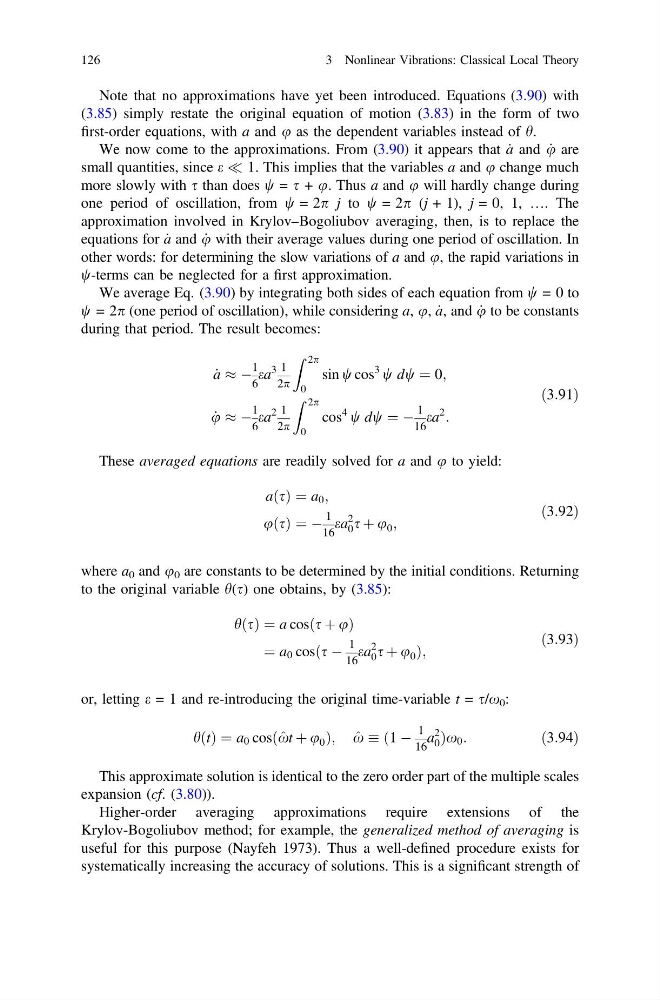
We average Eq. (3.90) by integrating both sides of each equation from w = 0 to
w = 2p (one period of oscillation), while considering a, u, _
a, and _
u to be constants
during that period. The result becomes:
_
a % À
1
6
ea
3 1
2p
Z 2p
0
sin w cos
3 w dw ¼ 0;
_
u % À
1
6
ea
2 1
2p
Z 2p
0
cos
4 w dw ¼ À
1
16
ea
2
:
ð3:91Þ
These averaged equations are readily solved for a and u to yield:
aðsÞ ¼ a 0 ;
uðsÞ ¼ À
1
16
ea
2
0 s þ u 0 ;
ð3:92Þ
where a 0 and u 0 are constants to be determined by the initial conditions. Returning
to the original variable h(s) one obtains, by (3.85):
hðsÞ ¼ a cosðs þ uÞ
¼ a 0 cosðs À
1
16
ea
2
0 s þ u 0 Þ;
ð3:93Þ
or, letting e = 1 and re-introducing the original time-variable t = s/x 0 :
hðtÞ ¼ a 0 cosð ^
xt þ u 0 Þ; ^
x ð1 À
1
16
a
2
0 Þx 0 :
ð3:94Þ
This approximate solution is identical to the zero order part of the multiple scales
expansion (cf. (3.80)).
Higher-order averaging approximations require extensions of the
Krylov-Bogoliubov method; for example, the generalized method of averaging is
useful for this purpose (Nayfeh 1973). Thus a well-defined procedure exists for
systematically increasing the accuracy of solutions. This is a significant strength of
126
3 Nonlinear Vibrations: Classical Local Theory
(3.85) simply restate the original equation of motion (3.83) in the form of two
first-order equations, with a and u as the dependent variables instead of h.
We now come to the approximations. From (3.90) it appears that _
a and _
u are
small quantities, since e ( 1. This implies that the variables a and u change much
more slowly with s than does w = s + u. Thus a and u will hardly change during
one period of oscillation, from w = 2p j to w = 2p (j + 1), j = 0, 1, …. The
approximation involved in Krylov–Bogoliubov averaging, then, is to replace the
equations for _
a and _
u with their average values during one period of oscillation. In
other words: for determining the slow variations of a and u, the rapid variations in
w-terms can be neglected for a first approximation.
We average Eq. (3.90) by integrating both sides of each equation from w = 0 to
w = 2p (one period of oscillation), while considering a, u, _
a, and _
u to be constants
during that period. The result becomes:
_
a % À
1
6
ea
3 1
2p
Z 2p
0
sin w cos
3 w dw ¼ 0;
_
u % À
1
6
ea
2 1
2p
Z 2p
0
cos
4 w dw ¼ À
1
16
ea
2
:
ð3:91Þ
These averaged equations are readily solved for a and u to yield:
aðsÞ ¼ a 0 ;
uðsÞ ¼ À
1
16
ea
2
0 s þ u 0 ;
ð3:92Þ
where a 0 and u 0 are constants to be determined by the initial conditions. Returning
to the original variable h(s) one obtains, by (3.85):
hðsÞ ¼ a cosðs þ uÞ
¼ a 0 cosðs À
1
16
ea
2
0 s þ u 0 Þ;
ð3:93Þ
or, letting e = 1 and re-introducing the original time-variable t = s/x 0 :
hðtÞ ¼ a 0 cosð ^
xt þ u 0 Þ; ^
x ð1 À
1
16
a
2
0 Þx 0 :
ð3:94Þ
This approximate solution is identical to the zero order part of the multiple scales
expansion (cf. (3.80)).
Higher-order averaging approximations require extensions of the
Krylov-Bogoliubov method; for example, the generalized method of averaging is
useful for this purpose (Nayfeh 1973). Thus a well-defined procedure exists for
systematically increasing the accuracy of solutions. This is a significant strength of
126
3 Nonlinear Vibrations: Classical Local Theory