

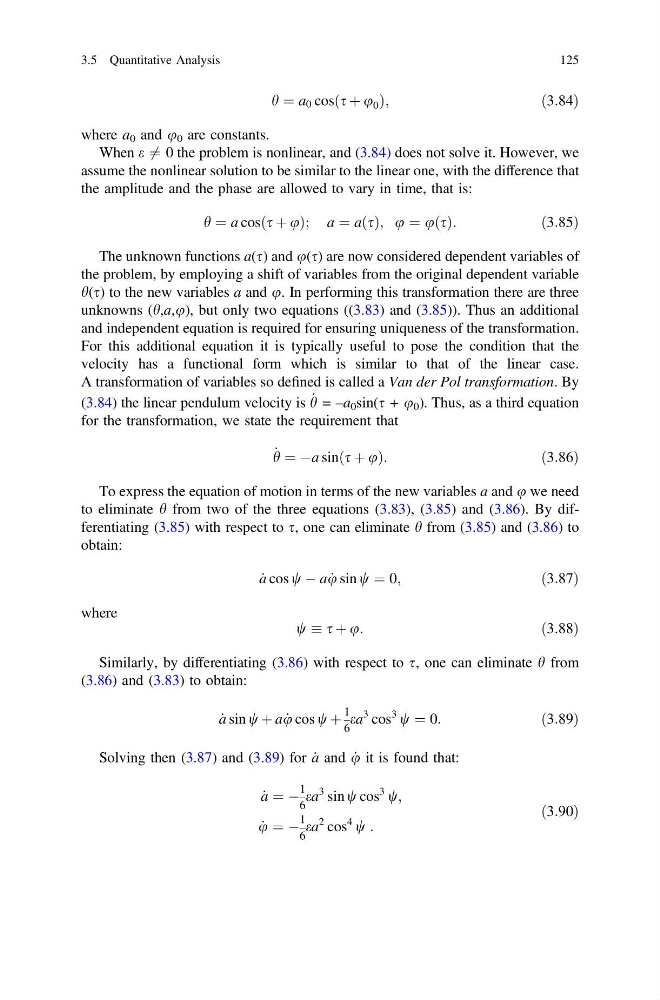
h ¼ a 0 cosðs þ u 0 Þ;
ð3:84Þ
where a 0 and u 0 are constants.
When e 6 ¼ 0 the problem is nonlinear, and (3.84) does not solve it. However, we
assume the nonlinear solution to be similar to the linear one, with the difference that
the amplitude and the phase are allowed to vary in time, that is:
h ¼ a cosðs þ uÞ; a ¼ aðsÞ; u ¼ uðsÞ:
ð3:85Þ
The unknown functions a(s) and u(s) are now considered dependent variables of
the problem, by employing a shift of variables from the original dependent variable
h(s) to the new variables a and u. In performing this transformation there are three
unknowns (h,a,u), but only two equations ((3.83) and (3.85)). Thus an additional
and independent equation is required for ensuring uniqueness of the transformation.
For this additional equation it is typically useful to pose the condition that the
velocity has a functional form which is similar to that of the linear case.
A transformation of variables so defined is called a Van der Pol transformation. By
(3.84) the linear pendulum velocity is _
h = –a 0 sin(s + u 0 ). Thus, as a third equation
for the transformation, we state the requirement that
_
h ¼ Àa sinðs þ uÞ:
ð3:86Þ
To express the equation of motion in terms of the new variables a and u we need
to eliminate h from two of the three equations (3.83), (3.85) and (3.86). By differentiating (3.85) with respect to s, one can eliminate h from (3.85) and (3.86) to
obtain:
_
a cos w À a _
u sin w ¼ 0;
ð3:87Þ
where
w s þ u:
ð3:88Þ
Similarly, by differentiating (3.86) with respect to s, one can eliminate h from
(3.86) and (3.83) to obtain:
_
a sin w þ a _
u cos w þ
1
6
ea
3 cos
3 w ¼ 0:
ð3:89Þ
Solving then (3.87) and (3.89) for _
a and _
u it is found that:
_
a ¼ À
1
6
ea
3 sin w cos
3 w;
_
u ¼ À
1
6
ea
2 cos
4 w :
ð3:90Þ
3.5 Quantitative Analysis
125
ð3:84Þ
where a 0 and u 0 are constants.
When e 6 ¼ 0 the problem is nonlinear, and (3.84) does not solve it. However, we
assume the nonlinear solution to be similar to the linear one, with the difference that
the amplitude and the phase are allowed to vary in time, that is:
h ¼ a cosðs þ uÞ; a ¼ aðsÞ; u ¼ uðsÞ:
ð3:85Þ
The unknown functions a(s) and u(s) are now considered dependent variables of
the problem, by employing a shift of variables from the original dependent variable
h(s) to the new variables a and u. In performing this transformation there are three
unknowns (h,a,u), but only two equations ((3.83) and (3.85)). Thus an additional
and independent equation is required for ensuring uniqueness of the transformation.
For this additional equation it is typically useful to pose the condition that the
velocity has a functional form which is similar to that of the linear case.
A transformation of variables so defined is called a Van der Pol transformation. By
(3.84) the linear pendulum velocity is _
h = –a 0 sin(s + u 0 ). Thus, as a third equation
for the transformation, we state the requirement that
_
h ¼ Àa sinðs þ uÞ:
ð3:86Þ
To express the equation of motion in terms of the new variables a and u we need
to eliminate h from two of the three equations (3.83), (3.85) and (3.86). By differentiating (3.85) with respect to s, one can eliminate h from (3.85) and (3.86) to
obtain:
_
a cos w À a _
u sin w ¼ 0;
ð3:87Þ
where
w s þ u:
ð3:88Þ
Similarly, by differentiating (3.86) with respect to s, one can eliminate h from
(3.86) and (3.83) to obtain:
_
a sin w þ a _
u cos w þ
1
6
ea
3 cos
3 w ¼ 0:
ð3:89Þ
Solving then (3.87) and (3.89) for _
a and _
u it is found that:
_
a ¼ À
1
6
ea
3 sin w cos
3 w;
_
u ¼ À
1
6
ea
2 cos
4 w :
ð3:90Þ
3.5 Quantitative Analysis
125