

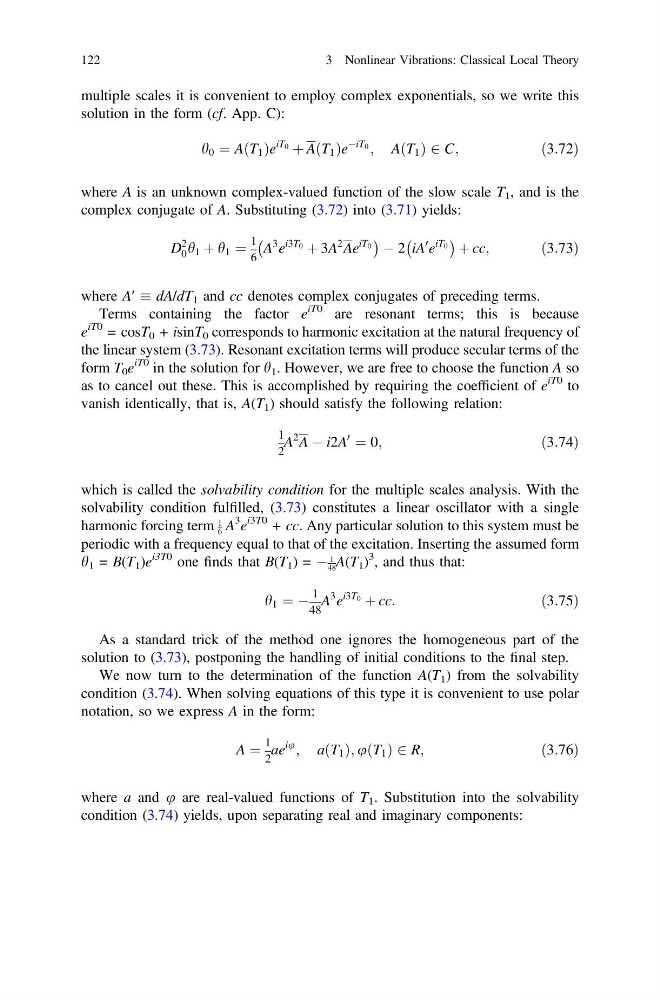
multiple scales it is convenient to employ complex exponentials, so we write this
solution in the form (cf. App. C):
h 0 ¼ AðT 1 Þe
iT 0 þ AðT 1 Þe
ÀiT 0 ; AðT 1 Þ 2 C;
ð3:72Þ
where A is an unknown complex-valued function of the slow scale T 1 , and is the
complex conjugate of A. Substituting (3.72) into (3.71) yields:
D
2
0 h 1 þ h 1 ¼
1
6
A
3 e
i3T 0 þ 3A
2 Ae
iT 0
À
Á À 2 iA
0 e
iT 0
À
Á þ cc;
ð3:73Þ
where A′ dA/dT 1 and cc denotes complex conjugates of preceding terms.
Terms containing the factor e
iT0 are resonant terms; this is because
e
iT0 = cosT 0 + isinT 0 corresponds to harmonic excitation at the natural frequency of
the linear system (3.73). Resonant excitation terms will produce secular terms of the
form T 0 e
iT0 in the solution for h 1 . However, we are free to choose the function A so
as to cancel out these. This is accomplished by requiring the coefficient of e
iT0 to
vanish identically, that is, A(T 1 ) should satisfy the following relation:
1
2
A
2 A À i2A
0
¼ 0;
ð3:74Þ
which is called the solvability condition for the multiple scales analysis. With the
solvability condition fulfilled, (3.73) constitutes a linear oscillator with a single
harmonic forcing term
1
6 A
3 e
i3T0 + cc. Any particular solution to this system must be
periodic with a frequency equal to that of the excitation. Inserting the assumed form
h 1 = B(T 1 )e
i3T0 one finds that B(T 1 ) = À
1
48 A(T 1 )
3 , and thus that:
h 1 ¼ À
1
48
A
3 e
i3T 0 þ cc:
ð3:75Þ
As a standard trick of the method one ignores the homogeneous part of the
solution to (3.73), postponing the handling of initial conditions to the final step.
We now turn to the determination of the function A(T 1 ) from the solvability
condition (3.74). When solving equations of this type it is convenient to use polar
notation, so we express A in the form:
A ¼
1
2
ae
iu
; aðT 1 Þ; uðT 1 Þ 2 R;
ð3:76Þ
where a and u are real-valued functions of T 1 . Substitution into the solvability
condition (3.74) yields, upon separating real and imaginary components:
122
3 Nonlinear Vibrations: Classical Local Theory
solution in the form (cf. App. C):
h 0 ¼ AðT 1 Þe
iT 0 þ AðT 1 Þe
ÀiT 0 ; AðT 1 Þ 2 C;
ð3:72Þ
where A is an unknown complex-valued function of the slow scale T 1 , and is the
complex conjugate of A. Substituting (3.72) into (3.71) yields:
D
2
0 h 1 þ h 1 ¼
1
6
A
3 e
i3T 0 þ 3A
2 Ae
iT 0
À
Á À 2 iA
0 e
iT 0
À
Á þ cc;
ð3:73Þ
where A′ dA/dT 1 and cc denotes complex conjugates of preceding terms.
Terms containing the factor e
iT0 are resonant terms; this is because
e
iT0 = cosT 0 + isinT 0 corresponds to harmonic excitation at the natural frequency of
the linear system (3.73). Resonant excitation terms will produce secular terms of the
form T 0 e
iT0 in the solution for h 1 . However, we are free to choose the function A so
as to cancel out these. This is accomplished by requiring the coefficient of e
iT0 to
vanish identically, that is, A(T 1 ) should satisfy the following relation:
1
2
A
2 A À i2A
0
¼ 0;
ð3:74Þ
which is called the solvability condition for the multiple scales analysis. With the
solvability condition fulfilled, (3.73) constitutes a linear oscillator with a single
harmonic forcing term
1
6 A
3 e
i3T0 + cc. Any particular solution to this system must be
periodic with a frequency equal to that of the excitation. Inserting the assumed form
h 1 = B(T 1 )e
i3T0 one finds that B(T 1 ) = À
1
48 A(T 1 )
3 , and thus that:
h 1 ¼ À
1
48
A
3 e
i3T 0 þ cc:
ð3:75Þ
As a standard trick of the method one ignores the homogeneous part of the
solution to (3.73), postponing the handling of initial conditions to the final step.
We now turn to the determination of the function A(T 1 ) from the solvability
condition (3.74). When solving equations of this type it is convenient to use polar
notation, so we express A in the form:
A ¼
1
2
ae
iu
; aðT 1 Þ; uðT 1 Þ 2 R;
ð3:76Þ
where a and u are real-valued functions of T 1 . Substitution into the solvability
condition (3.74) yields, upon separating real and imaginary components:
122
3 Nonlinear Vibrations: Classical Local Theory