

omitted in the final results (i.e. put to unity) – or could be kept, so as to indicate the
order of approximation involved.
3.5.3 The Straightforward Expansion
This simplest and most obvious approach, unfortunately, does not produce useful
solutions. It is included here merely to illustrate the fundamental principle of
applying perturbations, and to show why more workable perturbation methods are
necessarily more involved.
We seek a solution h(s) to the nonlinear system (3.54) that is valid for small but
finite amplitudes. By a straightforward expansion we assume the solution to be
expandable in a series as follows, in terms of the small parameter e:
hðs; eÞ ¼ h 0 ðsÞ þ eh 1 ðsÞ þ e
2 h 2 ðsÞ þ Á Á Á ;
ð3:55Þ
where h j (s), j = 1,2,… are unknown functions to be determined, and the terms form
a sequence decreasing in magnitude, i.e. |e
j h j (s)| > |e
j+1 h j+1 (s)| for j = 0,1,…. The
expansion should be uniformly valid, that is, it should hold for all s > 0.
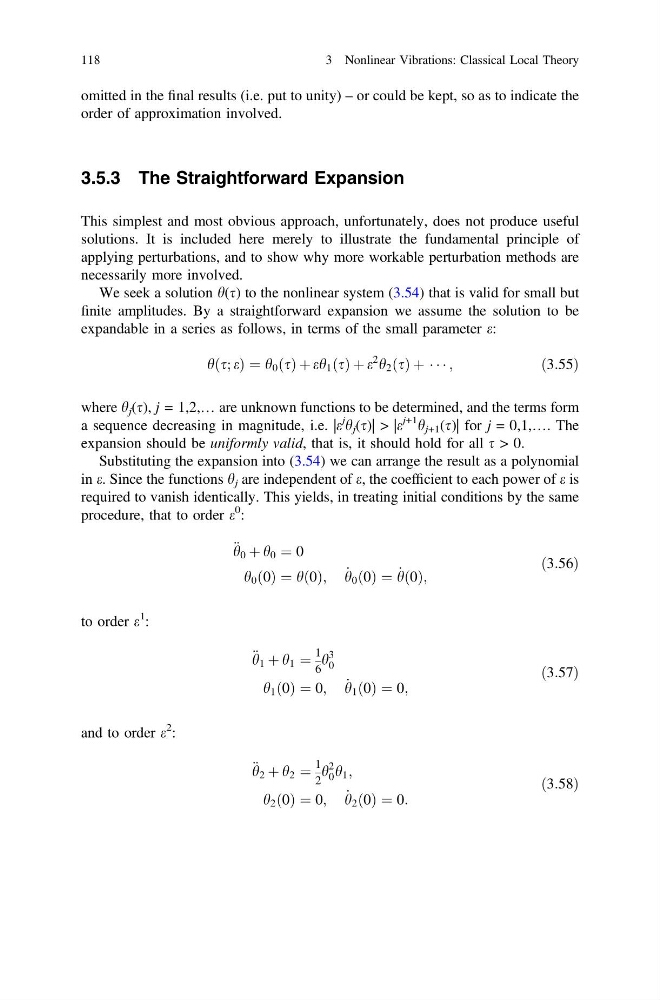
Substituting the expansion into (3.54) we can arrange the result as a polynomial
in e. Since the functions h j are independent of e, the coefficient to each power of e is
required to vanish identically. This yields, in treating initial conditions by the same
procedure, that to order e
0 :
€ h 0 þ h 0 ¼ 0
h 0 ð0Þ ¼ hð0Þ; _
h 0 ð0Þ ¼ _
hð0Þ;
ð3:56Þ
to order e
1
:
€ h 1 þ h 1 ¼
1
6
h
3
0
h 1 ð0Þ ¼ 0; _
h 1 ð0Þ ¼ 0;
ð3:57Þ
and to order e
2 :
€ h 2 þ h 2 ¼
1
2
h
2
0 h 1 ;
h 2 ð0Þ ¼ 0; _
h 2 ð0Þ ¼ 0:
ð3:58Þ
118
3 Nonlinear Vibrations: Classical Local Theory
order of approximation involved.
3.5.3 The Straightforward Expansion
This simplest and most obvious approach, unfortunately, does not produce useful
solutions. It is included here merely to illustrate the fundamental principle of
applying perturbations, and to show why more workable perturbation methods are
necessarily more involved.
We seek a solution h(s) to the nonlinear system (3.54) that is valid for small but
finite amplitudes. By a straightforward expansion we assume the solution to be
expandable in a series as follows, in terms of the small parameter e:
hðs; eÞ ¼ h 0 ðsÞ þ eh 1 ðsÞ þ e
2 h 2 ðsÞ þ Á Á Á ;
ð3:55Þ
where h j (s), j = 1,2,… are unknown functions to be determined, and the terms form
a sequence decreasing in magnitude, i.e. |e
j h j (s)| > |e
j+1 h j+1 (s)| for j = 0,1,…. The
expansion should be uniformly valid, that is, it should hold for all s > 0.
Substituting the expansion into (3.54) we can arrange the result as a polynomial
in e. Since the functions h j are independent of e, the coefficient to each power of e is
required to vanish identically. This yields, in treating initial conditions by the same
procedure, that to order e
0 :
€ h 0 þ h 0 ¼ 0
h 0 ð0Þ ¼ hð0Þ; _
h 0 ð0Þ ¼ _
hð0Þ;
ð3:56Þ
to order e
1
:
€ h 1 þ h 1 ¼
1
6
h
3
0
h 1 ð0Þ ¼ 0; _
h 1 ð0Þ ¼ 0;
ð3:57Þ
and to order e
2 :
€ h 2 þ h 2 ¼
1
2
h
2
0 h 1 ;
h 2 ð0Þ ¼ 0; _
h 2 ð0Þ ¼ 0:
ð3:58Þ
118
3 Nonlinear Vibrations: Classical Local Theory