

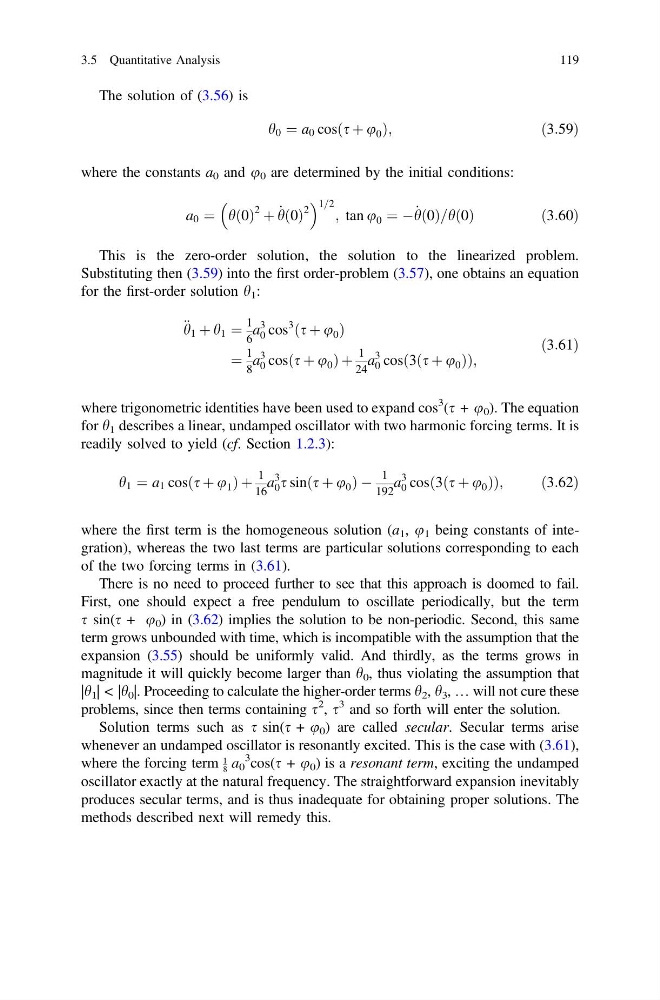
The solution of (3.56) is
h 0 ¼ a 0 cosðs þ u 0 Þ;
ð3:59Þ
where the constants a 0 and u 0 are determined by the initial conditions:
a 0 ¼ hð0Þ
2 þ _
hð0Þ
2
1=2 ; tan u 0 ¼ À _
hð0Þ=hð0Þ
ð 3:60Þ
This is the zero-order solution, the solution to the linearized problem.
Substituting then (3.59) into the first order-problem (3.57), one obtains an equation
for the first-order solution h 1 :
€ h 1 þ h 1 ¼
1
6
a
3
0 cos
3
ðs þ u 0 Þ
¼
1
8
a
3
0 cosðs þ u 0 Þ þ
1
24
a
3
0 cos 3ðs þ u 0 Þ
ð
Þ ;
ð3:61Þ
where trigonometric identities have been used to expand cos
3 (s + u 0 ). The equation
for h 1 describes a linear, undamped oscillator with two harmonic forcing terms. It is
readily solved to yield (cf. Section 1.2.3):
h 1 ¼ a 1 cosðs þ u 1 Þ þ
1
16
a
3
0 s sinðs þ u 0 Þ À
1
192
a
3
0 cos 3ðs þ u 0 Þ
ð
Þ ;
ð3:62Þ
where the first term is the homogeneous solution (a 1 , u 1 being constants of integration), whereas the two last terms are particular solutions corresponding to each
of the two forcing terms in (3.61).
There is no need to proceed further to see that this approach is doomed to fail.
First, one should expect a free pendulum to oscillate periodically, but the term
s sin(s + u 0 ) in (3.62) implies the solution to be non-periodic. Second, this same
term grows unbounded with time, which is incompatible with the assumption that the
expansion (3.55) should be uniformly valid. And thirdly, as the terms grows in
magnitude it will quickly become larger than h 0 , thus violating the assumption that
|h 1 | < |h 0 |. Proceeding to calculate the higher-order terms h 2 , h 3 , … will not cure these
problems, since then terms containing s
2
, s
3 and so forth will enter the solution.
Solution terms such as s sin(s + u 0 ) are called secular. Secular terms arise
whenever an undamped oscillator is resonantly excited. This is the case with (3.61),
where the forcing term
1
8 a 0
3 cos(s + u 0 ) is a resonant term, exciting the undamped
oscillator exactly at the natural frequency. The straightforward expansion inevitably
produces secular terms, and is thus inadequate for obtaining proper solutions. The
methods described next will remedy this.
3.5 Quantitative Analysis
119
h 0 ¼ a 0 cosðs þ u 0 Þ;
ð3:59Þ
where the constants a 0 and u 0 are determined by the initial conditions:
a 0 ¼ hð0Þ
2 þ _
hð0Þ
2
1=2 ; tan u 0 ¼ À _
hð0Þ=hð0Þ
ð 3:60Þ
This is the zero-order solution, the solution to the linearized problem.
Substituting then (3.59) into the first order-problem (3.57), one obtains an equation
for the first-order solution h 1 :
€ h 1 þ h 1 ¼
1
6
a
3
0 cos
3
ðs þ u 0 Þ
¼
1
8
a
3
0 cosðs þ u 0 Þ þ
1
24
a
3
0 cos 3ðs þ u 0 Þ
ð
Þ ;
ð3:61Þ
where trigonometric identities have been used to expand cos
3 (s + u 0 ). The equation
for h 1 describes a linear, undamped oscillator with two harmonic forcing terms. It is
readily solved to yield (cf. Section 1.2.3):
h 1 ¼ a 1 cosðs þ u 1 Þ þ
1
16
a
3
0 s sinðs þ u 0 Þ À
1
192
a
3
0 cos 3ðs þ u 0 Þ
ð
Þ ;
ð3:62Þ
where the first term is the homogeneous solution (a 1 , u 1 being constants of integration), whereas the two last terms are particular solutions corresponding to each
of the two forcing terms in (3.61).
There is no need to proceed further to see that this approach is doomed to fail.
First, one should expect a free pendulum to oscillate periodically, but the term
s sin(s + u 0 ) in (3.62) implies the solution to be non-periodic. Second, this same
term grows unbounded with time, which is incompatible with the assumption that the
expansion (3.55) should be uniformly valid. And thirdly, as the terms grows in
magnitude it will quickly become larger than h 0 , thus violating the assumption that
|h 1 | < |h 0 |. Proceeding to calculate the higher-order terms h 2 , h 3 , … will not cure these
problems, since then terms containing s
2
, s
3 and so forth will enter the solution.
Solution terms such as s sin(s + u 0 ) are called secular. Secular terms arise
whenever an undamped oscillator is resonantly excited. This is the case with (3.61),
where the forcing term
1
8 a 0
3 cos(s + u 0 ) is a resonant term, exciting the undamped
oscillator exactly at the natural frequency. The straightforward expansion inevitably
produces secular terms, and is thus inadequate for obtaining proper solutions. The
methods described next will remedy this.
3.5 Quantitative Analysis
119