

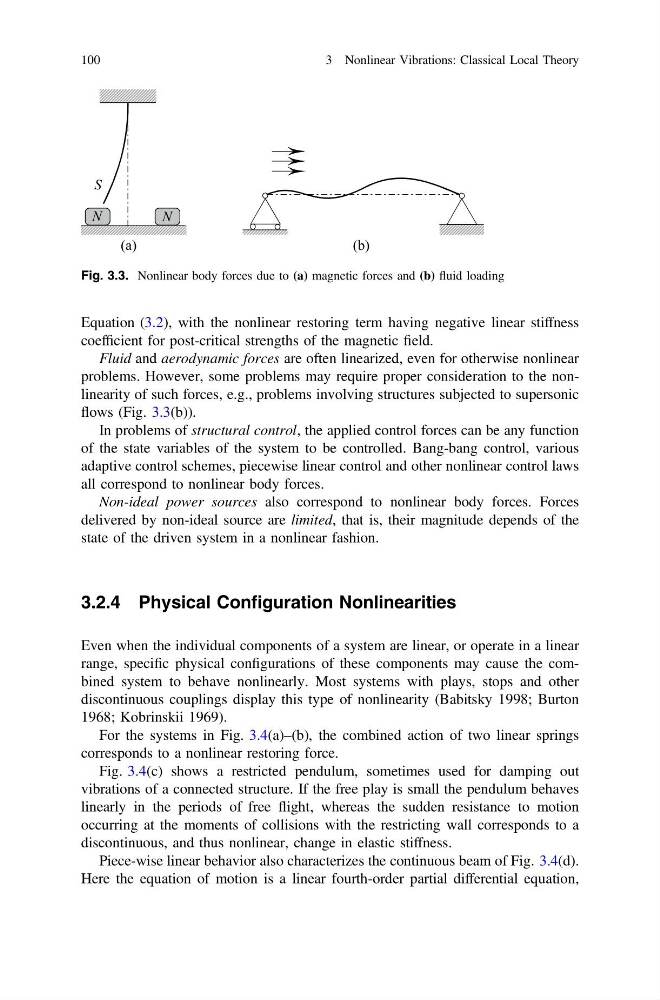
Equation (3.2), with the nonlinear restoring term having negative linear stiffness
coefficient for post-critical strengths of the magnetic field.
Fluid and aerodynamic forces are often linearized, even for otherwise nonlinear
problems. However, some problems may require proper consideration to the nonlinearity of such forces, e.g., problems involving structures subjected to supersonic
flows (Fig. 3.3(b)).
In problems of structural control, the applied control forces can be any function
of the state variables of the system to be controlled. Bang-bang control, various
adaptive control schemes, piecewise linear control and other nonlinear control laws
all correspond to nonlinear body forces.
Non-ideal power sources also correspond to nonlinear body forces. Forces
delivered by non-ideal source are limited, that is, their magnitude depends of the
state of the driven system in a nonlinear fashion.
3.2.4 Physical Configuration Nonlinearities
Even when the individual components of a system are linear, or operate in a linear
range, specific physical configurations of these components may cause the combined system to behave nonlinearly. Most systems with plays, stops and other
discontinuous couplings display this type of nonlinearity (Babitsky 1998; Burton
1968; Kobrinskii 1969).
For the systems in Fig. 3.4(a)–(b), the combined action of two linear springs
corresponds to a nonlinear restoring force.
Fig. 3.4(c) shows a restricted pendulum, sometimes used for damping out
vibrations of a connected structure. If the free play is small the pendulum behaves
linearly in the periods of free flight, whereas the sudden resistance to motion
occurring at the moments of collisions with the restricting wall corresponds to a
discontinuous, and thus nonlinear, change in elastic stiffness.
Piece-wise linear behavior also characterizes the continuous beam of Fig. 3.4(d).
Here the equation of motion is a linear fourth-order partial differential equation,
Fig. 3.3. Nonlinear body forces due to (a) magnetic forces and (b) fluid loading
100
3 Nonlinear Vibrations: Classical Local Theory
coefficient for post-critical strengths of the magnetic field.
Fluid and aerodynamic forces are often linearized, even for otherwise nonlinear
problems. However, some problems may require proper consideration to the nonlinearity of such forces, e.g., problems involving structures subjected to supersonic
flows (Fig. 3.3(b)).
In problems of structural control, the applied control forces can be any function
of the state variables of the system to be controlled. Bang-bang control, various
adaptive control schemes, piecewise linear control and other nonlinear control laws
all correspond to nonlinear body forces.
Non-ideal power sources also correspond to nonlinear body forces. Forces
delivered by non-ideal source are limited, that is, their magnitude depends of the
state of the driven system in a nonlinear fashion.
3.2.4 Physical Configuration Nonlinearities
Even when the individual components of a system are linear, or operate in a linear
range, specific physical configurations of these components may cause the combined system to behave nonlinearly. Most systems with plays, stops and other
discontinuous couplings display this type of nonlinearity (Babitsky 1998; Burton
1968; Kobrinskii 1969).
For the systems in Fig. 3.4(a)–(b), the combined action of two linear springs
corresponds to a nonlinear restoring force.
Fig. 3.4(c) shows a restricted pendulum, sometimes used for damping out
vibrations of a connected structure. If the free play is small the pendulum behaves
linearly in the periods of free flight, whereas the sudden resistance to motion
occurring at the moments of collisions with the restricting wall corresponds to a
discontinuous, and thus nonlinear, change in elastic stiffness.
Piece-wise linear behavior also characterizes the continuous beam of Fig. 3.4(d).
Here the equation of motion is a linear fourth-order partial differential equation,
Fig. 3.3. Nonlinear body forces due to (a) magnetic forces and (b) fluid loading
100
3 Nonlinear Vibrations: Classical Local Theory