

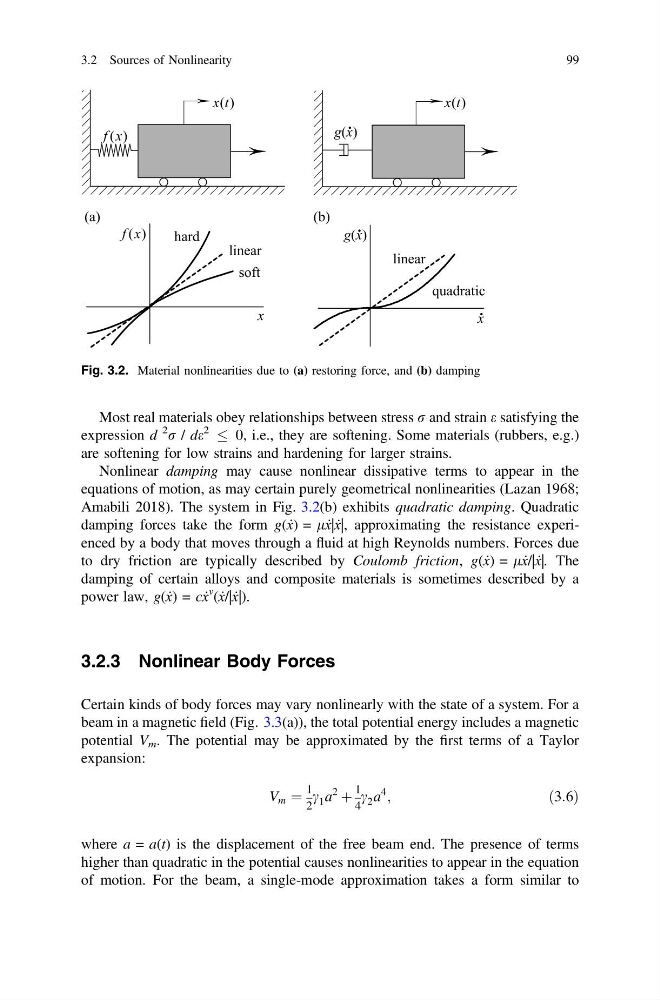
Most real materials obey relationships between stress r and strain e satisfying the
expression d
2 r / de
2
0, i.e., they are softening. Some materials (rubbers, e.g.)
are softening for low strains and hardening for larger strains.
Nonlinear damping may cause nonlinear dissipative terms to appear in the
equations of motion, as may certain purely geometrical nonlinearities (Lazan 1968;
Amabili 2018). The system in Fig. 3.2(b) exhibits quadratic damping. Quadratic
damping forces take the form g(ẋ) = lẋ|ẋ|, approximating the resistance experienced by a body that moves through a fluid at high Reynolds numbers. Forces due
to dry friction are typically described by Coulomb friction, g(ẋ) = lẋ/|ẋ|. The
damping of certain alloys and composite materials is sometimes described by a
power law, g(ẋ) = cẋ
m (ẋ/|ẋ|).
3.2.3 Nonlinear Body Forces
Certain kinds of body forces may vary nonlinearly with the state of a system. For a
beam in a magnetic field (Fig. 3.3(a)), the total potential energy includes a magnetic
potential V m . The potential may be approximated by the first terms of a Taylor
expansion:
V m ¼
1
2
c 1 a
2
þ
1
4
c 2 a
4
;
ð3:6Þ
where a = a(t) is the displacement of the free beam end. The presence of terms
higher than quadratic in the potential causes nonlinearities to appear in the equation
of motion. For the beam, a single-mode approximation takes a form similar to
Fig. 3.2. Material nonlinearities due to (a) restoring force, and (b) damping
3.2 Sources of Nonlinearity
99
expression d
2 r / de
2
0, i.e., they are softening. Some materials (rubbers, e.g.)
are softening for low strains and hardening for larger strains.
Nonlinear damping may cause nonlinear dissipative terms to appear in the
equations of motion, as may certain purely geometrical nonlinearities (Lazan 1968;
Amabili 2018). The system in Fig. 3.2(b) exhibits quadratic damping. Quadratic
damping forces take the form g(ẋ) = lẋ|ẋ|, approximating the resistance experienced by a body that moves through a fluid at high Reynolds numbers. Forces due
to dry friction are typically described by Coulomb friction, g(ẋ) = lẋ/|ẋ|. The
damping of certain alloys and composite materials is sometimes described by a
power law, g(ẋ) = cẋ
m (ẋ/|ẋ|).
3.2.3 Nonlinear Body Forces
Certain kinds of body forces may vary nonlinearly with the state of a system. For a
beam in a magnetic field (Fig. 3.3(a)), the total potential energy includes a magnetic
potential V m . The potential may be approximated by the first terms of a Taylor
expansion:
V m ¼
1
2
c 1 a
2
þ
1
4
c 2 a
4
;
ð3:6Þ
where a = a(t) is the displacement of the free beam end. The presence of terms
higher than quadratic in the potential causes nonlinearities to appear in the equation
of motion. For the beam, a single-mode approximation takes a form similar to
Fig. 3.2. Material nonlinearities due to (a) restoring force, and (b) damping
3.2 Sources of Nonlinearity
99