

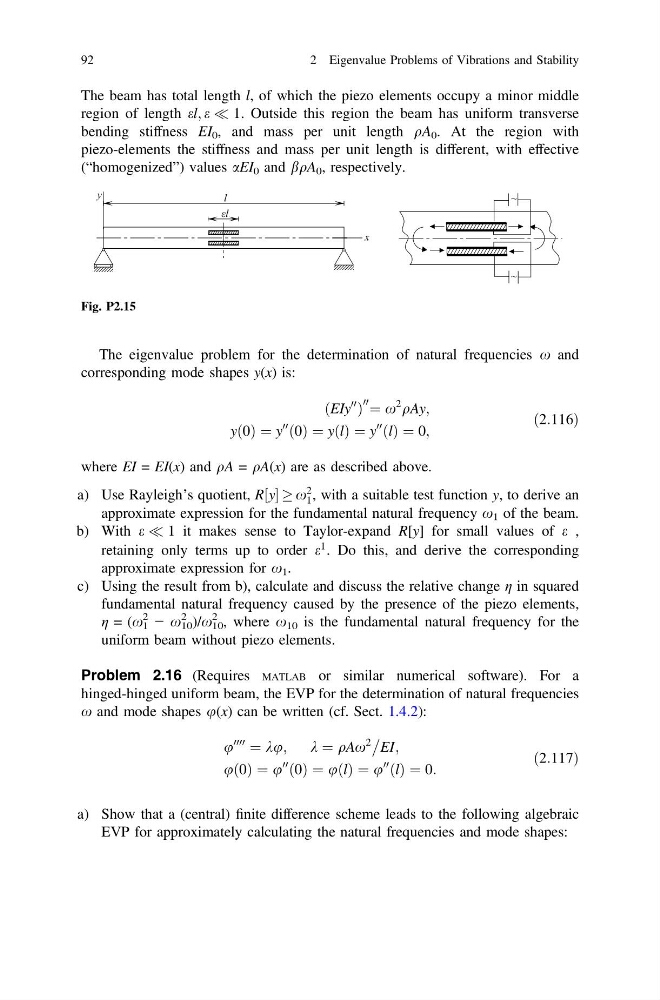
The beam has total length l, of which the piezo elements occupy a minor middle
region of length el; e ( 1. Outside this region the beam has uniform transverse
bending stiffness EI 0 , and mass per unit length qA 0 . At the region with
piezo-elements the stiffness and mass per unit length is different, with effective
(“homogenized”) values aEI 0 and bqA 0 , respectively.
The eigenvalue problem for the determination of natural frequencies x and
corresponding mode shapes y(x) is:
EIy
00
ð
Þ
00 ¼ x
2 qAy;
yð0Þ ¼ y
00
ð0Þ ¼ yðlÞ ¼ y
00
ðlÞ ¼ 0;
ð2:116Þ
where EI = EI(x) and qA = qA(x) are as described above.
a) Use Rayleigh’s quotient, R y
½ ! x
2
1 , with a suitable test function y, to derive an
approximate expression for the fundamental natural frequency x 1 of the beam.
b) With e ( 1 it makes sense to Taylor-expand R[y] for small values of e ,
retaining only terms up to order e
1 . Do this, and derive the corresponding
approximate expression for x 1 .
c) Using the result from b), calculate and discuss the relative change η in squared
fundamental natural frequency caused by the presence of the piezo elements,
η = (x 1
2
− x 10
2 )/x 10
2 , where x 10 is the fundamental natural frequency for the
uniform beam without piezo elements.
Problem 2.16 (Requires MATLAB or similar numerical software). For a
hinged-hinged uniform beam, the EVP for the determination of natural frequencies
x and mode shapes u(x) can be written (cf. Sect. 1.4.2):
u
0000
¼ ku;
k ¼ qAx
2
EI;
uð0Þ ¼ u
00
ð0Þ ¼ uðlÞ ¼ u
00
ðlÞ ¼ 0:
ð2:117Þ
a) Show that a (central) finite difference scheme leads to the following algebraic
EVP for approximately calculating the natural frequencies and mode shapes:
Fig. P2.15
92
2 Eigenvalue Problems of Vibrations and Stability
region of length el; e ( 1. Outside this region the beam has uniform transverse
bending stiffness EI 0 , and mass per unit length qA 0 . At the region with
piezo-elements the stiffness and mass per unit length is different, with effective
(“homogenized”) values aEI 0 and bqA 0 , respectively.
The eigenvalue problem for the determination of natural frequencies x and
corresponding mode shapes y(x) is:
EIy
00
ð
Þ
00 ¼ x
2 qAy;
yð0Þ ¼ y
00
ð0Þ ¼ yðlÞ ¼ y
00
ðlÞ ¼ 0;
ð2:116Þ
where EI = EI(x) and qA = qA(x) are as described above.
a) Use Rayleigh’s quotient, R y
½ ! x
2
1 , with a suitable test function y, to derive an
approximate expression for the fundamental natural frequency x 1 of the beam.
b) With e ( 1 it makes sense to Taylor-expand R[y] for small values of e ,
retaining only terms up to order e
1 . Do this, and derive the corresponding
approximate expression for x 1 .
c) Using the result from b), calculate and discuss the relative change η in squared
fundamental natural frequency caused by the presence of the piezo elements,
η = (x 1
2
− x 10
2 )/x 10
2 , where x 10 is the fundamental natural frequency for the
uniform beam without piezo elements.
Problem 2.16 (Requires MATLAB or similar numerical software). For a
hinged-hinged uniform beam, the EVP for the determination of natural frequencies
x and mode shapes u(x) can be written (cf. Sect. 1.4.2):
u
0000
¼ ku;
k ¼ qAx
2
EI;
uð0Þ ¼ u
00
ð0Þ ¼ uðlÞ ¼ u
00
ðlÞ ¼ 0:
ð2:117Þ
a) Show that a (central) finite difference scheme leads to the following algebraic
EVP for approximately calculating the natural frequencies and mode shapes:
Fig. P2.15
92
2 Eigenvalue Problems of Vibrations and Stability