

Problem 2.11 For the elastic rope of Problems 2.6 and 2.8:
a) Compute the Rayleigh quotient of u 1 as obtained in Problem 2.8c.
b) Perform one eigenfunction iteration, from u 1 to u 2 , to obtain an estimate for the
lowest mode shape u 1 .
c) Calculate an approximate lowest natural frequency using the inclusion theorem
with functions u 1 and u 2 .
d) Apply an iteration to compute the polynomial u 3 .
e) Compute the Rayleigh quotients of u 2 and u 3 , respectively.
f) Supply bounds for the lowest natural frequency using the Rayleigh quotients of
u 1 , u 2 and u 3 .
Problem 2.12 Fig. P2.12 shows a column of length l, mass per unit length qA
(x) and bending stiffness EI(x). The column is simply supported at one end, and
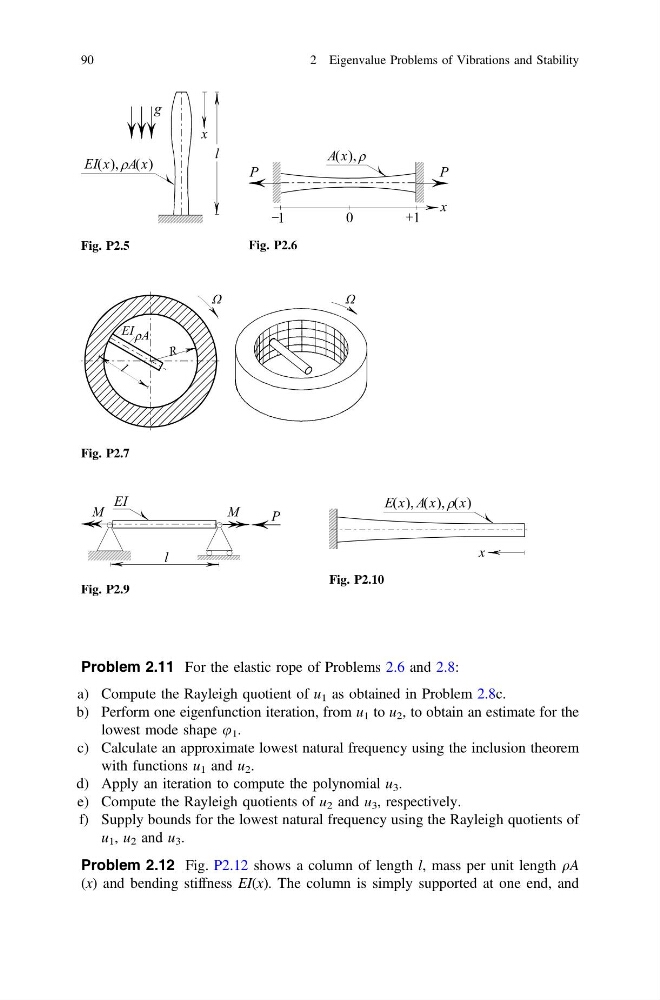
Fig. P2.5
Fig. P2.6
Fig. P2.7
Fig. P2.9
Fig. P2.10
90
2 Eigenvalue Problems of Vibrations and Stability
a) Compute the Rayleigh quotient of u 1 as obtained in Problem 2.8c.
b) Perform one eigenfunction iteration, from u 1 to u 2 , to obtain an estimate for the
lowest mode shape u 1 .
c) Calculate an approximate lowest natural frequency using the inclusion theorem
with functions u 1 and u 2 .
d) Apply an iteration to compute the polynomial u 3 .
e) Compute the Rayleigh quotients of u 2 and u 3 , respectively.
f) Supply bounds for the lowest natural frequency using the Rayleigh quotients of
u 1 , u 2 and u 3 .
Problem 2.12 Fig. P2.12 shows a column of length l, mass per unit length qA
(x) and bending stiffness EI(x). The column is simply supported at one end, and
Fig. P2.5
Fig. P2.6
Fig. P2.7
Fig. P2.9
Fig. P2.10
90
2 Eigenvalue Problems of Vibrations and Stability