

a) Set up an EVP for assessing whether the column will buckle in the plane of the
tube cross-section.
b) Determine the values of l2]0;2R[for which the EVP is self-adjoint and completely definite.
Problem 2.8 For the elastic rope of Problem 2.6:
a) Calculate a pair of approximations for the lowest eigenvalue, using Rayleigh’s
quotient with test functions u = 1 − x
2 and u = cos(px/2), respectively.
b) Calculate all eigenvalues approximately using the comparison theorem.
c) Calculate an approximate first eigenvalue, using the inclusion theorem with the
test function u 1 = x
4 + ax
3 + bx
2 + cx + d.
Problem 2.9 Fig. P2.9 shows a column having circular cylindrical cross-section
and bending stiffness EI. A twisting moment M and a compressive force P act along
the undeformed axis of the column.
a) Set up an EVP for the critical buckling loads in terms of M and P.
b) Examine whether the EVP is self-adjoint.
Problem 2.10 The clamped-free elastic rod in Fig. P2.10 has length l = 1,
Young’s modulus E(x), cross-sectional area A(x) and density q (x).
a) Set up an EVP for the determination of natural frequencies and mode shapes
associated with small axial vibrations of the rod.
b) Examine whether the EVP is self-adjoint and completely definite.
c) Assuming E(x) = q (x) = 1 and A(x) = 1 + x
2 , employ the inclusion theorem
with test functions x
4 + c 1 x
3 + c 2 x
2 + c 3 x + c 4 and A(x)
p sin[q(x − 1)] for estimating upper and lower bounds for the lowest natural frequency.
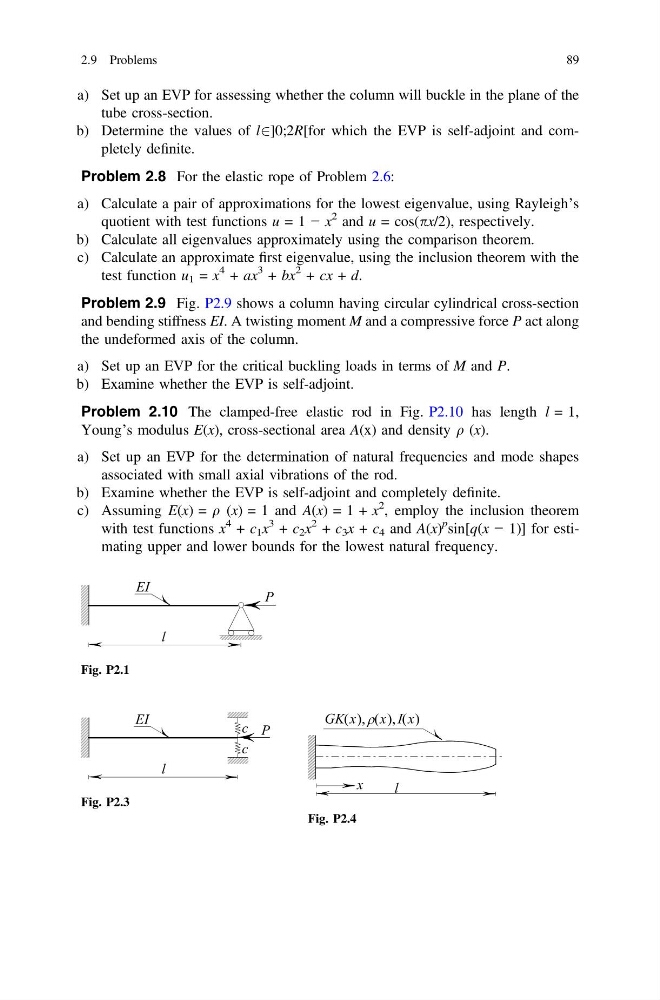
Fig. P2.1
Fig. P2.3
Fig. P2.4
2.9 Problems
89
tube cross-section.
b) Determine the values of l2]0;2R[for which the EVP is self-adjoint and completely definite.
Problem 2.8 For the elastic rope of Problem 2.6:
a) Calculate a pair of approximations for the lowest eigenvalue, using Rayleigh’s
quotient with test functions u = 1 − x
2 and u = cos(px/2), respectively.
b) Calculate all eigenvalues approximately using the comparison theorem.
c) Calculate an approximate first eigenvalue, using the inclusion theorem with the
test function u 1 = x
4 + ax
3 + bx
2 + cx + d.
Problem 2.9 Fig. P2.9 shows a column having circular cylindrical cross-section
and bending stiffness EI. A twisting moment M and a compressive force P act along
the undeformed axis of the column.
a) Set up an EVP for the critical buckling loads in terms of M and P.
b) Examine whether the EVP is self-adjoint.
Problem 2.10 The clamped-free elastic rod in Fig. P2.10 has length l = 1,
Young’s modulus E(x), cross-sectional area A(x) and density q (x).
a) Set up an EVP for the determination of natural frequencies and mode shapes
associated with small axial vibrations of the rod.
b) Examine whether the EVP is self-adjoint and completely definite.
c) Assuming E(x) = q (x) = 1 and A(x) = 1 + x
2 , employ the inclusion theorem
with test functions x
4 + c 1 x
3 + c 2 x
2 + c 3 x + c 4 and A(x)
p sin[q(x − 1)] for estimating upper and lower bounds for the lowest natural frequency.
Fig. P2.1
Fig. P2.3
Fig. P2.4
2.9 Problems
89