

83
the literature for 100% dense sample whereas, the elastic moduli of the composite are much lower than those of both monolithic materials. This reduction in density and elastic moduli are due to the presence of porosity in the composite sample.
Table 15.2 displays the compressive strength of the two materials obtained under both quasi-static and dynamic loading
conditions. The strength values for the 100% B 6 O are significantly higher than those of the composite, which affirms the
deleterious effects of incomplete sintering and interphase cracking on the composite.
While the compressive strength, density, and elastic moduli are macroscale properties providing information about the
composite as a whole, micro Vickers indentation can be used to probe microscale properties of each individual phase. As the
Vickers hardness of ceramic is dependent on the indentation load, a load-independent hardness measure known as slope
hardness [56] is calculated from a linear fit between the indentation load (P) and the square of the indent diagonal length (d
2
),
given by
P md
=
2
(15.1)
where m is the slope of the regression line. A load- independent slope hardness can then be calculated as
H
P
d
m
=
=
0 0001891
0 0001891
2
.
.
(15.2)
where H is the slope hardness in GPa, P is the indentation load in N, and d is the indent diagonal length in mm. A detailed
description of this method can be found in previous studies [33, 57, 58]. The quasi-static indentation hardness values of each
material at each load, along with their slope hardness values, are plotted in Fig. 15.6.
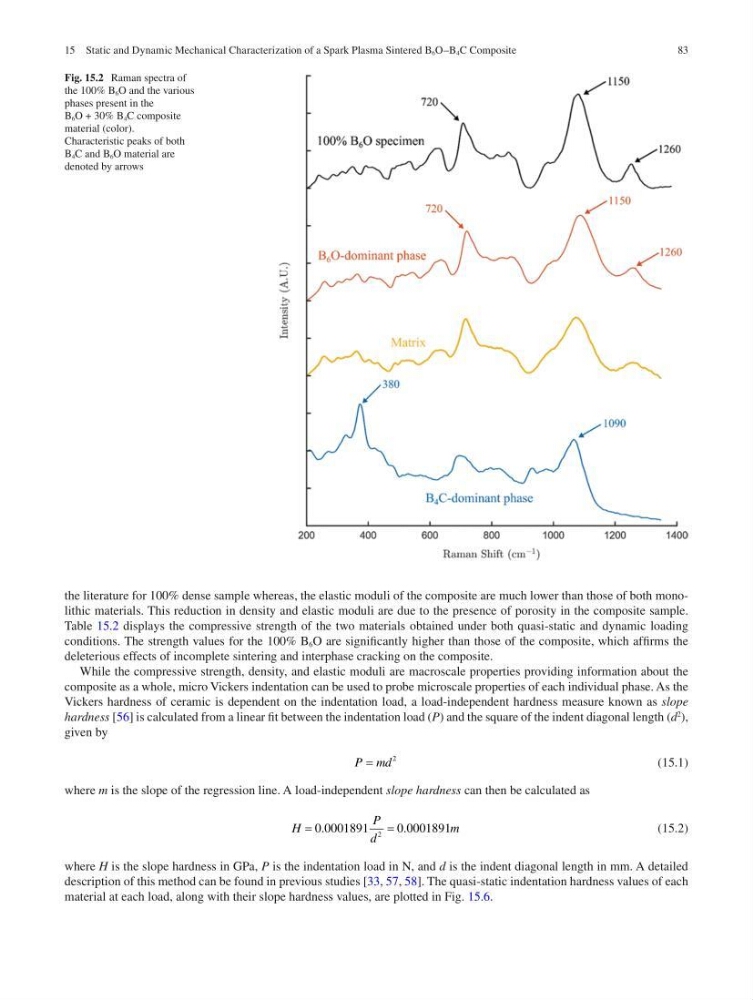
Fig. 15.2 Raman spectra of
the 100% B 6 O and the various
phases present in the
B 6 O + 30% B 4 C composite
material (color).
Characteristic peaks of both
B 4 C and B 6 O material are
denoted by arrows
15 Static and Dynamic Mechanical Characterization of a Spark Plasma Sintered B 6 O–B 4 C Composite
the literature for 100% dense sample whereas, the elastic moduli of the composite are much lower than those of both monolithic materials. This reduction in density and elastic moduli are due to the presence of porosity in the composite sample.
Table 15.2 displays the compressive strength of the two materials obtained under both quasi-static and dynamic loading
conditions. The strength values for the 100% B 6 O are significantly higher than those of the composite, which affirms the
deleterious effects of incomplete sintering and interphase cracking on the composite.
While the compressive strength, density, and elastic moduli are macroscale properties providing information about the
composite as a whole, micro Vickers indentation can be used to probe microscale properties of each individual phase. As the
Vickers hardness of ceramic is dependent on the indentation load, a load-independent hardness measure known as slope
hardness [56] is calculated from a linear fit between the indentation load (P) and the square of the indent diagonal length (d
2
),
given by
P md
=
2
(15.1)
where m is the slope of the regression line. A load- independent slope hardness can then be calculated as
H
P
d
m
=
=
0 0001891
0 0001891
2
.
.
(15.2)
where H is the slope hardness in GPa, P is the indentation load in N, and d is the indent diagonal length in mm. A detailed
description of this method can be found in previous studies [33, 57, 58]. The quasi-static indentation hardness values of each
material at each load, along with their slope hardness values, are plotted in Fig. 15.6.
Fig. 15.2 Raman spectra of
the 100% B 6 O and the various
phases present in the
B 6 O + 30% B 4 C composite
material (color).
Characteristic peaks of both
B 4 C and B 6 O material are
denoted by arrows
15 Static and Dynamic Mechanical Characterization of a Spark Plasma Sintered B 6 O–B 4 C Composite