

12
conditions [3]. In order to obtain a better understanding of this delamination phenomenon, the authors here seek to develop
a technique that will isolate those behaviors that contribute to delamination in layered materials.
An ideal method for the study of this behavior is the shaft- loaded blister test, used commonly in the field of adhesion science. This method has been used at quasi-static load rates to measure the properties of thin adhesive films [4] as well as the
adhesion of epoxy coatings [5]. Due to the mechanical application of the applied load, the shaft-loaded blister test is an
attractive option to be modified for dynamic load conditions. This chapter discusses preliminary work to apply this experimental method to study the dynamic behavior of an adhesive interface.
3.2 Methodology
For this study, experiments were performed on three different polymer coatings applied to a 6061-T6 aluminum substrate.
The substrates were 61 mm × 61 mm × 1.5 mm, with a 12.7 mm diameter hole punched through the center. These center
holes were sealed with press-fit PTFE discs before applying the adhesive material. For the adhesive materials, we selected
Sylgard
®
184 elastomer, SC-15 epoxy, and TGDDM epoxy cured with Jeffamine
®
D230. After curing the adhesive at 90 °C
for 12 h, the PTFE discs were carefully removed such that the adhesive coating was not damaged. Initial experiments were
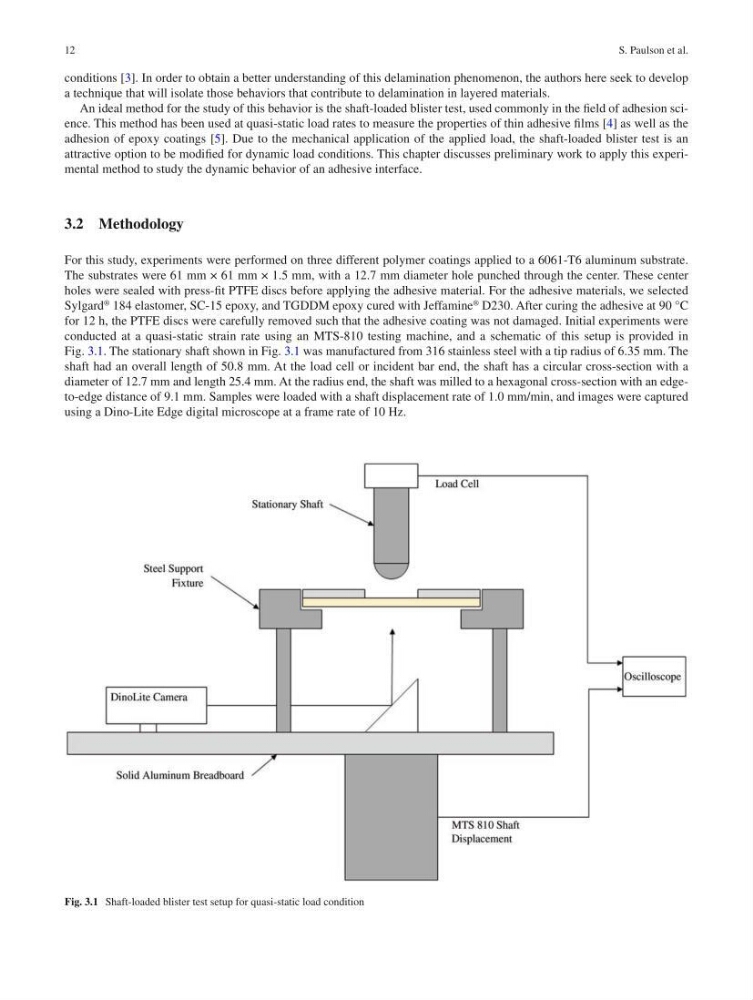
conducted at a quasi-static strain rate using an MTS-810 testing machine, and a schematic of this setup is provided in
Fig. 3.1. The stationary shaft shown in Fig. 3.1 was manufactured from 316 stainless steel with a tip radius of 6.35 mm. The
shaft had an overall length of 50.8 mm. At the load cell or incident bar end, the shaft has a circular cross-section with a
diameter of 12.7 mm and length 25.4 mm. At the radius end, the shaft was milled to a hexagonal cross-section with an edgeto-edge distance of 9.1 mm. Samples were loaded with a shaft displacement rate of 1.0 mm/min, and images were captured
using a Dino-Lite Edge digital microscope at a frame rate of 10 Hz.
Fig. 3.1 Shaft-loaded blister test setup for quasi-static load condition
S. Paulson et al.
conditions [3]. In order to obtain a better understanding of this delamination phenomenon, the authors here seek to develop
a technique that will isolate those behaviors that contribute to delamination in layered materials.
An ideal method for the study of this behavior is the shaft- loaded blister test, used commonly in the field of adhesion science. This method has been used at quasi-static load rates to measure the properties of thin adhesive films [4] as well as the
adhesion of epoxy coatings [5]. Due to the mechanical application of the applied load, the shaft-loaded blister test is an
attractive option to be modified for dynamic load conditions. This chapter discusses preliminary work to apply this experimental method to study the dynamic behavior of an adhesive interface.
3.2 Methodology
For this study, experiments were performed on three different polymer coatings applied to a 6061-T6 aluminum substrate.
The substrates were 61 mm × 61 mm × 1.5 mm, with a 12.7 mm diameter hole punched through the center. These center
holes were sealed with press-fit PTFE discs before applying the adhesive material. For the adhesive materials, we selected
Sylgard
®
184 elastomer, SC-15 epoxy, and TGDDM epoxy cured with Jeffamine
®
D230. After curing the adhesive at 90 °C
for 12 h, the PTFE discs were carefully removed such that the adhesive coating was not damaged. Initial experiments were
conducted at a quasi-static strain rate using an MTS-810 testing machine, and a schematic of this setup is provided in
Fig. 3.1. The stationary shaft shown in Fig. 3.1 was manufactured from 316 stainless steel with a tip radius of 6.35 mm. The
shaft had an overall length of 50.8 mm. At the load cell or incident bar end, the shaft has a circular cross-section with a
diameter of 12.7 mm and length 25.4 mm. At the radius end, the shaft was milled to a hexagonal cross-section with an edgeto-edge distance of 9.1 mm. Samples were loaded with a shaft displacement rate of 1.0 mm/min, and images were captured
using a Dino-Lite Edge digital microscope at a frame rate of 10 Hz.
Fig. 3.1 Shaft-loaded blister test setup for quasi-static load condition
S. Paulson et al.