

13
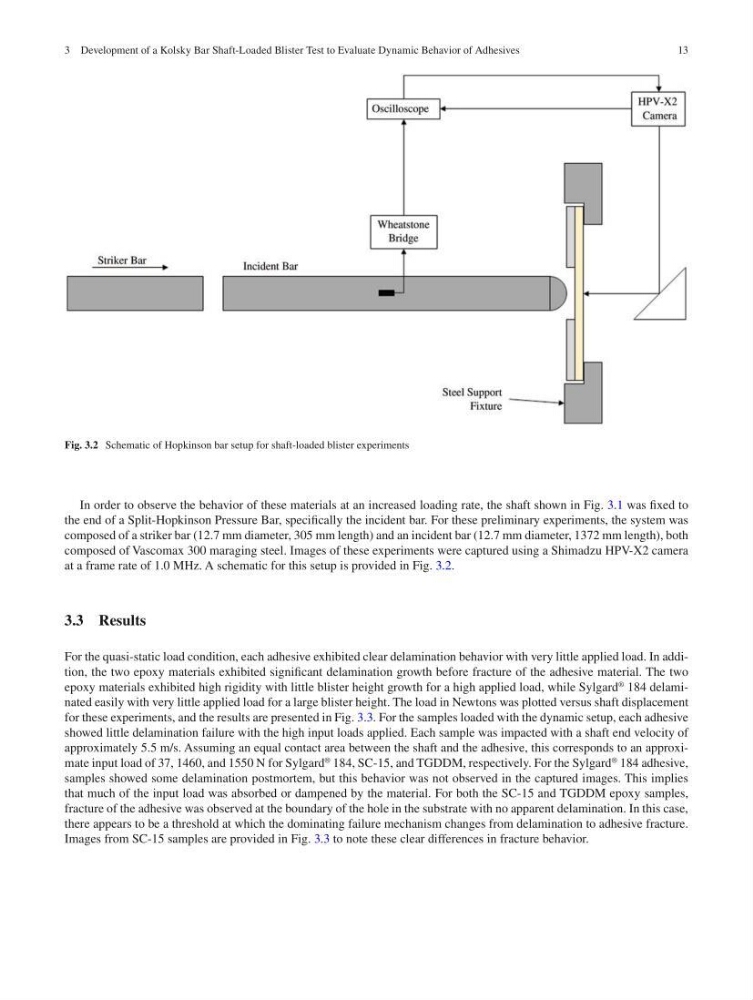
In order to observe the behavior of these materials at an increased loading rate, the shaft shown in Fig. 3.1 was fixed to
the end of a Split-Hopkinson Pressure Bar, specifically the incident bar. For these preliminary experiments, the system was
composed of a striker bar (12.7 mm diameter, 305 mm length) and an incident bar (12.7 mm diameter, 1372 mm length), both
composed of Vascomax 300 maraging steel. Images of these experiments were captured using a Shimadzu HPV-X2 camera
at a frame rate of 1.0 MHz. A schematic for this setup is provided in Fig. 3.2.
3.3 Results
For the quasi-static load condition, each adhesive exhibited clear delamination behavior with very little applied load. In addition, the two epoxy materials exhibited significant delamination growth before fracture of the adhesive material. The two
epoxy materials exhibited high rigidity with little blister height growth for a high applied load, while Sylgard
®
184 delaminated easily with very little applied load for a large blister height. The load in Newtons was plotted versus shaft displacement
for these experiments, and the results are presented in Fig. 3.3. For the samples loaded with the dynamic setup, each adhesive
showed little delamination failure with the high input loads applied. Each sample was impacted with a shaft end velocity of
approximately 5.5 m/s. Assuming an equal contact area between the shaft and the adhesive, this corresponds to an approximate input load of 37, 1460, and 1550 N for Sylgard
®
184, SC-15, and TGDDM, respectively. For the Sylgard
®
184 adhesive,
samples showed some delamination postmortem, but this behavior was not observed in the captured images. This implies
that much of the input load was absorbed or dampened by the material. For both the SC-15 and TGDDM epoxy samples,
fracture of the adhesive was observed at the boundary of the hole in the substrate with no apparent delamination. In this case,
there appears to be a threshold at which the dominating failure mechanism changes from delamination to adhesive fracture.
Images from SC-15 samples are provided in Fig. 3.3 to note these clear differences in fracture behavior.
Fig. 3.2 Schematic of Hopkinson bar setup for shaft-loaded blister experiments
3 Development of a Kolsky Bar Shaft-Loaded Blister Test to Evaluate Dynamic Behavior of Adhesives
In order to observe the behavior of these materials at an increased loading rate, the shaft shown in Fig. 3.1 was fixed to
the end of a Split-Hopkinson Pressure Bar, specifically the incident bar. For these preliminary experiments, the system was
composed of a striker bar (12.7 mm diameter, 305 mm length) and an incident bar (12.7 mm diameter, 1372 mm length), both
composed of Vascomax 300 maraging steel. Images of these experiments were captured using a Shimadzu HPV-X2 camera
at a frame rate of 1.0 MHz. A schematic for this setup is provided in Fig. 3.2.
3.3 Results
For the quasi-static load condition, each adhesive exhibited clear delamination behavior with very little applied load. In addition, the two epoxy materials exhibited significant delamination growth before fracture of the adhesive material. The two
epoxy materials exhibited high rigidity with little blister height growth for a high applied load, while Sylgard
®
184 delaminated easily with very little applied load for a large blister height. The load in Newtons was plotted versus shaft displacement
for these experiments, and the results are presented in Fig. 3.3. For the samples loaded with the dynamic setup, each adhesive
showed little delamination failure with the high input loads applied. Each sample was impacted with a shaft end velocity of
approximately 5.5 m/s. Assuming an equal contact area between the shaft and the adhesive, this corresponds to an approximate input load of 37, 1460, and 1550 N for Sylgard
®
184, SC-15, and TGDDM, respectively. For the Sylgard
®
184 adhesive,
samples showed some delamination postmortem, but this behavior was not observed in the captured images. This implies
that much of the input load was absorbed or dampened by the material. For both the SC-15 and TGDDM epoxy samples,
fracture of the adhesive was observed at the boundary of the hole in the substrate with no apparent delamination. In this case,
there appears to be a threshold at which the dominating failure mechanism changes from delamination to adhesive fracture.
Images from SC-15 samples are provided in Fig. 3.3 to note these clear differences in fracture behavior.
Fig. 3.2 Schematic of Hopkinson bar setup for shaft-loaded blister experiments
3 Development of a Kolsky Bar Shaft-Loaded Blister Test to Evaluate Dynamic Behavior of Adhesives