

3.5 Shell Theories
51
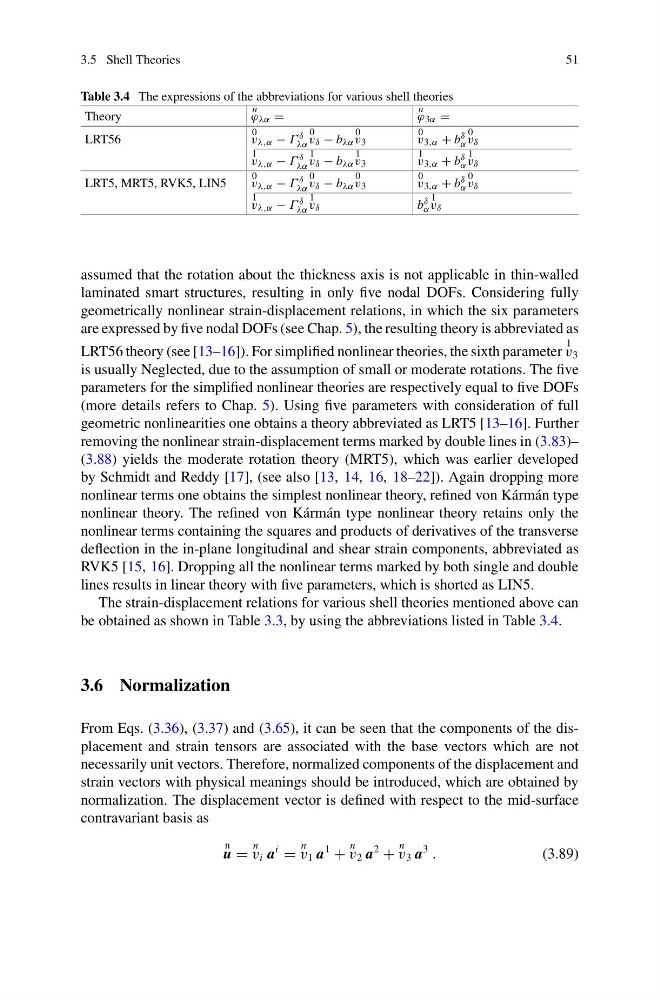
Table 3.4 The expressions of the abbreviations for various shell theories
Theory
n
ϕ λα =
n
ϕ 3α =
LRT56
0
v λ,α − Γ δ
λα
0
v δ − b λα
0
v 3
0
v 3,α + b δ
α
0
v δ
1
v λ,α − Γ δ
λα
1
v δ − b λα
1
v 3
1
v 3,α + b δ
α
1
v δ
LRT5, MRT5, RVK5, LIN5
0
v λ,α − Γ δ
λα
0
v δ − b λα
0
v 3
0
v 3,α + b δ
α
0
v δ
1
v λ,α − Γ δ
λα
1
v δ
b δ
α
1
v δ
assumed that the rotation about the thickness axis is not applicable in thin-walled
laminated smart structures, resulting in only five nodal DOFs. Considering fully
geometrically nonlinear strain-displacement relations, in which the six parameters
are expressed by five nodal DOFs (see Chap. 5), the resulting theory is abbreviated as
LRT56 theory (see [13–16]). For simplified nonlinear theories, the sixth parameter
1
v 3
is usually Neglected, due to the assumption of small or moderate rotations. The five
parameters for the simplified nonlinear theories are respectively equal to five DOFs
(more details refers to Chap. 5). Using five parameters with consideration of full
geometric nonlinearities one obtains a theory abbreviated as LRT5 [13–16]. Further
removing the nonlinear strain-displacement terms marked by double lines in (3.83)–
(3.88) yields the moderate rotation theory (MRT5), which was earlier developed
by Schmidt and Reddy [17], (see also [13, 14, 16, 18–22]). Again dropping more
nonlinear terms one obtains the simplest nonlinear theory, refined von Kármán type
nonlinear theory. The refined von Kármán type nonlinear theory retains only the
nonlinear terms containing the squares and products of derivatives of the transverse
deflection in the in-plane longitudinal and shear strain components, abbreviated as
RVK5 [15, 16]. Dropping all the nonlinear terms marked by both single and double
lines results in linear theory with five parameters, which is shorted as LIN5.
The strain-displacement relations for various shell theories mentioned above can
be obtained as shown in Table 3.3, by using the abbreviations listed in Table 3.4.
3.6 Normalization
From Eqs. (3.36), (3.37) and (3.65), it can be seen that the components of the displacement and strain tensors are associated with the base vectors which are not
necessarily unit vectors. Therefore, normalized components of the displacement and
strain vectors with physical meanings should be introduced, which are obtained by
normalization. The displacement vector is defined with respect to the mid-surface
contravariant basis as
n
u =
n
v i a
i
=
n
v 1 a
1
+
n
v 2 a
2
+
n
v 3 a
3
.
(3.89)
51
Table 3.4 The expressions of the abbreviations for various shell theories
Theory
n
ϕ λα =
n
ϕ 3α =
LRT56
0
v λ,α − Γ δ
λα
0
v δ − b λα
0
v 3
0
v 3,α + b δ
α
0
v δ
1
v λ,α − Γ δ
λα
1
v δ − b λα
1
v 3
1
v 3,α + b δ
α
1
v δ
LRT5, MRT5, RVK5, LIN5
0
v λ,α − Γ δ
λα
0
v δ − b λα
0
v 3
0
v 3,α + b δ
α
0
v δ
1
v λ,α − Γ δ
λα
1
v δ
b δ
α
1
v δ
assumed that the rotation about the thickness axis is not applicable in thin-walled
laminated smart structures, resulting in only five nodal DOFs. Considering fully
geometrically nonlinear strain-displacement relations, in which the six parameters
are expressed by five nodal DOFs (see Chap. 5), the resulting theory is abbreviated as
LRT56 theory (see [13–16]). For simplified nonlinear theories, the sixth parameter
1
v 3
is usually Neglected, due to the assumption of small or moderate rotations. The five
parameters for the simplified nonlinear theories are respectively equal to five DOFs
(more details refers to Chap. 5). Using five parameters with consideration of full
geometric nonlinearities one obtains a theory abbreviated as LRT5 [13–16]. Further
removing the nonlinear strain-displacement terms marked by double lines in (3.83)–
(3.88) yields the moderate rotation theory (MRT5), which was earlier developed
by Schmidt and Reddy [17], (see also [13, 14, 16, 18–22]). Again dropping more
nonlinear terms one obtains the simplest nonlinear theory, refined von Kármán type
nonlinear theory. The refined von Kármán type nonlinear theory retains only the
nonlinear terms containing the squares and products of derivatives of the transverse
deflection in the in-plane longitudinal and shear strain components, abbreviated as
RVK5 [15, 16]. Dropping all the nonlinear terms marked by both single and double
lines results in linear theory with five parameters, which is shorted as LIN5.
The strain-displacement relations for various shell theories mentioned above can
be obtained as shown in Table 3.3, by using the abbreviations listed in Table 3.4.
3.6 Normalization
From Eqs. (3.36), (3.37) and (3.65), it can be seen that the components of the displacement and strain tensors are associated with the base vectors which are not
necessarily unit vectors. Therefore, normalized components of the displacement and
strain vectors with physical meanings should be introduced, which are obtained by
normalization. The displacement vector is defined with respect to the mid-surface
contravariant basis as
n
u =
n
v i a
i
=
n
v 1 a
1
+
n
v 2 a
2
+
n
v 3 a
3
.
(3.89)