

52
3 Geometrically Nonlinear Theories
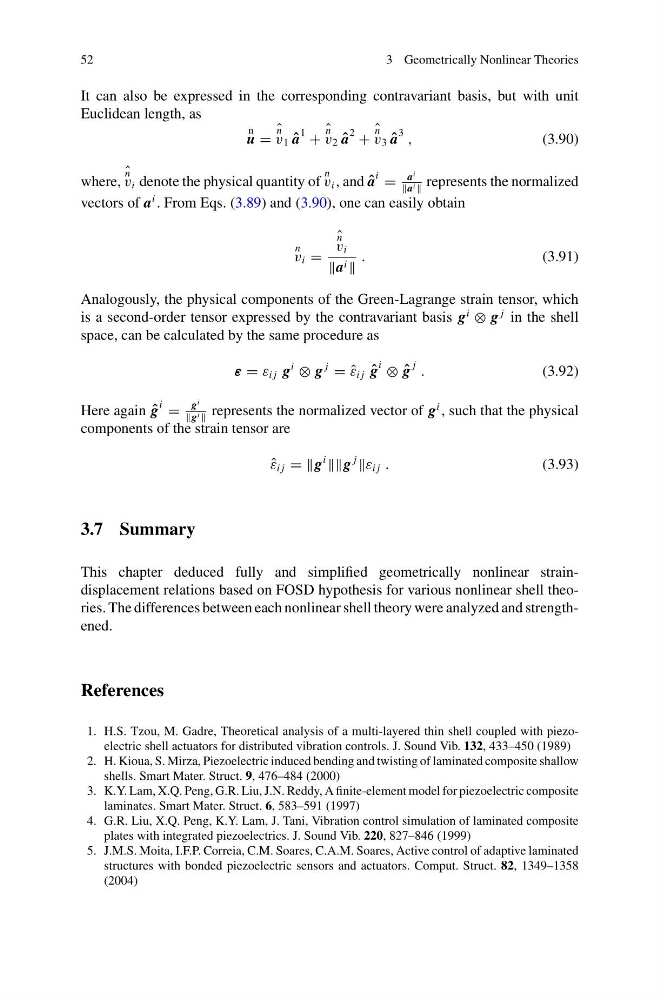
It can also be expressed in the corresponding contravariant basis, but with unit
Euclidean length, as
n
u =
ˆ
n
v 1 ˆ
a
1 +
ˆ
n
v 2 ˆ
a
2 +
ˆ
n
v 3 ˆ
a
3 ,
(3.90)
where,
ˆ
n
v i denote the physical quantity of
n
v i , and ˆ
a
i =
a
i
a i
represents the normalized
vectors of a
i . From Eqs. (3.89) and (3.90), one can easily obtain
n
v i =
ˆ
n
v i
a i
.
(3.91)
Analogously, the physical components of the Green-Lagrange strain tensor, which
is a second-order tensor expressed by the contravariant basis g
i
⊗ g
j in the shell
space, can be calculated by the same procedure as
ε = ε i j g
i
⊗ g
j
= ˆ
ε i j ˆ
g
i ⊗ ˆ
g
j .
(3.92)
Here again ˆ
g
i =
g
i
g i
represents the normalized vector of g
i , such that the physical
components of the strain tensor are
ˆ
ε i j = =g
i
g
j
ε i j .
(3.93)
3.7 Summary
This chapter deduced fully and simplified geometrically nonlinear straindisplacement relations based on FOSD hypothesis for various nonlinear shell theories. The differences between each nonlinear shell theory were analyzed and strengthened.
References
1. H.S. Tzou, M. Gadre, Theoretical analysis of a multi-layered thin shell coupled with piezoelectric shell actuators for distributed vibration controls. J. Sound Vib. 132, 433–450 (1989)
2. H. Kioua, S. Mirza, Piezoelectric induced bending and twisting of laminated composite shallow
shells. Smart Mater. Struct. 9, 476–484 (2000)
3. K.Y. Lam, X.Q. Peng, G.R. Liu, J.N. Reddy, A finite-element model for piezoelectric composite
laminates. Smart Mater. Struct. 6, 583–591 (1997)
4. G.R. Liu, X.Q. Peng, K.Y. Lam, J. Tani, Vibration control simulation of laminated composite
plates with integrated piezoelectrics. J. Sound Vib. 220, 827–846 (1999)
5. J.M.S. Moita, I.F.P. Correia, C.M. Soares, C.A.M. Soares, Active control of adaptive laminated
structures with bonded piezoelectric sensors and actuators. Comput. Struct. 82, 1349–1358
(2004)
3 Geometrically Nonlinear Theories
It can also be expressed in the corresponding contravariant basis, but with unit
Euclidean length, as
n
u =
ˆ
n
v 1 ˆ
a
1 +
ˆ
n
v 2 ˆ
a
2 +
ˆ
n
v 3 ˆ
a
3 ,
(3.90)
where,
ˆ
n
v i denote the physical quantity of
n
v i , and ˆ
a
i =
a
i
a i
represents the normalized
vectors of a
i . From Eqs. (3.89) and (3.90), one can easily obtain
n
v i =
ˆ
n
v i
a i
.
(3.91)
Analogously, the physical components of the Green-Lagrange strain tensor, which
is a second-order tensor expressed by the contravariant basis g
i
⊗ g
j in the shell
space, can be calculated by the same procedure as
ε = ε i j g
i
⊗ g
j
= ˆ
ε i j ˆ
g
i ⊗ ˆ
g
j .
(3.92)
Here again ˆ
g
i =
g
i
g i
represents the normalized vector of g
i , such that the physical
components of the strain tensor are
ˆ
ε i j = =g
i
g
j
ε i j .
(3.93)
3.7 Summary
This chapter deduced fully and simplified geometrically nonlinear straindisplacement relations based on FOSD hypothesis for various nonlinear shell theories. The differences between each nonlinear shell theory were analyzed and strengthened.
References
1. H.S. Tzou, M. Gadre, Theoretical analysis of a multi-layered thin shell coupled with piezoelectric shell actuators for distributed vibration controls. J. Sound Vib. 132, 433–450 (1989)
2. H. Kioua, S. Mirza, Piezoelectric induced bending and twisting of laminated composite shallow
shells. Smart Mater. Struct. 9, 476–484 (2000)
3. K.Y. Lam, X.Q. Peng, G.R. Liu, J.N. Reddy, A finite-element model for piezoelectric composite
laminates. Smart Mater. Struct. 6, 583–591 (1997)
4. G.R. Liu, X.Q. Peng, K.Y. Lam, J. Tani, Vibration control simulation of laminated composite
plates with integrated piezoelectrics. J. Sound Vib. 220, 827–846 (1999)
5. J.M.S. Moita, I.F.P. Correia, C.M. Soares, C.A.M. Soares, Active control of adaptive laminated
structures with bonded piezoelectric sensors and actuators. Comput. Struct. 82, 1349–1358
(2004)