

3.3 Kinematics of Shell Structures
45
n
ϕ λβ =
n
v λ|β − b λβ
n
v 3 ,
(3.44)
n
ϕ
λ
β =
n
v
λ |β − b
λ
β
n
v
3
,
(3.45)
n
ϕ 3β =
n
v 3,β + b
α
β
n
v α ,
(3.46)
n
ϕ
3
β =
n
v
3 ,β + b αβ
n
v
α
,
(3.47)
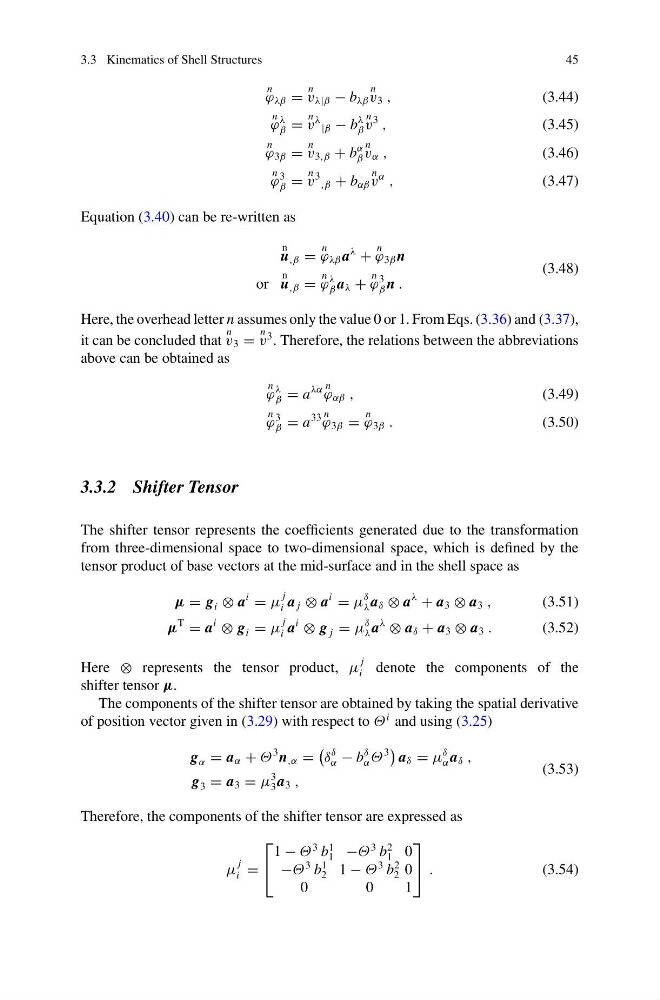
Equation (3.40) can be re-written as
n
u ,β =
n
ϕ λβ a
λ
+
n
ϕ 3β n
or
n
u ,β =
n
ϕ
λ
β a λ +
n
ϕ
3
β n .
(3.48)
Here, the overhead letter n assumes only the value 0 or 1. From Eqs. (3.36) and (3.37),
it can be concluded that
n
v 3 =
n
v
3 . Therefore, the relations between the abbreviations
above can be obtained as
n
ϕ
λ
β = a
λα n
ϕ αβ ,
(3.49)
n
ϕ
3
β = a
33 n
ϕ 3β =
n
ϕ 3β .
(3.50)
3.3.2 Shifter Tensor
The shifter tensor represents the coefficients generated due to the transformation
from three-dimensional space to two-dimensional space, which is defined by the
tensor product of base vectors at the mid-surface and in the shell space as
μ = g i ⊗ a
i
= μ
j
i a j ⊗ a
i
= μ
δ
λ a δ ⊗ a
λ
+ a 3 ⊗ a 3 ,
(3.51)
μ
T
= a
i
⊗ g i = μ
j
i a
i
⊗ g j = μ
δ
λ a
λ
⊗ a δ + a 3 ⊗ a 3 .
(3.52)
Here ⊗ represents the tensor product, μ
j
i denote the components of the
shifter tensor μ.
The components of the shifter tensor are obtained by taking the spatial derivative
of position vector given in (3.29) with respect to Θ
i and using (3.25)
g α = a α + Θ
3 n ,α =
δ
δ
α − b
δ
α Θ
3
a δ = μ
δ
α a δ ,
g 3 = a 3 = μ
3
3 a 3 ,
(3.53)
Therefore, the components of the shifter tensor are expressed as
μ
j
i =
⎡
⎣
1 − Θ
3 b
1
1 −Θ
3 b
2
1 0
−Θ
3 b
1
2 1 − Θ
3 b
2
2 0
0
0
1
⎤
⎦ .
(3.54)
45
n
ϕ λβ =
n
v λ|β − b λβ
n
v 3 ,
(3.44)
n
ϕ
λ
β =
n
v
λ |β − b
λ
β
n
v
3
,
(3.45)
n
ϕ 3β =
n
v 3,β + b
α
β
n
v α ,
(3.46)
n
ϕ
3
β =
n
v
3 ,β + b αβ
n
v
α
,
(3.47)
Equation (3.40) can be re-written as
n
u ,β =
n
ϕ λβ a
λ
+
n
ϕ 3β n
or
n
u ,β =
n
ϕ
λ
β a λ +
n
ϕ
3
β n .
(3.48)
Here, the overhead letter n assumes only the value 0 or 1. From Eqs. (3.36) and (3.37),
it can be concluded that
n
v 3 =
n
v
3 . Therefore, the relations between the abbreviations
above can be obtained as
n
ϕ
λ
β = a
λα n
ϕ αβ ,
(3.49)
n
ϕ
3
β = a
33 n
ϕ 3β =
n
ϕ 3β .
(3.50)
3.3.2 Shifter Tensor
The shifter tensor represents the coefficients generated due to the transformation
from three-dimensional space to two-dimensional space, which is defined by the
tensor product of base vectors at the mid-surface and in the shell space as
μ = g i ⊗ a
i
= μ
j
i a j ⊗ a
i
= μ
δ
λ a δ ⊗ a
λ
+ a 3 ⊗ a 3 ,
(3.51)
μ
T
= a
i
⊗ g i = μ
j
i a
i
⊗ g j = μ
δ
λ a
λ
⊗ a δ + a 3 ⊗ a 3 .
(3.52)
Here ⊗ represents the tensor product, μ
j
i denote the components of the
shifter tensor μ.
The components of the shifter tensor are obtained by taking the spatial derivative
of position vector given in (3.29) with respect to Θ
i and using (3.25)
g α = a α + Θ
3 n ,α =
δ
δ
α − b
δ
α Θ
3
a δ = μ
δ
α a δ ,
g 3 = a 3 = μ
3
3 a 3 ,
(3.53)
Therefore, the components of the shifter tensor are expressed as
μ
j
i =
⎡
⎣
1 − Θ
3 b
1
1 −Θ
3 b
2
1 0
−Θ
3 b
1
2 1 − Θ
3 b
2
2 0
0
0
1
⎤
⎦ .
(3.54)