

46
3 Geometrically Nonlinear Theories
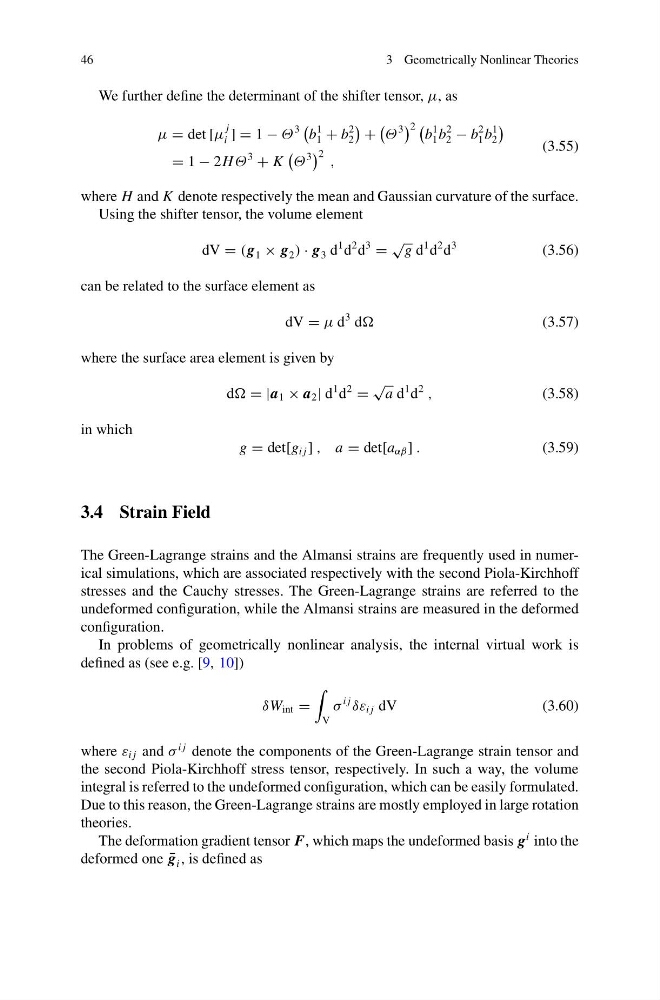
We further define the determinant of the shifter tensor, μ, as
μ = det [μ
j
i ] = 1 − Θ
3
b
1
1 + b
2
2
+
Θ
3
2
b
1
1 b
2
2 − b
2
1 b
1
2
= 1 − 2H Θ
3
+ K
Θ
3
2 ,
(3.55)
where H and K denote respectively the mean and Gaussian curvature of the surface.
Using the shifter tensor, the volume element
dV = (g 1 × g 2 ) · g 3 d
1 d
2 d
3
=
√ g d
1 d
2 d
3
(3.56)
can be related to the surface element as
dV = μ d
3 d
(3.57)
where the surface area element is given by
d = |a 1 × a 2 | d
1 d
2
=
√
a d
1 d
2
,
(3.58)
in which
g = det[g i j ] , a = det[a αβ ] .
(3.59)
3.4 Strain Field
The Green-Lagrange strains and the Almansi strains are frequently used in numerical simulations, which are associated respectively with the second Piola-Kirchhoff
stresses and the Cauchy stresses. The Green-Lagrange strains are referred to the
undeformed configuration, while the Almansi strains are measured in the deformed
configuration.
In problems of geometrically nonlinear analysis, the internal virtual work is
defined as (see e.g. [9, 10])
δW int =
V
σ
i j
δε i j dV
(3.60)
where ε i j and σ
i j denote the components of the Green-Lagrange strain tensor and
the second Piola-Kirchhoff stress tensor, respectively. In such a way, the volume
integral is referred to the undeformed configuration, which can be easily formulated.
Due to this reason, the Green-Lagrange strains are mostly employed in large rotation
theories.
The deformation gradient tensor F, which maps the undeformed basis g
i into the
deformed one ¯
g i , is defined as
3 Geometrically Nonlinear Theories
We further define the determinant of the shifter tensor, μ, as
μ = det [μ
j
i ] = 1 − Θ
3
b
1
1 + b
2
2
+
Θ
3
2
b
1
1 b
2
2 − b
2
1 b
1
2
= 1 − 2H Θ
3
+ K
Θ
3
2 ,
(3.55)
where H and K denote respectively the mean and Gaussian curvature of the surface.
Using the shifter tensor, the volume element
dV = (g 1 × g 2 ) · g 3 d
1 d
2 d
3
=
√ g d
1 d
2 d
3
(3.56)
can be related to the surface element as
dV = μ d
3 d
(3.57)
where the surface area element is given by
d = |a 1 × a 2 | d
1 d
2
=
√
a d
1 d
2
,
(3.58)
in which
g = det[g i j ] , a = det[a αβ ] .
(3.59)
3.4 Strain Field
The Green-Lagrange strains and the Almansi strains are frequently used in numerical simulations, which are associated respectively with the second Piola-Kirchhoff
stresses and the Cauchy stresses. The Green-Lagrange strains are referred to the
undeformed configuration, while the Almansi strains are measured in the deformed
configuration.
In problems of geometrically nonlinear analysis, the internal virtual work is
defined as (see e.g. [9, 10])
δW int =
V
σ
i j
δε i j dV
(3.60)
where ε i j and σ
i j denote the components of the Green-Lagrange strain tensor and
the second Piola-Kirchhoff stress tensor, respectively. In such a way, the volume
integral is referred to the undeformed configuration, which can be easily formulated.
Due to this reason, the Green-Lagrange strains are mostly employed in large rotation
theories.
The deformation gradient tensor F, which maps the undeformed basis g
i into the
deformed one ¯
g i , is defined as