

108
6 Nonlinear Analysis of Piezoceramic Laminated Structures
β
h
R
β
free
Θ
3
h = 12.6 mm
L = 254 mm
R = 2540 mm
G 23 = 0.66 GPa
G 13 = 0.66 GPa
G 12 = 0.66 GPa
ν 12 = 0.25
E 2 = 1.1 GPa
E 1 = 3.3 GPa
Θ
2
L
L
hinged
hinged
Θ
1
P
free
β = 0.1 rad
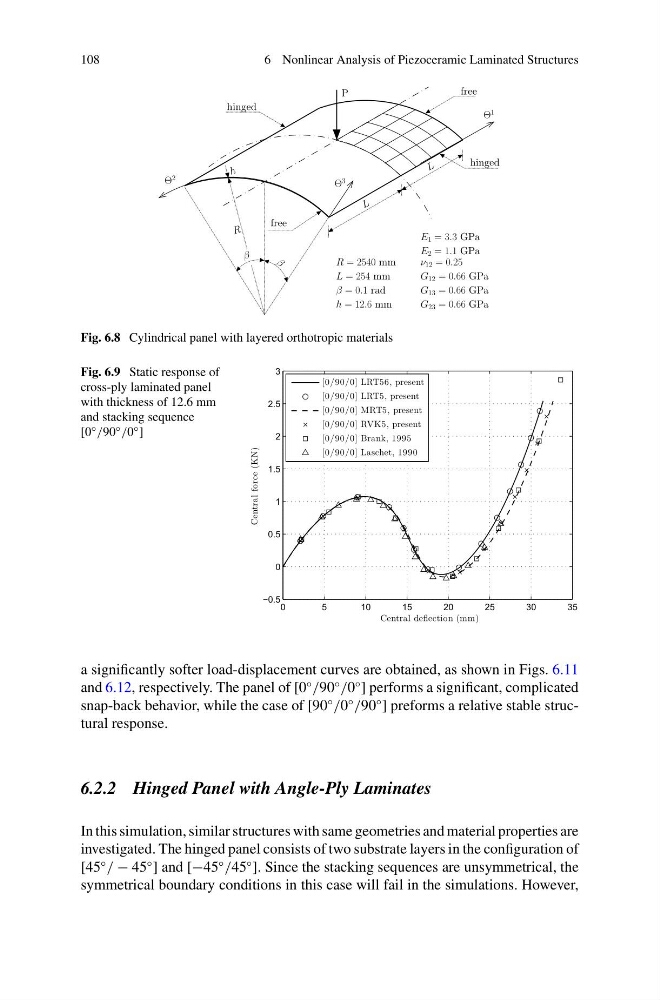
Fig. 6.8 Cylindrical panel with layered orthotropic materials
Fig. 6.9 Static response of
cross-ply laminated panel
with thickness of 12.6 mm
and stacking sequence
[0 ◦ /90 ◦ /0 ◦ ]
0
5
10
15
20
25
30
35
−0.5
0
0.5
1
1.5
2
2.5
3
Central deflection (mm)
Central force (KN)
[0/90/0] LRT56, present
[0/90/0] LRT5, present
[0/90/0] MRT5, present
[0/90/0] RVK5, present
[0/90/0] Brank, 1995
[0/90/0] Laschet, 1990
a significantly softer load-displacement curves are obtained, as shown in Figs. 6.11
and 6.12, respectively. The panel of [0
◦
/90
◦
/0
◦
] performs a significant, complicated
snap-back behavior, while the case of [90
◦
/0
◦
/90
◦
] preforms a relative stable structural response.
6.2.2 Hinged Panel with Angle-Ply Laminates
In this simulation, similar structures with same geometries and material properties are
investigated. The hinged panel consists of two substrate layers in the configuration of
[45
◦
/ − 45
◦
] and [−45
◦
/45
◦
]. Since the stacking sequences are unsymmetrical, the
symmetrical boundary conditions in this case will fail in the simulations. However,
6 Nonlinear Analysis of Piezoceramic Laminated Structures
β
h
R
β
free
Θ
3
h = 12.6 mm
L = 254 mm
R = 2540 mm
G 23 = 0.66 GPa
G 13 = 0.66 GPa
G 12 = 0.66 GPa
ν 12 = 0.25
E 2 = 1.1 GPa
E 1 = 3.3 GPa
Θ
2
L
L
hinged
hinged
Θ
1
P
free
β = 0.1 rad
Fig. 6.8 Cylindrical panel with layered orthotropic materials
Fig. 6.9 Static response of
cross-ply laminated panel
with thickness of 12.6 mm
and stacking sequence
[0 ◦ /90 ◦ /0 ◦ ]
0
5
10
15
20
25
30
35
−0.5
0
0.5
1
1.5
2
2.5
3
Central deflection (mm)
Central force (KN)
[0/90/0] LRT56, present
[0/90/0] LRT5, present
[0/90/0] MRT5, present
[0/90/0] RVK5, present
[0/90/0] Brank, 1995
[0/90/0] Laschet, 1990
a significantly softer load-displacement curves are obtained, as shown in Figs. 6.11
and 6.12, respectively. The panel of [0
◦
/90
◦
/0
◦
] performs a significant, complicated
snap-back behavior, while the case of [90
◦
/0
◦
/90
◦
] preforms a relative stable structural response.
6.2.2 Hinged Panel with Angle-Ply Laminates
In this simulation, similar structures with same geometries and material properties are
investigated. The hinged panel consists of two substrate layers in the configuration of
[45
◦
/ − 45
◦
] and [−45
◦
/45
◦
]. Since the stacking sequences are unsymmetrical, the
symmetrical boundary conditions in this case will fail in the simulations. However,