

6.2 Buckling and Post-buckling Analysis
109
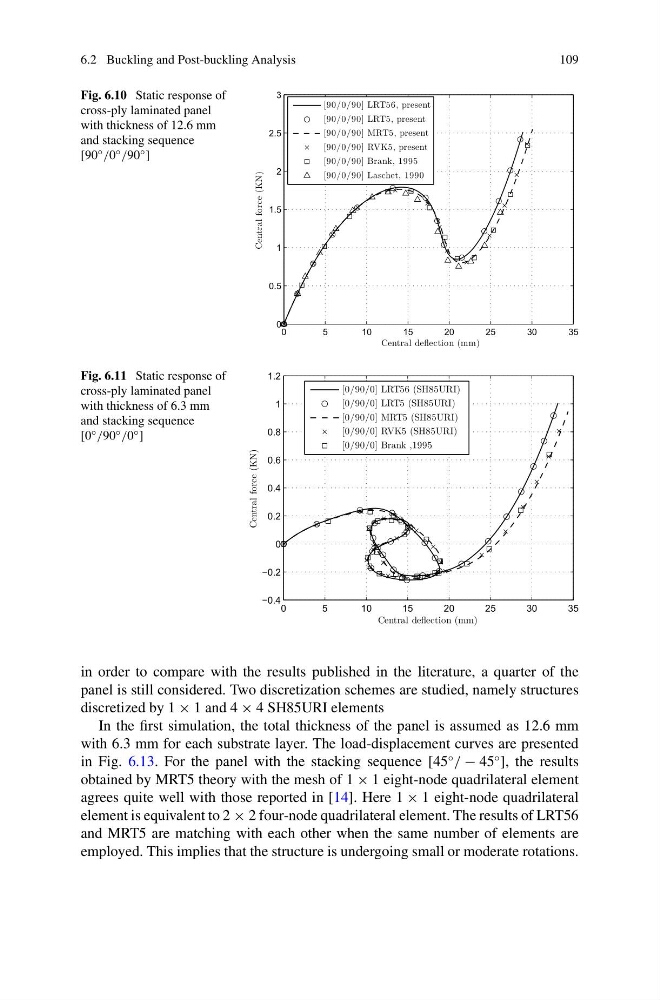
Fig. 6.10 Static response of
cross-ply laminated panel
with thickness of 12.6 mm
and stacking sequence
[90 ◦ /0 ◦ /90 ◦ ]
0
5
10
15
20
25
30
35
0
0.5
1
1.5
2
2.5
3
Central deflection (mm)
Central force (KN)
[90/0/90] LRT56, present
[90/0/90] LRT5, present
[90/0/90] MRT5, present
[90/0/90] RVK5, present
[90/0/90] Brank, 1995
[90/0/90] Laschet, 1990
Fig. 6.11 Static response of
cross-ply laminated panel
with thickness of 6.3 mm
and stacking sequence
[0 ◦ /90 ◦ /0 ◦ ]
0
5
10
15
20
25
30
35
−0.4
−0.2
0
0.2
0.4
0.6
0.8
1
1.2
Central deflection (mm)
Central force (KN)
[0/90/0] LRT56 (SH85URI)
[0/90/0] LRT5 (SH85URI)
[0/90/0] MRT5 (SH85URI)
[0/90/0] RVK5 (SH85URI)
[0/90/0] Brank ,1995
in order to compare with the results published in the literature, a quarter of the
panel is still considered. Two discretization schemes are studied, namely structures
discretized by 1 × 1 and 4 × 4 SH85URI elements
In the first simulation, the total thickness of the panel is assumed as 12.6 mm
with 6.3 mm for each substrate layer. The load-displacement curves are presented
in Fig. 6.13. For the panel with the stacking sequence [45
◦
/ − 45
◦
], the results
obtained by MRT5 theory with the mesh of 1 × 1 eight-node quadrilateral element
agrees quite well with those reported in [14]. Here 1 × 1 eight-node quadrilateral
element is equivalent to 2 × 2 four-node quadrilateral element. The results of LRT56
and MRT5 are matching with each other when the same number of elements are
employed. This implies that the structure is undergoing small or moderate rotations.
109
Fig. 6.10 Static response of
cross-ply laminated panel
with thickness of 12.6 mm
and stacking sequence
[90 ◦ /0 ◦ /90 ◦ ]
0
5
10
15
20
25
30
35
0
0.5
1
1.5
2
2.5
3
Central deflection (mm)
Central force (KN)
[90/0/90] LRT56, present
[90/0/90] LRT5, present
[90/0/90] MRT5, present
[90/0/90] RVK5, present
[90/0/90] Brank, 1995
[90/0/90] Laschet, 1990
Fig. 6.11 Static response of
cross-ply laminated panel
with thickness of 6.3 mm
and stacking sequence
[0 ◦ /90 ◦ /0 ◦ ]
0
5
10
15
20
25
30
35
−0.4
−0.2
0
0.2
0.4
0.6
0.8
1
1.2
Central deflection (mm)
Central force (KN)
[0/90/0] LRT56 (SH85URI)
[0/90/0] LRT5 (SH85URI)
[0/90/0] MRT5 (SH85URI)
[0/90/0] RVK5 (SH85URI)
[0/90/0] Brank ,1995
in order to compare with the results published in the literature, a quarter of the
panel is still considered. Two discretization schemes are studied, namely structures
discretized by 1 × 1 and 4 × 4 SH85URI elements
In the first simulation, the total thickness of the panel is assumed as 12.6 mm
with 6.3 mm for each substrate layer. The load-displacement curves are presented
in Fig. 6.13. For the panel with the stacking sequence [45
◦
/ − 45
◦
], the results
obtained by MRT5 theory with the mesh of 1 × 1 eight-node quadrilateral element
agrees quite well with those reported in [14]. Here 1 × 1 eight-node quadrilateral
element is equivalent to 2 × 2 four-node quadrilateral element. The results of LRT56
and MRT5 are matching with each other when the same number of elements are
employed. This implies that the structure is undergoing small or moderate rotations.