

possible combinations of several elementary steps of work
3 done on the system or,
in some cases, elementary steps of adiabatic work performed by the system, or a
mixture of both kinds of step(s). Suppose that these combinations are made to bring
about the same change of a system’s state from an initial state to a final state.
Carrying out various combinations of adiabatic work setups, our imaginary
experimentalist is able to draw the generalization that “if a system is caused to
change from an initial state to a final state by only adiabatic work, the work done on
the system for all adiabatic paths connecting the two states is the same.”
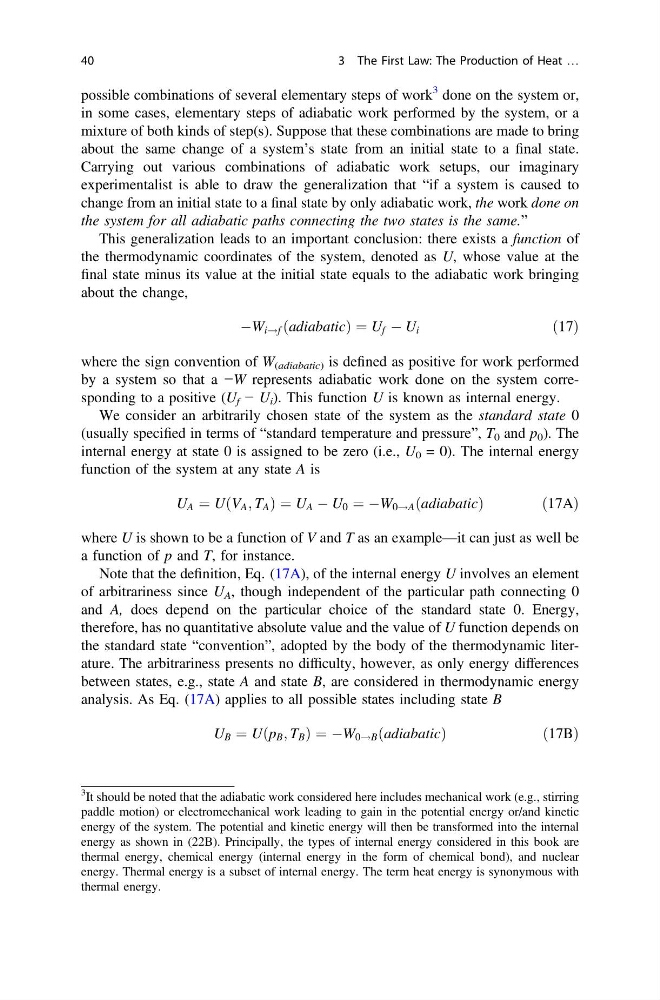
This generalization leads to an important conclusion: there exists a function of
the thermodynamic coordinates of the system, denoted as U, whose value at the
final state minus its value at the initial state equals to the adiabatic work bringing
about the change,
ÀW i!f ðadiabaticÞ ¼ U f À U i
ð17Þ
where the sign convention of W (adiabatic) is defined as positive for work performed
by a system so that a −W represents adiabatic work done on the system corresponding to a positive (U f − U i ). This function U is known as internal energy.
We consider an arbitrarily chosen state of the system as the standard state 0
(usually specified in terms of “standard temperature and pressure”, T 0 and p 0 ). The
internal energy at state 0 is assigned to be zero (i.e., U 0 = 0). The internal energy
function of the system at any state A is
U A ¼ U V A ; T A
ð
Þ¼U A À U 0 ¼ ÀW 0!A ðadiabaticÞ
ð 17AÞ
where U is shown to be a function of V and T as an example—it can just as well be
a function of p and T, for instance.
Note that the definition, Eq. (17A), of the internal energy U involves an element
of arbitrariness since U A , though independent of the particular path connecting 0
and A, does depend on the particular choice of the standard state 0. Energy,
therefore, has no quantitative absolute value and the value of U function depends on
the standard state “convention”, adopted by the body of the thermodynamic literature. The arbitrariness presents no difficulty, however, as only energy differences
between states, e.g., state A and state B, are considered in thermodynamic energy
analysis. As Eq. (17A) applies to all possible states including state B
U B ¼ U p B ; T B
ð
Þ¼ ÀW 0!B ðadiabaticÞ
ð 17BÞ
3
It should be noted that the adiabatic work considered here includes mechanical work (e.g., stirring
paddle motion) or electromechanical work leading to gain in the potential energy or/and kinetic
energy of the system. The potential and kinetic energy will then be transformed into the internal
energy as shown in (22B). Principally, the types of internal energy considered in this book are
thermal energy, chemical energy (internal energy in the form of chemical bond), and nuclear
energy. Thermal energy is a subset of internal energy. The term heat energy is synonymous with
thermal energy.
40
3 The First Law: The Production of Heat …
3 done on the system or,
in some cases, elementary steps of adiabatic work performed by the system, or a
mixture of both kinds of step(s). Suppose that these combinations are made to bring
about the same change of a system’s state from an initial state to a final state.
Carrying out various combinations of adiabatic work setups, our imaginary
experimentalist is able to draw the generalization that “if a system is caused to
change from an initial state to a final state by only adiabatic work, the work done on
the system for all adiabatic paths connecting the two states is the same.”
This generalization leads to an important conclusion: there exists a function of
the thermodynamic coordinates of the system, denoted as U, whose value at the
final state minus its value at the initial state equals to the adiabatic work bringing
about the change,
ÀW i!f ðadiabaticÞ ¼ U f À U i
ð17Þ
where the sign convention of W (adiabatic) is defined as positive for work performed
by a system so that a −W represents adiabatic work done on the system corresponding to a positive (U f − U i ). This function U is known as internal energy.
We consider an arbitrarily chosen state of the system as the standard state 0
(usually specified in terms of “standard temperature and pressure”, T 0 and p 0 ). The
internal energy at state 0 is assigned to be zero (i.e., U 0 = 0). The internal energy
function of the system at any state A is
U A ¼ U V A ; T A
ð
Þ¼U A À U 0 ¼ ÀW 0!A ðadiabaticÞ
ð 17AÞ
where U is shown to be a function of V and T as an example—it can just as well be
a function of p and T, for instance.
Note that the definition, Eq. (17A), of the internal energy U involves an element
of arbitrariness since U A , though independent of the particular path connecting 0
and A, does depend on the particular choice of the standard state 0. Energy,
therefore, has no quantitative absolute value and the value of U function depends on
the standard state “convention”, adopted by the body of the thermodynamic literature. The arbitrariness presents no difficulty, however, as only energy differences
between states, e.g., state A and state B, are considered in thermodynamic energy
analysis. As Eq. (17A) applies to all possible states including state B
U B ¼ U p B ; T B
ð
Þ¼ ÀW 0!B ðadiabaticÞ
ð 17BÞ
3
It should be noted that the adiabatic work considered here includes mechanical work (e.g., stirring
paddle motion) or electromechanical work leading to gain in the potential energy or/and kinetic
energy of the system. The potential and kinetic energy will then be transformed into the internal
energy as shown in (22B). Principally, the types of internal energy considered in this book are
thermal energy, chemical energy (internal energy in the form of chemical bond), and nuclear
energy. Thermal energy is a subset of internal energy. The term heat energy is synonymous with
thermal energy.
40
3 The First Law: The Production of Heat …