

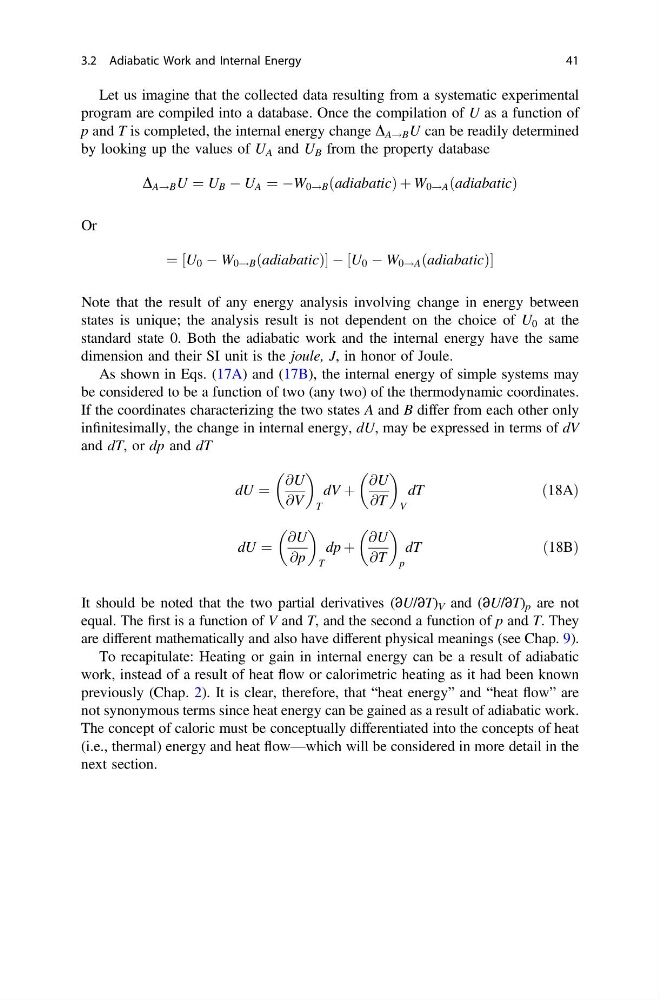
Let us imagine that the collected data resulting from a systematic experimental
program are compiled into a database. Once the compilation of U as a function of
p and T is completed, the internal energy change D A!B U can be readily determined
by looking up the values of U A and U B from the property database
D A!B U ¼ U B À U A ¼ ÀW 0!B ðadiabaticÞ þ W 0!A ðadiabaticÞ
Or
¼ U 0 À W 0!B ðadiabaticÞ
½
À U 0 À W 0!A ðadiabaticÞ
½
Note that the result of any energy analysis involving change in energy between
states is unique; the analysis result is not dependent on the choice of U 0 at the
standard state 0. Both the adiabatic work and the internal energy have the same
dimension and their SI unit is the joule, J, in honor of Joule.
As shown in Eqs. (17A) and (17B), the internal energy of simple systems may
be considered to be a function of two (any two) of the thermodynamic coordinates.
If the coordinates characterizing the two states A and B differ from each other only
infinitesimally, the change in internal energy, dU, may be expressed in terms of dV
and dT, or dp and dT
dU ¼
@U
@V
T
dV þ
@U
@T
V
dT
ð18AÞ
dU ¼
@U
@p
T
dp þ
@U
@T
p
dT
ð18BÞ
It should be noted that the two partial derivatives (∂U/∂T) V and (∂U/∂T) p are not
equal. The first is a function of V and T, and the second a function of p and T. They
are different mathematically and also have different physical meanings (see Chap. 9).
To recapitulate: Heating or gain in internal energy can be a result of adiabatic
work, instead of a result of heat flow or calorimetric heating as it had been known
previously (Chap. 2). It is clear, therefore, that “heat energy” and “heat flow” are
not synonymous terms since heat energy can be gained as a result of adiabatic work.
The concept of caloric must be conceptually differentiated into the concepts of heat
(i.e., thermal) energy and heat flow—which will be considered in more detail in the
next section.
3.2 Adiabatic Work and Internal Energy
41
program are compiled into a database. Once the compilation of U as a function of
p and T is completed, the internal energy change D A!B U can be readily determined
by looking up the values of U A and U B from the property database
D A!B U ¼ U B À U A ¼ ÀW 0!B ðadiabaticÞ þ W 0!A ðadiabaticÞ
Or
¼ U 0 À W 0!B ðadiabaticÞ
½
À U 0 À W 0!A ðadiabaticÞ
½
Note that the result of any energy analysis involving change in energy between
states is unique; the analysis result is not dependent on the choice of U 0 at the
standard state 0. Both the adiabatic work and the internal energy have the same
dimension and their SI unit is the joule, J, in honor of Joule.
As shown in Eqs. (17A) and (17B), the internal energy of simple systems may
be considered to be a function of two (any two) of the thermodynamic coordinates.
If the coordinates characterizing the two states A and B differ from each other only
infinitesimally, the change in internal energy, dU, may be expressed in terms of dV
and dT, or dp and dT
dU ¼
@U
@V
T
dV þ
@U
@T
V
dT
ð18AÞ
dU ¼
@U
@p
T
dp þ
@U
@T
p
dT
ð18BÞ
It should be noted that the two partial derivatives (∂U/∂T) V and (∂U/∂T) p are not
equal. The first is a function of V and T, and the second a function of p and T. They
are different mathematically and also have different physical meanings (see Chap. 9).
To recapitulate: Heating or gain in internal energy can be a result of adiabatic
work, instead of a result of heat flow or calorimetric heating as it had been known
previously (Chap. 2). It is clear, therefore, that “heat energy” and “heat flow” are
not synonymous terms since heat energy can be gained as a result of adiabatic work.
The concept of caloric must be conceptually differentiated into the concepts of heat
(i.e., thermal) energy and heat flow—which will be considered in more detail in the
next section.
3.2 Adiabatic Work and Internal Energy
41