

The crucial experiment that produced the conclusive evidence of conversion of
mechanical work into heat energy was a series of experiments performed by Joule
in the period from 1840 to 1849, which showed that the same effect of calorimetric
heating could be obtained by mechanical work or the input of the mechanical
energy (MEH). It was Rudolf Clausius, however, who first introduced the concept
of a new state function, internal energy, and thus made the first explicit statement of
the first law of thermodynamics [1].
2
Joule’s original demonstration of the MEH made no use of the concept of
energy; in his 1850 paper he summarized MEH this way,
The quantity of heat produced by the friction of bodies, whether solid or liquid, is always
proportional to the quantity of force [mechanical energy] expended.
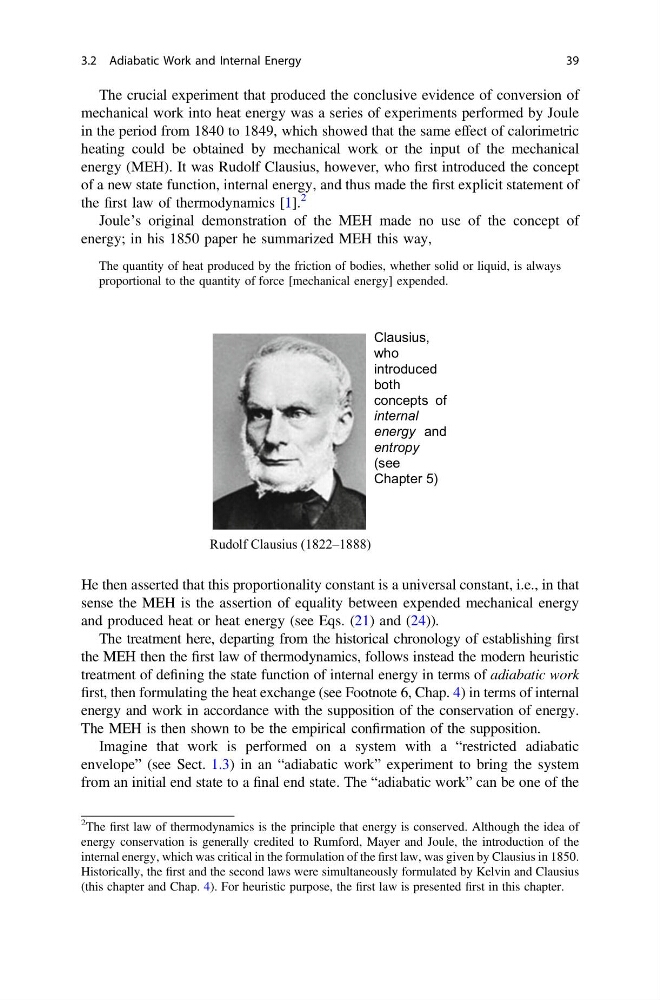
Rudolf Clausius (1822–1888)
Clausius,
who
introduced
both
concepts of
internal
energy and
entropy
(see
Chapter 5)
He then asserted that this proportionality constant is a universal constant, i.e., in that
sense the MEH is the assertion of equality between expended mechanical energy
and produced heat or heat energy (see Eqs. (21) and (24)).
The treatment here, departing from the historical chronology of establishing first
the MEH then the first law of thermodynamics, follows instead the modern heuristic
treatment of defining the state function of internal energy in terms of adiabatic work
first, then formulating the heat exchange (see Footnote 6, Chap. 4) in terms of internal
energy and work in accordance with the supposition of the conservation of energy.
The MEH is then shown to be the empirical confirmation of the supposition.
Imagine that work is performed on a system with a “restricted adiabatic
envelope” (see Sect. 1.3) in an “adiabatic work” experiment to bring the system
from an initial end state to a final end state. The “adiabatic work” can be one of the
2
The first law of thermodynamics is the principle that energy is conserved. Although the idea of
energy conservation is generally credited to Rumford, Mayer and Joule, the introduction of the
internal energy, which was critical in the formulation of the first law, was given by Clausius in 1850.
Historically, the first and the second laws were simultaneously formulated by Kelvin and Clausius
(this chapter and Chap. 4). For heuristic purpose, the first law is presented first in this chapter.
3.2 Adiabatic Work and Internal Energy
39
mechanical work into heat energy was a series of experiments performed by Joule
in the period from 1840 to 1849, which showed that the same effect of calorimetric
heating could be obtained by mechanical work or the input of the mechanical
energy (MEH). It was Rudolf Clausius, however, who first introduced the concept
of a new state function, internal energy, and thus made the first explicit statement of
the first law of thermodynamics [1].
2
Joule’s original demonstration of the MEH made no use of the concept of
energy; in his 1850 paper he summarized MEH this way,
The quantity of heat produced by the friction of bodies, whether solid or liquid, is always
proportional to the quantity of force [mechanical energy] expended.
Rudolf Clausius (1822–1888)
Clausius,
who
introduced
both
concepts of
internal
energy and
entropy
(see
Chapter 5)
He then asserted that this proportionality constant is a universal constant, i.e., in that
sense the MEH is the assertion of equality between expended mechanical energy
and produced heat or heat energy (see Eqs. (21) and (24)).
The treatment here, departing from the historical chronology of establishing first
the MEH then the first law of thermodynamics, follows instead the modern heuristic
treatment of defining the state function of internal energy in terms of adiabatic work
first, then formulating the heat exchange (see Footnote 6, Chap. 4) in terms of internal
energy and work in accordance with the supposition of the conservation of energy.
The MEH is then shown to be the empirical confirmation of the supposition.
Imagine that work is performed on a system with a “restricted adiabatic
envelope” (see Sect. 1.3) in an “adiabatic work” experiment to bring the system
from an initial end state to a final end state. The “adiabatic work” can be one of the
2
The first law of thermodynamics is the principle that energy is conserved. Although the idea of
energy conservation is generally credited to Rumford, Mayer and Joule, the introduction of the
internal energy, which was critical in the formulation of the first law, was given by Clausius in 1850.
Historically, the first and the second laws were simultaneously formulated by Kelvin and Clausius
(this chapter and Chap. 4). For heuristic purpose, the first law is presented first in this chapter.
3.2 Adiabatic Work and Internal Energy
39