

By the middle of the nineteenth century, the idea of vis viva was refined into the
mechanical equivalent of heat (MEH, Joule [1843–1850]), which transformed the
notion of vis viva into a quantitative proposition by demonstrating that the same
effect of heating through heat exchange can be obtained by dissipative heating of
mechanical work. Thereby, the unit of heat, the calorie, can be converted into an
equivalent unit of mechanical work/energy.
1 This demonstration, of course, showed
the idea of materiality of heat to be categorically false. An extension of MEH is the
more comprehensive “mechanical theory of heat,” which sought to understand the
nature of heat: What is heat, if it is not a material caloric?
In other words, the program of the mechanical theory, as it will be discussed in
Sect. 4.8, sought to place heat in its ontological category. While the placing of heat
correctly in its ontological category is of foremost importance philosophically, it
does not provide the best way to understand heat or to define heat (certainly, it alone
is not sufficient). Instead, understanding heat can be sought indirectly in terms of
the two laws of thermodynamics (Sect. 1.1) as equal partners. One critical part of
the indirect answer is the first law of thermodynamics.
A key in the formulation of the first law is the concept of internal energy U. With
the introduction of U, the concept of energy became an extraordinarily useful
concept in unifying many branches of knowledge. The present chapter focuses on
the energetic issues of internal energy (U) and heat exchange (Q).
Defining heat requires both energetic and entropic understanding of heat and will
be given in Sect. 5.6.
3.2 Adiabatic Work and Internal Energy
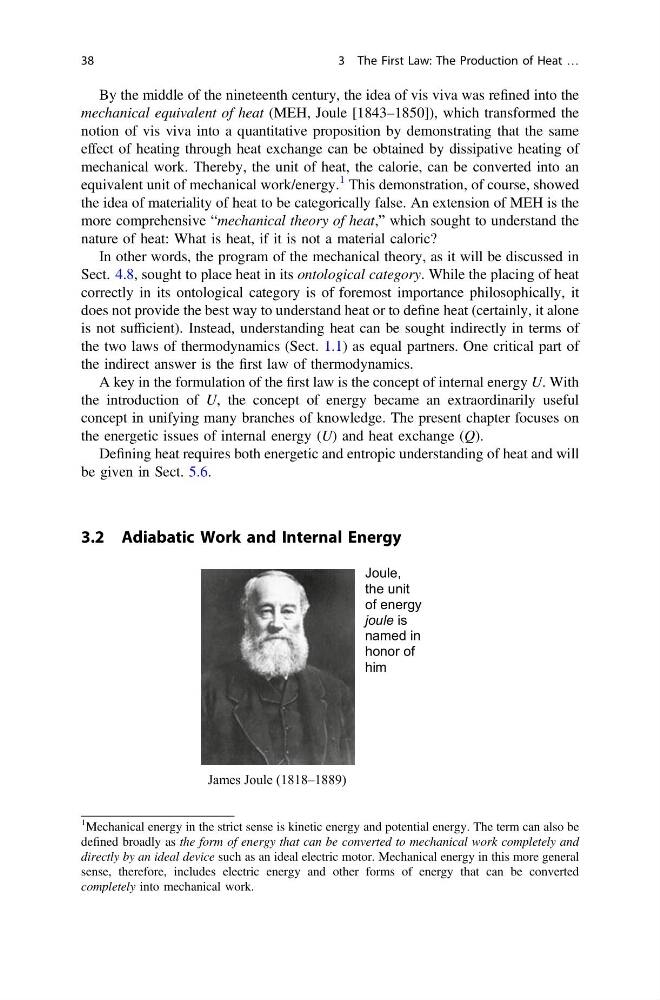
James Joule (1818–1889)
Joule,
the unit
of energy
joule is
named in
honor of
him
1
Mechanical energy in the strict sense is kinetic energy and potential energy. The term can also be
defined broadly as the form of energy that can be converted to mechanical work completely and
directly by an ideal device such as an ideal electric motor. Mechanical energy in this more general
sense, therefore, includes electric energy and other forms of energy that can be converted
completely into mechanical work.
38
3 The First Law: The Production of Heat …
mechanical equivalent of heat (MEH, Joule [1843–1850]), which transformed the
notion of vis viva into a quantitative proposition by demonstrating that the same
effect of heating through heat exchange can be obtained by dissipative heating of
mechanical work. Thereby, the unit of heat, the calorie, can be converted into an
equivalent unit of mechanical work/energy.
1 This demonstration, of course, showed
the idea of materiality of heat to be categorically false. An extension of MEH is the
more comprehensive “mechanical theory of heat,” which sought to understand the
nature of heat: What is heat, if it is not a material caloric?
In other words, the program of the mechanical theory, as it will be discussed in
Sect. 4.8, sought to place heat in its ontological category. While the placing of heat
correctly in its ontological category is of foremost importance philosophically, it
does not provide the best way to understand heat or to define heat (certainly, it alone
is not sufficient). Instead, understanding heat can be sought indirectly in terms of
the two laws of thermodynamics (Sect. 1.1) as equal partners. One critical part of
the indirect answer is the first law of thermodynamics.
A key in the formulation of the first law is the concept of internal energy U. With
the introduction of U, the concept of energy became an extraordinarily useful
concept in unifying many branches of knowledge. The present chapter focuses on
the energetic issues of internal energy (U) and heat exchange (Q).
Defining heat requires both energetic and entropic understanding of heat and will
be given in Sect. 5.6.
3.2 Adiabatic Work and Internal Energy
James Joule (1818–1889)
Joule,
the unit
of energy
joule is
named in
honor of
him
1
Mechanical energy in the strict sense is kinetic energy and potential energy. The term can also be
defined broadly as the form of energy that can be converted to mechanical work completely and
directly by an ideal device such as an ideal electric motor. Mechanical energy in this more general
sense, therefore, includes electric energy and other forms of energy that can be converted
completely into mechanical work.
38
3 The First Law: The Production of Heat …