

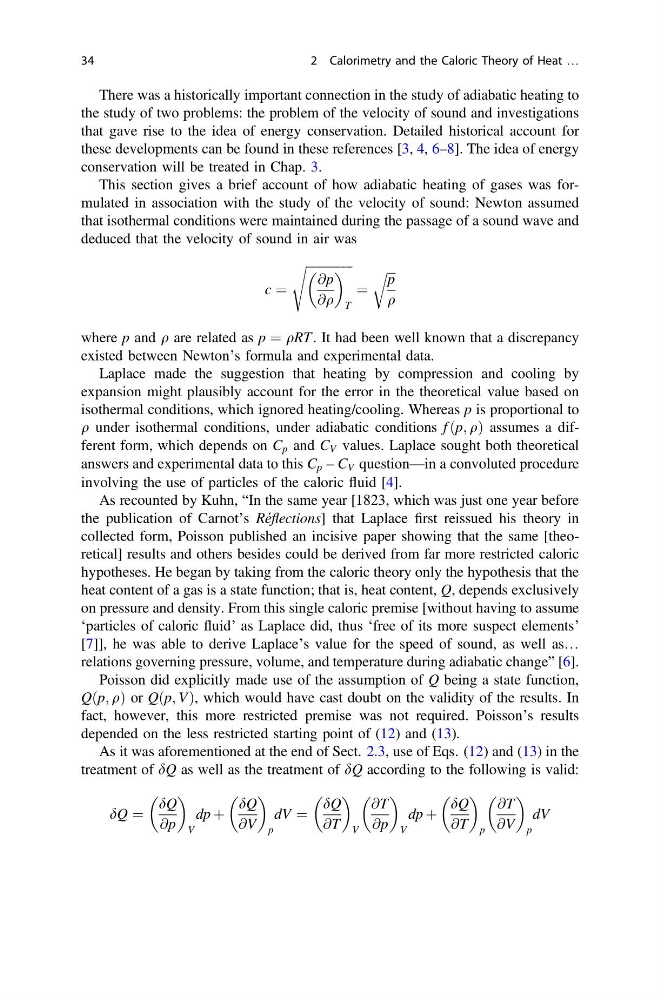
There was a historically important connection in the study of adiabatic heating to
the study of two problems: the problem of the velocity of sound and investigations
that gave rise to the idea of energy conservation. Detailed historical account for
these developments can be found in these references [3, 4, 6–8]. The idea of energy
conservation will be treated in Chap. 3.
This section gives a brief account of how adiabatic heating of gases was formulated in association with the study of the velocity of sound: Newton assumed
that isothermal conditions were maintained during the passage of a sound wave and
deduced that the velocity of sound in air was
c ¼
ffiffiffiffiffiffiffiffiffiffiffiffiffiffiffi
@p
@q
T
s
¼
ffiffiffi
p
q
r
where p and q are related as p ¼ qRT. It had been well known that a discrepancy
existed between Newton’s formula and experimental data.
Laplace made the suggestion that heating by compression and cooling by
expansion might plausibly account for the error in the theoretical value based on
isothermal conditions, which ignored heating/cooling. Whereas p is proportional to
q under isothermal conditions, under adiabatic conditions f p; q
ð Þ assumes a different form, which depends on C p and C V values. Laplace sought both theoretical
answers and experimental data to this C p – C V question—in a convoluted procedure
involving the use of particles of the caloric fluid [4].
As recounted by Kuhn, “In the same year [1823, which was just one year before
the publication of Carnot’s Réflections] that Laplace first reissued his theory in
collected form, Poisson published an incisive paper showing that the same [theoretical] results and others besides could be derived from far more restricted caloric
hypotheses. He began by taking from the caloric theory only the hypothesis that the
heat content of a gas is a state function; that is, heat content, Q, depends exclusively
on pressure and density. From this single caloric premise [without having to assume
‘particles of caloric fluid’ as Laplace did, thus ‘free of its more suspect elements’
[7]], he was able to derive Laplace’s value for the speed of sound, as well as…
relations governing pressure, volume, and temperature during adiabatic change” [6].
Poisson did explicitly made use of the assumption of Q being a state function,
Q p; q
ð Þ or Q p; V
ð
Þ, which would have cast doubt on the validity of the results. In
fact, however, this more restricted premise was not required. Poisson’s results
depended on the less restricted starting point of (12) and (13).
As it was aforementioned at the end of Sect. 2.3, use of Eqs. (12) and (13) in the
treatment of dQ as well as the treatment of dQ according to the following is valid:
dQ ¼
dQ
@p
V
dp þ
dQ
@V
p
dV ¼
dQ
@T
V
@T
@p
V
dp þ
dQ
@T
p
@T
@V
p
dV
34
2 Calorimetry and the Caloric Theory of Heat …
the study of two problems: the problem of the velocity of sound and investigations
that gave rise to the idea of energy conservation. Detailed historical account for
these developments can be found in these references [3, 4, 6–8]. The idea of energy
conservation will be treated in Chap. 3.
This section gives a brief account of how adiabatic heating of gases was formulated in association with the study of the velocity of sound: Newton assumed
that isothermal conditions were maintained during the passage of a sound wave and
deduced that the velocity of sound in air was
c ¼
ffiffiffiffiffiffiffiffiffiffiffiffiffiffiffi
@p
@q
T
s
¼
ffiffiffi
p
q
r
where p and q are related as p ¼ qRT. It had been well known that a discrepancy
existed between Newton’s formula and experimental data.
Laplace made the suggestion that heating by compression and cooling by
expansion might plausibly account for the error in the theoretical value based on
isothermal conditions, which ignored heating/cooling. Whereas p is proportional to
q under isothermal conditions, under adiabatic conditions f p; q
ð Þ assumes a different form, which depends on C p and C V values. Laplace sought both theoretical
answers and experimental data to this C p – C V question—in a convoluted procedure
involving the use of particles of the caloric fluid [4].
As recounted by Kuhn, “In the same year [1823, which was just one year before
the publication of Carnot’s Réflections] that Laplace first reissued his theory in
collected form, Poisson published an incisive paper showing that the same [theoretical] results and others besides could be derived from far more restricted caloric
hypotheses. He began by taking from the caloric theory only the hypothesis that the
heat content of a gas is a state function; that is, heat content, Q, depends exclusively
on pressure and density. From this single caloric premise [without having to assume
‘particles of caloric fluid’ as Laplace did, thus ‘free of its more suspect elements’
[7]], he was able to derive Laplace’s value for the speed of sound, as well as…
relations governing pressure, volume, and temperature during adiabatic change” [6].
Poisson did explicitly made use of the assumption of Q being a state function,
Q p; q
ð Þ or Q p; V
ð
Þ, which would have cast doubt on the validity of the results. In
fact, however, this more restricted premise was not required. Poisson’s results
depended on the less restricted starting point of (12) and (13).
As it was aforementioned at the end of Sect. 2.3, use of Eqs. (12) and (13) in the
treatment of dQ as well as the treatment of dQ according to the following is valid:
dQ ¼
dQ
@p
V
dp þ
dQ
@V
p
dV ¼
dQ
@T
V
@T
@p
V
dp þ
dQ
@T
p
@T
@V
p
dV
34
2 Calorimetry and the Caloric Theory of Heat …