

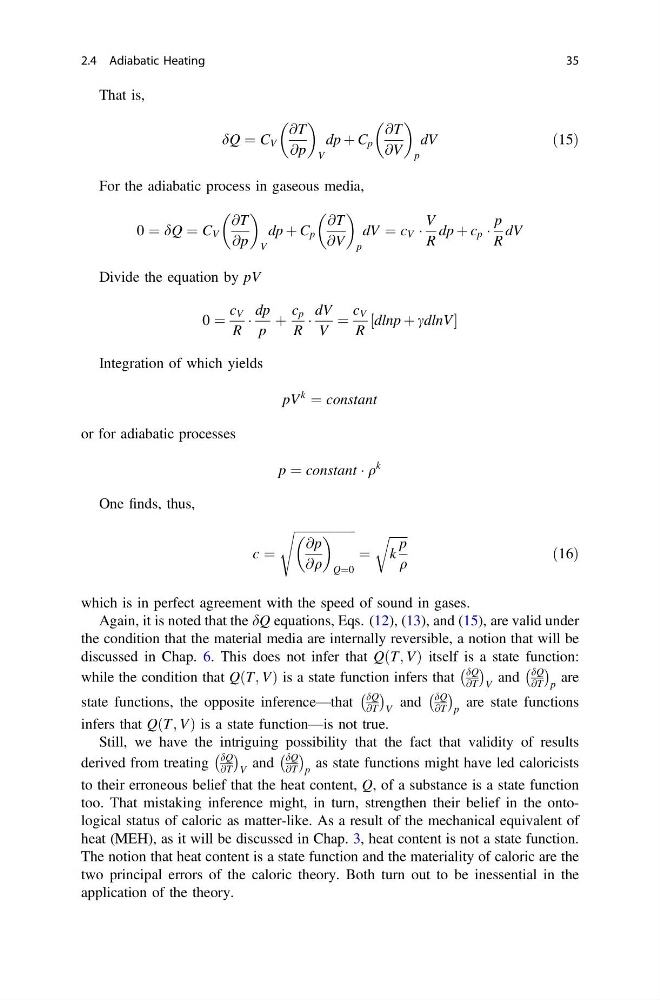
That is,
dQ ¼ C V
@T
@p
V
dp þ C p
@T
@V
p
dV
ð15Þ
For the adiabatic process in gaseous media,
0 ¼ dQ ¼ C V
@T
@p
V
dp þ C p
@T
@V
p
dV ¼ c V Á
V
R
dp þ c p Á
p
R
dV
Divide the equation by pV
0 ¼
c V
R
Á
dp
p
þ
c p
R
Á
dV
V
¼
c V
R
dlnp þ cdlnV
½
Integration of which yields
pV
k
¼ constant
or for adiabatic processes
p ¼ constant Á q
k
One finds, thus,
c ¼
ffiffiffiffiffiffiffiffiffiffiffiffiffiffiffiffiffiffiffi ffi
@p
@q
Q¼0
s
¼
ffiffiffiffiffiffi
k
p
q
r
ð16Þ
which is in perfect agreement with the speed of sound in gases.
Again, it is noted that the dQ equations, Eqs. (12), (13), and (15), are valid under
the condition that the material media are internally reversible, a notion that will be
discussed in Chap. 6. This does not infer that Q T; V
ð
Þ itself is a state function:
while the condition that Q T; V
ð
Þ is a state function infers that
dQ
@T
À Á
V
and
dQ
@T
À Á
p
are
state functions, the opposite inference—that
dQ
@T
À Á
V
and
dQ
@T
À Á
p
are state functions
infers that Q T; V
ð
Þ is a state function—is not true.
Still, we have the intriguing possibility that the fact that validity of results
derived from treating
dQ
@T
À Á
V
and
dQ
@T
À Á
p
as state functions might have led caloricists
to their erroneous belief that the heat content, Q, of a substance is a state function
too. That mistaking inference might, in turn, strengthen their belief in the ontological status of caloric as matter-like. As a result of the mechanical equivalent of
heat (MEH), as it will be discussed in Chap. 3, heat content is not a state function.
The notion that heat content is a state function and the materiality of caloric are the
two principal errors of the caloric theory. Both turn out to be inessential in the
application of the theory.
2.4 Adiabatic Heating
35
dQ ¼ C V
@T
@p
V
dp þ C p
@T
@V
p
dV
ð15Þ
For the adiabatic process in gaseous media,
0 ¼ dQ ¼ C V
@T
@p
V
dp þ C p
@T
@V
p
dV ¼ c V Á
V
R
dp þ c p Á
p
R
dV
Divide the equation by pV
0 ¼
c V
R
Á
dp
p
þ
c p
R
Á
dV
V
¼
c V
R
dlnp þ cdlnV
½
Integration of which yields
pV
k
¼ constant
or for adiabatic processes
p ¼ constant Á q
k
One finds, thus,
c ¼
ffiffiffiffiffiffiffiffiffiffiffiffiffiffiffiffiffiffiffi ffi
@p
@q
Q¼0
s
¼
ffiffiffiffiffiffi
k
p
q
r
ð16Þ
which is in perfect agreement with the speed of sound in gases.
Again, it is noted that the dQ equations, Eqs. (12), (13), and (15), are valid under
the condition that the material media are internally reversible, a notion that will be
discussed in Chap. 6. This does not infer that Q T; V
ð
Þ itself is a state function:
while the condition that Q T; V
ð
Þ is a state function infers that
dQ
@T
À Á
V
and
dQ
@T
À Á
p
are
state functions, the opposite inference—that
dQ
@T
À Á
V
and
dQ
@T
À Á
p
are state functions
infers that Q T; V
ð
Þ is a state function—is not true.
Still, we have the intriguing possibility that the fact that validity of results
derived from treating
dQ
@T
À Á
V
and
dQ
@T
À Á
p
as state functions might have led caloricists
to their erroneous belief that the heat content, Q, of a substance is a state function
too. That mistaking inference might, in turn, strengthen their belief in the ontological status of caloric as matter-like. As a result of the mechanical equivalent of
heat (MEH), as it will be discussed in Chap. 3, heat content is not a state function.
The notion that heat content is a state function and the materiality of caloric are the
two principal errors of the caloric theory. Both turn out to be inessential in the
application of the theory.
2.4 Adiabatic Heating
35