

in reference to water as the calorimetric substance was constant pressure heat
capacity. Here a distinction is made between constant volume heat capacity and
constant pressure heat capacity.
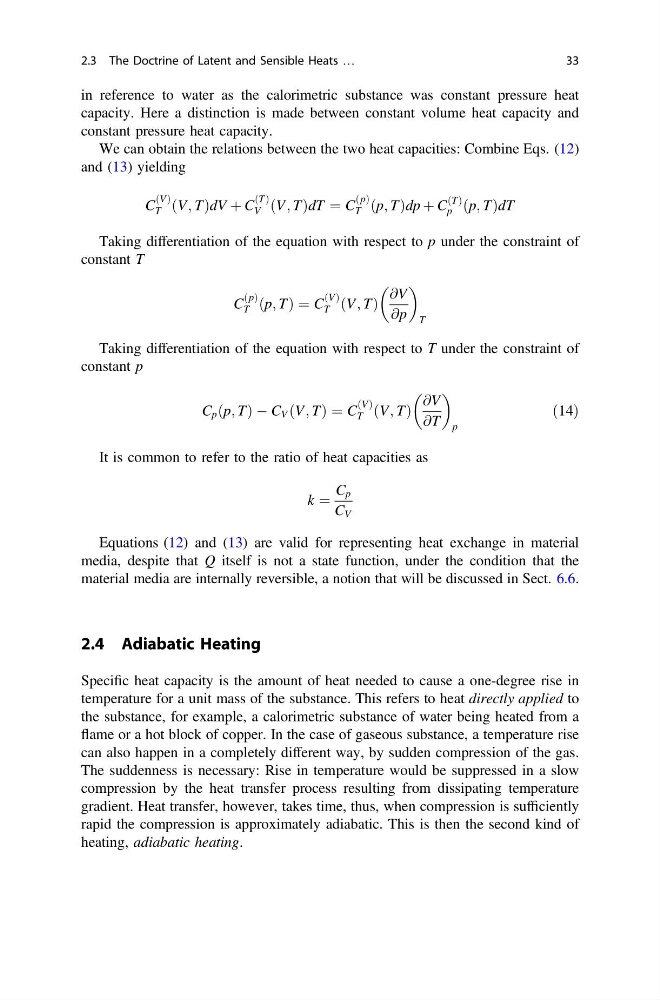
We can obtain the relations between the two heat capacities: Combine Eqs. (12)
and (13) yielding
C
V
ð Þ
T
V; T
ð
ÞdV þ C
T
ð Þ
V V; T
ð
ÞdT ¼ C
p
ð Þ
T p; T
ð
Þdp þ C
T
ð Þ
p
p; T
ð
ÞdT
Taking differentiation of the equation with respect to p under the constraint of
constant T
C
p
ð Þ
T p; T
ð
Þ ¼ C
V
ð Þ
T
V; T
ð
Þ
@V
@p
T
Taking differentiation of the equation with respect to T under the constraint of
constant p
C p p; T
ð
ÞÀC V V; T
ð
Þ ¼C
V
ð Þ
T
V; T
ð
Þ
@V
@T
p
ð14Þ
It is common to refer to the ratio of heat capacities as
k ¼
C p
C V
Equations (12) and (13) are valid for representing heat exchange in material
media, despite that Q itself is not a state function, under the condition that the
material media are internally reversible, a notion that will be discussed in Sect. 6.6.
2.4 Adiabatic Heating
Specific heat capacity is the amount of heat needed to cause a one-degree rise in
temperature for a unit mass of the substance. This refers to heat directly applied to
the substance, for example, a calorimetric substance of water being heated from a
flame or a hot block of copper. In the case of gaseous substance, a temperature rise
can also happen in a completely different way, by sudden compression of the gas.
The suddenness is necessary: Rise in temperature would be suppressed in a slow
compression by the heat transfer process resulting from dissipating temperature
gradient. Heat transfer, however, takes time, thus, when compression is sufficiently
rapid the compression is approximately adiabatic. This is then the second kind of
heating, adiabatic heating.
2.3 The Doctrine of Latent and Sensible Heats …
33
capacity. Here a distinction is made between constant volume heat capacity and
constant pressure heat capacity.
We can obtain the relations between the two heat capacities: Combine Eqs. (12)
and (13) yielding
C
V
ð Þ
T
V; T
ð
ÞdV þ C
T
ð Þ
V V; T
ð
ÞdT ¼ C
p
ð Þ
T p; T
ð
Þdp þ C
T
ð Þ
p
p; T
ð
ÞdT
Taking differentiation of the equation with respect to p under the constraint of
constant T
C
p
ð Þ
T p; T
ð
Þ ¼ C
V
ð Þ
T
V; T
ð
Þ
@V
@p
T
Taking differentiation of the equation with respect to T under the constraint of
constant p
C p p; T
ð
ÞÀC V V; T
ð
Þ ¼C
V
ð Þ
T
V; T
ð
Þ
@V
@T
p
ð14Þ
It is common to refer to the ratio of heat capacities as
k ¼
C p
C V
Equations (12) and (13) are valid for representing heat exchange in material
media, despite that Q itself is not a state function, under the condition that the
material media are internally reversible, a notion that will be discussed in Sect. 6.6.
2.4 Adiabatic Heating
Specific heat capacity is the amount of heat needed to cause a one-degree rise in
temperature for a unit mass of the substance. This refers to heat directly applied to
the substance, for example, a calorimetric substance of water being heated from a
flame or a hot block of copper. In the case of gaseous substance, a temperature rise
can also happen in a completely different way, by sudden compression of the gas.
The suddenness is necessary: Rise in temperature would be suppressed in a slow
compression by the heat transfer process resulting from dissipating temperature
gradient. Heat transfer, however, takes time, thus, when compression is sufficiently
rapid the compression is approximately adiabatic. This is then the second kind of
heating, adiabatic heating.
2.3 The Doctrine of Latent and Sensible Heats …
33