

2.3 The Doctrine of Latent and Sensible Heats
in an Internally Reversible Medium
When heat is applied to a body, it may raise its temperature or change its state
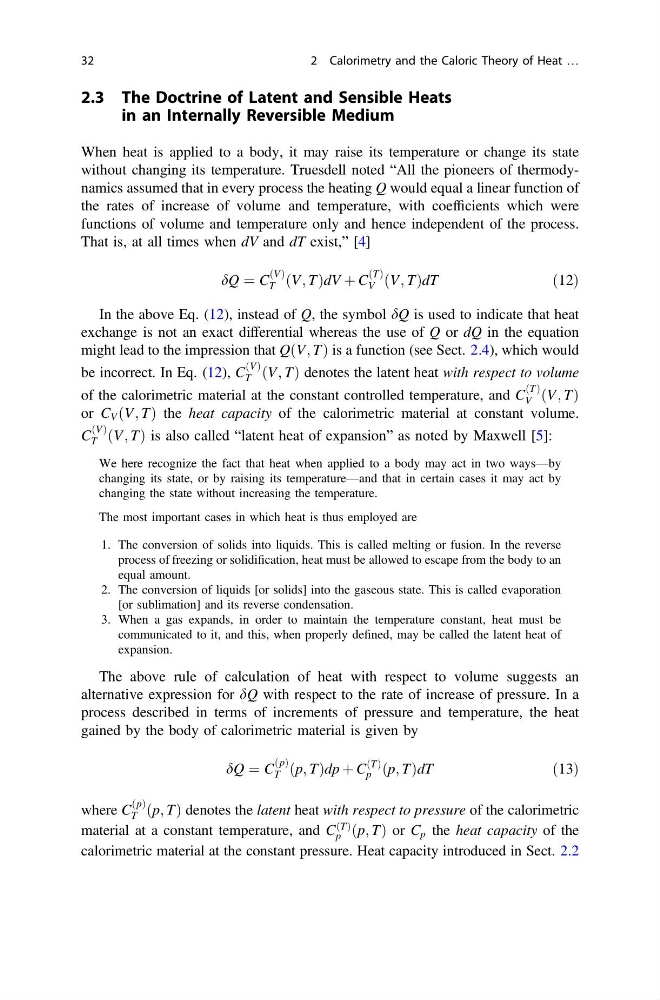
without changing its temperature. Truesdell noted “All the pioneers of thermodynamics assumed that in every process the heating Q would equal a linear function of
the rates of increase of volume and temperature, with coefficients which were
functions of volume and temperature only and hence independent of the process.
That is, at all times when dV and dT exist,” [4]
dQ ¼ C
V
ð Þ
T
V; T
ð
ÞdV þ C
T
ð Þ
V V; T
ð
ÞdT
ð12Þ
In the above Eq. (12), instead of Q, the symbol dQ is used to indicate that heat
exchange is not an exact differential whereas the use of Q or dQ in the equation
might lead to the impression that Q V; T
ð
Þis a function (see Sect. 2.4), which would
be incorrect. In Eq. (12), C
V
ð Þ
T
V; T
ð
Þ denotes the latent heat with respect to volume
of the calorimetric material at the constant controlled temperature, and C
T
ð Þ
V V; T
ð
Þ
or C V V; T
ð
Þ the heat capacity of the calorimetric material at constant volume.
C
V
ð Þ
T
V; T
ð
Þ is also called “latent heat of expansion” as noted by Maxwell [5]:
We here recognize the fact that heat when applied to a body may act in two ways—by
changing its state, or by raising its temperature—and that in certain cases it may act by
changing the state without increasing the temperature.
The most important cases in which heat is thus employed are
1. The conversion of solids into liquids. This is called melting or fusion. In the reverse
process of freezing or solidification, heat must be allowed to escape from the body to an
equal amount.
2. The conversion of liquids [or solids] into the gaseous state. This is called evaporation
[or sublimation] and its reverse condensation.
3. When a gas expands, in order to maintain the temperature constant, heat must be
communicated to it, and this, when properly defined, may be called the latent heat of
expansion.
The above rule of calculation of heat with respect to volume suggests an
alternative expression for dQ with respect to the rate of increase of pressure. In a
process described in terms of increments of pressure and temperature, the heat
gained by the body of calorimetric material is given by
dQ ¼ C
p
ð Þ
T p; T
ð
Þdp þ C
T
ð Þ
p
p; T
ð
ÞdT
ð13Þ
where C
p
ð Þ
T p; T
ð
Þdenotes the latent heat with respect to pressure of the calorimetric
material at a constant temperature, and C
T
ð Þ
p
p; T
ð
Þ or C p the heat capacity of the
calorimetric material at the constant pressure. Heat capacity introduced in Sect. 2.2
32
2 Calorimetry and the Caloric Theory of Heat …
in an Internally Reversible Medium
When heat is applied to a body, it may raise its temperature or change its state
without changing its temperature. Truesdell noted “All the pioneers of thermodynamics assumed that in every process the heating Q would equal a linear function of
the rates of increase of volume and temperature, with coefficients which were
functions of volume and temperature only and hence independent of the process.
That is, at all times when dV and dT exist,” [4]
dQ ¼ C
V
ð Þ
T
V; T
ð
ÞdV þ C
T
ð Þ
V V; T
ð
ÞdT
ð12Þ
In the above Eq. (12), instead of Q, the symbol dQ is used to indicate that heat
exchange is not an exact differential whereas the use of Q or dQ in the equation
might lead to the impression that Q V; T
ð
Þis a function (see Sect. 2.4), which would
be incorrect. In Eq. (12), C
V
ð Þ
T
V; T
ð
Þ denotes the latent heat with respect to volume
of the calorimetric material at the constant controlled temperature, and C
T
ð Þ
V V; T
ð
Þ
or C V V; T
ð
Þ the heat capacity of the calorimetric material at constant volume.
C
V
ð Þ
T
V; T
ð
Þ is also called “latent heat of expansion” as noted by Maxwell [5]:
We here recognize the fact that heat when applied to a body may act in two ways—by
changing its state, or by raising its temperature—and that in certain cases it may act by
changing the state without increasing the temperature.
The most important cases in which heat is thus employed are
1. The conversion of solids into liquids. This is called melting or fusion. In the reverse
process of freezing or solidification, heat must be allowed to escape from the body to an
equal amount.
2. The conversion of liquids [or solids] into the gaseous state. This is called evaporation
[or sublimation] and its reverse condensation.
3. When a gas expands, in order to maintain the temperature constant, heat must be
communicated to it, and this, when properly defined, may be called the latent heat of
expansion.
The above rule of calculation of heat with respect to volume suggests an
alternative expression for dQ with respect to the rate of increase of pressure. In a
process described in terms of increments of pressure and temperature, the heat
gained by the body of calorimetric material is given by
dQ ¼ C
p
ð Þ
T p; T
ð
Þdp þ C
T
ð Þ
p
p; T
ð
ÞdT
ð13Þ
where C
p
ð Þ
T p; T
ð
Þdenotes the latent heat with respect to pressure of the calorimetric
material at a constant temperature, and C
T
ð Þ
p
p; T
ð
Þ or C p the heat capacity of the
calorimetric material at the constant pressure. Heat capacity introduced in Sect. 2.2
32
2 Calorimetry and the Caloric Theory of Heat …