

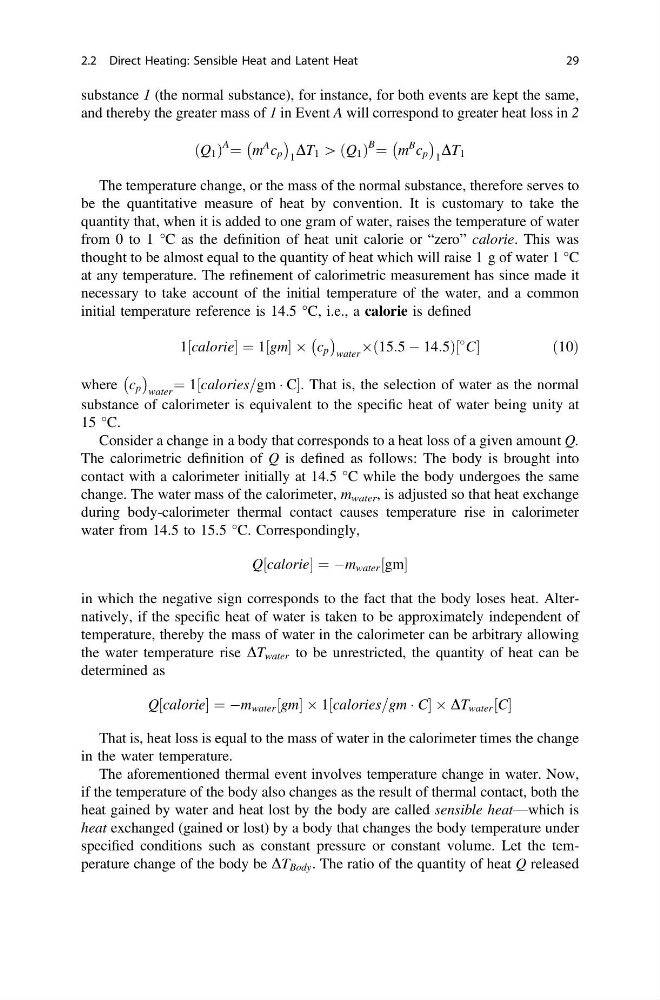
substance 1 (the normal substance), for instance, for both events are kept the same,
and thereby the greater mass of 1 in Event A will correspond to greater heat loss in 2
Q 1
ð Þ
A ¼ m
A c p
À
Á
1
DT 1 [ Q 1
ð Þ
B ¼ m
B c p
À
Á
1
DT 1
The temperature change, or the mass of the normal substance, therefore serves to
be the quantitative measure of heat by convention. It is customary to take the
quantity that, when it is added to one gram of water, raises the temperature of water
from 0 to 1 °C as the definition of heat unit calorie or “zero” calorie. This was
thought to be almost equal to the quantity of heat which will raise 1 g of water 1 °C
at any temperature. The refinement of calorimetric measurement has since made it
necessary to take account of the initial temperature of the water, and a common
initial temperature reference is 14.5 °C, i.e., a calorie is defined
1 calorie
½
¼1 gm
½ Â c p
À Á
water
 15:5 À 14:5
ð
Þ
C
½
ð10Þ
where c p
À Á
water
¼ 1 calories=gm Á C
½
. That is, the selection of water as the normal
substance of calorimeter is equivalent to the specific heat of water being unity at
15 °C.
Consider a change in a body that corresponds to a heat loss of a given amount Q.
The calorimetric definition of Q is defined as follows: The body is brought into
contact with a calorimeter initially at 14.5 °C while the body undergoes the same
change. The water mass of the calorimeter, m water , is adjusted so that heat exchange
during body-calorimeter thermal contact causes temperature rise in calorimeter
water from 14.5 to 15.5 °C. Correspondingly,
Q calorie
½
¼Àm water gm
½
in which the negative sign corresponds to the fact that the body loses heat. Alternatively, if the specific heat of water is taken to be approximately independent of
temperature, thereby the mass of water in the calorimeter can be arbitrary allowing
the water temperature rise DT water to be unrestricted, the quantity of heat can be
determined as
Q calorie
½
¼Àm water gm
½ Â1 calories=gm Á C
½
 DT water C
½
That is, heat loss is equal to the mass of water in the calorimeter times the change
in the water temperature.
The aforementioned thermal event involves temperature change in water. Now,
if the temperature of the body also changes as the result of thermal contact, both the
heat gained by water and heat lost by the body are called sensible heat—which is
heat exchanged (gained or lost) by a body that changes the body temperature under
specified conditions such as constant pressure or constant volume. Let the temperature change of the body be DT Body . The ratio of the quantity of heat Q released
2.2 Direct Heating: Sensible Heat and Latent Heat
29
and thereby the greater mass of 1 in Event A will correspond to greater heat loss in 2
Q 1
ð Þ
A ¼ m
A c p
À
Á
1
DT 1 [ Q 1
ð Þ
B ¼ m
B c p
À
Á
1
DT 1
The temperature change, or the mass of the normal substance, therefore serves to
be the quantitative measure of heat by convention. It is customary to take the
quantity that, when it is added to one gram of water, raises the temperature of water
from 0 to 1 °C as the definition of heat unit calorie or “zero” calorie. This was
thought to be almost equal to the quantity of heat which will raise 1 g of water 1 °C
at any temperature. The refinement of calorimetric measurement has since made it
necessary to take account of the initial temperature of the water, and a common
initial temperature reference is 14.5 °C, i.e., a calorie is defined
1 calorie
½
¼1 gm
½ Â c p
À Á
water
 15:5 À 14:5
ð
Þ
C
½
ð10Þ
where c p
À Á
water
¼ 1 calories=gm Á C
½
. That is, the selection of water as the normal
substance of calorimeter is equivalent to the specific heat of water being unity at
15 °C.
Consider a change in a body that corresponds to a heat loss of a given amount Q.
The calorimetric definition of Q is defined as follows: The body is brought into
contact with a calorimeter initially at 14.5 °C while the body undergoes the same
change. The water mass of the calorimeter, m water , is adjusted so that heat exchange
during body-calorimeter thermal contact causes temperature rise in calorimeter
water from 14.5 to 15.5 °C. Correspondingly,
Q calorie
½
¼Àm water gm
½
in which the negative sign corresponds to the fact that the body loses heat. Alternatively, if the specific heat of water is taken to be approximately independent of
temperature, thereby the mass of water in the calorimeter can be arbitrary allowing
the water temperature rise DT water to be unrestricted, the quantity of heat can be
determined as
Q calorie
½
¼Àm water gm
½ Â1 calories=gm Á C
½
 DT water C
½
That is, heat loss is equal to the mass of water in the calorimeter times the change
in the water temperature.
The aforementioned thermal event involves temperature change in water. Now,
if the temperature of the body also changes as the result of thermal contact, both the
heat gained by water and heat lost by the body are called sensible heat—which is
heat exchanged (gained or lost) by a body that changes the body temperature under
specified conditions such as constant pressure or constant volume. Let the temperature change of the body be DT Body . The ratio of the quantity of heat Q released
2.2 Direct Heating: Sensible Heat and Latent Heat
29